May Grateful Dead Show Listening Guides Part 2


Welcome to this month's Grateful Dead Show Listening Guides!
This is the part 2 of the May Listening Guides.
We're covering May 16th - May 31st in this post.
May 1st - May 15th can be found here.
Since my website hosting provider (Wix) has a blog post size limit I had to split this month's Listening Guides into two posts. If you're looking for May 1st through the 15th, you can find those listening guides here.
If you like these reviews and you want to support me, please consider buying a copy of my book On This Day In Grateful Dead History: A Daily Listening Journal. They're $50 and I offer free shipping if you subscribe to my mailing list, where you'll get these writeups delivered. No spam, I promise!
Over time, as I've written these listening guides, I marked up my copy of the book like this:

The underlined songs are the ones I'm calling out as highlights (songs names that are bolded) in the listening guide, and the songs highlighted in yellow are the ones that Howard Weiner has identified as Jam Anthem renditions. I also write notes in the space provided if I'm feeling inspired or if there are any updates such as newly released material. Ultimately you can use it however you want, but this was my original intent with the book.
By the way, if you're new here, this is my month-by-month archive of my listening guides that gives you the most interesting and significant facts from Grateful Dead History, along with reviews of the music. If you'd like to stay up to date on new reviews and other information, you can subscribe here:
May
For the month of May, I was struck by the sheer magnitude of legendary performances and historical milestones covered in these sources, particularly regarding the highly acclaimed Spring 1977 tour. It seems to me that this month represents a peak in the band's history, featuring the "Holy Trinity" of shows on May 7, 8, and 9, 1977, with the May 8th show at Cornell University often cited as one of their all-time best. The reviews consistently highlight the precision and energy of this era, with Donna Godchaux and Keith Godchaux contributing significantly to the cohesive sound.
I also found the coverage of the Europe '72 tour ending in May to be quite poignant. The run at the Strand Lyceum in London marked the final performances of the tour and, sadly, the final recordings of Ron "Pigpen" McKernan, who would soon stop touring due to health issues. The sources note that his final version of "Turn On Your Lovelight" and other signature blues numbers occurred during this run.
Historical context is rich in these reviews, ranging from the band's primal psychedelic era in 1969 to the polished Wall of Sound performances in 1974, such as the May 19th show in Portland. I noticed a few unique guest appearances that added flavor to specific shows, such as Clarence Clemons on saxophone in 1989, Steve Miller sitting in during a 1992 Vegas show, and John Cipollina and Boz Scaggs joining the band in 1982. It is also fascinating to read about the "An Evening With The Grateful Dead" format in 1970, which featured acoustic sets and appearances by the New Riders of the Purple Sage.
Significant historical events in Grateful Dead History for May:
The Warlocks' first known performance (5/5/1965)
Bill Kreutzmann’s Birthday (5/7/1946)
RIP Bob Marley (5/11/1981)
RIP Larry "Ramrod" Schurtliff (5/16/2006)
Carter Beauford sits in on Drums (5/21/1995)
Bob Dylan’s Birthday (5/24/1941)
First Performances
Sunrise (5/1/1977), Jack-A-Roe (5/13/1977), Attics of My Life (5/14/1970), I Hear A Voice Callin’ (5/15/1970), Passenger (5/15/1977), Iko Iko (5/15/1977), Money Money (5/17/1974), Baba O’Reiley (5/19/1992), Tomorrow Never Knows (5/19/1992), Promised Land (5/29/1971)
Final Performances
Caution (Do Not Stop on Tracks) (5/11/1972), Who Do You Love (5/11/1972), Money Money (5/19/1974), Hurts Me Too (5/24/1972), Sitting On Top Of The World (5/25/1972), Pigpen version of Turn On Your Lovelight (5/24/1972), Mr. Charlie (5/26/1972), Next Time You See Me (5/26/1972), Two Souls In Communion (5/26/1972), Chinatown Shuffle (5/26/1972)
Only Performances
Ballad of Casey Jones (5/15/1970), A Mind to Give Up Livin' (5/28/1982)
May Grateful Dead Show Listening Guide Index
Index of 36 shows reviewed in May. Click the link to jump to the listening guide, or just scroll down.
May 16th
RIP Larry "Ramrod" Schurtliff (5/16/2006)
5/16/1981 Barton Hall, Cornell University, Ithaca, NY

While not as popular as the "other" Barton Hall show on 5/8/1977, this is an incredible performance! Officially released on 30 Trips Around The Sun. This is a really fun, energetic show with some truly funky moments, including one of the funkiest Stranger and Shakedown Street performances you'll ever hear. I've often wondered if the Dead had become aware at this point that Cornell '77 was such a highly regarded show, and took the stage there determined to exceed that reputation. They only played this venue 3 times (this would be the final time), and each one is outstanding. I don't think anyone would put either the 1980 or this performance above 1977, but they seem to be determined to impress the audience each time!
The first set is strong right from the start. A funky Stranger kicks things off, followed by a string of classics, all played with precision and freshness. Passenger and Let It Grow, which follows High Time, stand out as highlights, described as swirling, incendiary tours de force. There's a brief "Nobody's Fault but Mine" jam near the end of Truckin'. The feeling in May at Cornell seemed to promise a good show, and there was certainly some kind of magic afoot.
Opening the second set was a Shakedown Street that was extremely laidback, more of a casual jazzy exploration than its usual foot-stomping funk. However, Bertha brought back a driving rock 'n' roll edge, which carried through into charged versions of Sailor > Saint. Out of the closing flourishes of Saint, a Spanish Jam emerged. This wasn't just any jam; it cranked madly along at twice the normal pace for several diabolical minutes. It eventually resolved into a more open-ended jam that segued into Drums. The segment after Space was solid, highlighted by a triumphant Stella Blue closing jam. For the encore, Uncle John's Band was an inspired choice, delivered with spunk and folky charm. It feels like maybe Jerry, Bobby, Phil, Billy, Mickey, and Brent were determined to impress the audience each time they played this venue, and this performance certainly seems to uphold that idea.
May 17th
5/17/1974 P.N.E Coliseum, Vancouver, Canada

Officially released on Pacific Northwest '73-'74: The Complete Recordings. This show didn't circulate until June of 2000, and was always one of the more obscure tapes for a long time. Overall it's an excellent performance.
The first set kicked off with Promised Land, one of my favorite show openers, delivering a solid performance with a short yet energetic solo. Ramble On Rose and Loose Lucy stood out as key highlights, while a fiery Big River also made its mark as a standout moment. Though much of the remainder of the set consisted of well-played but fairly standard selections, it functioned as a warm-up for the main event: Playing in the Band. On this night, Playing in the Band was truly exceptional—an incredible performance stretching to nearly 23 minutes, offering ample room for exploration and risk-taking. The year 1974 was a landmark period for Playing in the Band, as it evolved into a sophisticated vehicle for deep musical space within a jazz-infused groove, anchored by Billy’s phenomenal drumming. The performance was defined by intricate, textured interactions among the band members, where no single musician dominated the improvisation; instead, it unfolded as a true collective conversation. Jerry’s nimble fretwork, intertwined with Keith’s eclectic keyboard jams, created a mesmerizing soundscape, all supported by Billy’s subtle but foundational rhythm. By aligning with his underlying pulse, the band delivered an improvisational masterpiece with remarkable cohesion. Without question, this song was the high point of the evening, providing a perfect close to the first set.
The second set kicked off with a raucous U.S. Blues, bringing a burst of patriotic energy before transitioning into Me and My Uncle, a staple of their live repertoire. A sweetly played Ship of Fools followed, and was a very fine highlight. One of the most intriguing moments of the night was the first-ever performance of Money Money, a rarity in the Dead’s catalog. This debut added an unexpected twist to the setlist, making it a notable historical moment. After that, the listener is treated to another signature suite from 1974: China Cat Sunflower > I Know You Rider. This version was well played and considered a scorching highlight, serving as a nice preview to upcoming stellar versions. The set continued sweetly with Sugaree.
The last major segment of the second set began with a nice, albeit short, version of Truckin'. During this song, Bobby appeared to forget what he was singing and delegated the entire first verse as a throwaway, prompting the crowd to react with cheers and laughter. After the final verse, instead of commonplace chordal jams, this rendition suffered an immediate mood change characterized by a slowly worked blues/jazz jam, tailor-made for the upcoming Nobody's Fault but Mine. Jerry treated the audience to some delicate finger work and provided subtle direction so that by the time Nobody's Fault But Mine began, they were all in sync. Source refers to the sequence Truckin' > Nobody's Fault But Mine > Eyes > China Doll as the big jam section. Like the Truckin' that began this sequence, the subsequent Eyes of the World was also made unusually short at 11 and a half minutes by a fairly harsh mid-song recording splice. Nevertheless, all the important aspects of the song were explored. Intricate and melodic scales formed a competent backbone to this compact rendition, before they decayed into a sweetly sung China Doll. Finally, Sugar Magnolia, though nearly ten minutes in length and slow in tempo, provided a well-received cap to an even-keel, and occasionally spectacular, evening.
5/17/1977 Memorial Coliseum, Tuscaloosa, AL
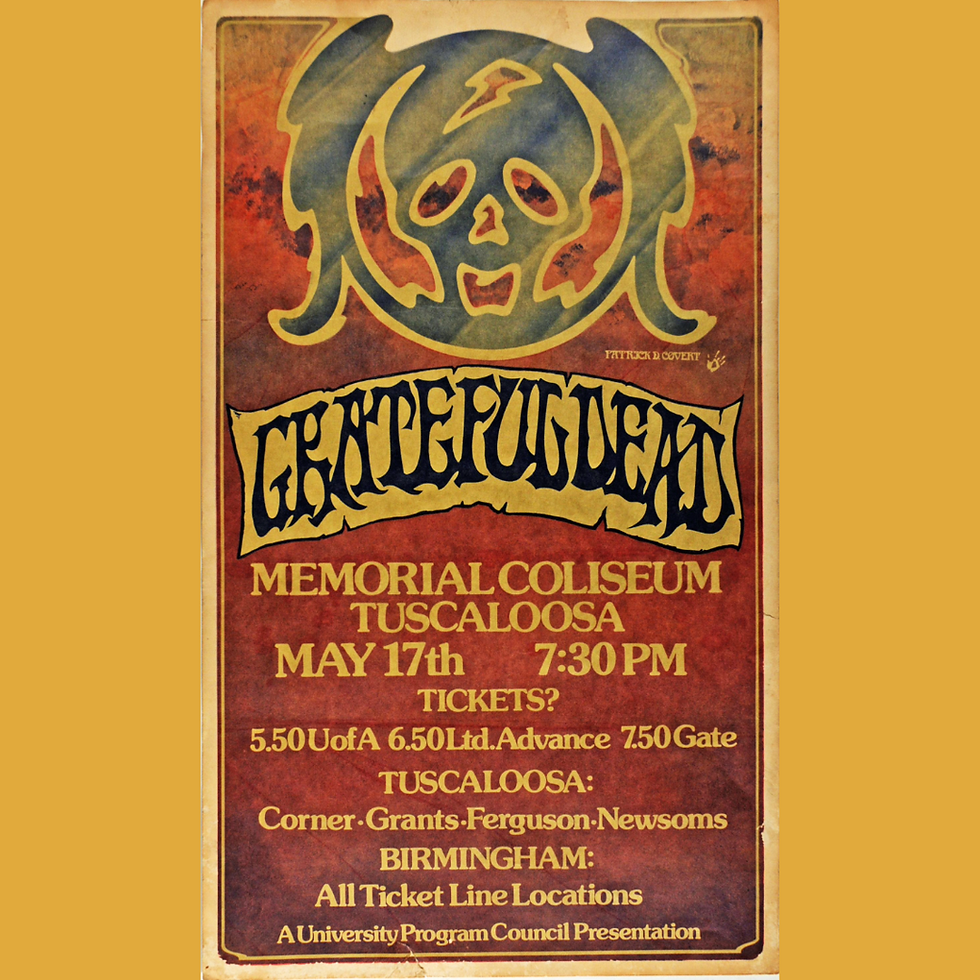
Officially released on May 1977. This show is a perfect example of what makes this tour so incredible. Night after night the band rides a wave of musical inspiration and skill, at a level of consistency that very few bands were ever capable of. As such, there isn't a single bad moment here.
The first set was packed with standout moments, and the energy was undeniable. Mississippi Half-Step Uptown Toodeloo was absolutely scorching—Jerry’s playing was on fire, and the build-up to the climax was electrifying. But the real show-stealer was Scarlet Begonias > Fire on the Mountain. This version was nothing short of extraordinary—long, dynamic, and overflowing with creativity. It felt like a true Jam Anthem performance, brimming with fluid transitions and inspired interplay.
What blows my mind is that this masterpiece came just two months after the composition’s debut at Winterland—yet it already sounded fully developed and road-tested. Throughout 1977, Scarlet > Fire occasionally appeared in the first set, as it did tonight. These early versions were so high-energy that they almost felt too intense for closing a set—better suited for launching the second half with a bang. And in this jam, Jerry was absolutely in command, his solos soaring above the mix. Phil, meanwhile, kept the groove steady, holding down the foundation rather than driving the improvisation, much like his playing on May 21, 1977. Keith, however, was the real architect of intricate textures, weaving unexpected flourishes into the jam that added depth and dimension.
The second set was packed with standout moments, delivering both high-energy rockers and deep, exploratory jams. The sequence of Samson and Delilah > Bertha > Good Lovin’ was a force to be reckoned with, carrying relentless momentum. Bertha was particularly radiant—bright, energetic, and jammed with infectious enthusiasm. Later in the set, Terrapin Station stood out as a pinnacle performance, its bridge stretching into something truly soulful and breathtaking. It’s incredible how polished and confident it sounded, considering it had only debuted three months earlier.
Compared to later years, the second set here felt like a collection of individual gems linked together, rather than a tightly woven thematic journey. That said, Jerry was at his most inspired throughout the show, especially during Scarlet Begonias > Fire on the Mountain, where his playing soared above the rest. Every song carried intention and energy, leaving no weak spots in the set. This is one of those shows that’s absolutely worth seeking out—an unforgettable night from a truly monumental month in the band’s history.
May 18th
5/18/1972 Kongressaal Deutsches Museum, München, Germany

Officially released on Europe '72 The Complete Recordings. This performance was excellent and worth listening to. The first set wasted no time getting things started with a rowdy Truckin', setting the tone for a high-energy night. Sugaree followed, and it was absolutely perfect—rich, smooth, and dripping with emotion. While the rest of the first set featured songs typical for the tour, they were executed flawlessly, even if many leaned toward shorter, more "by the book" renditions. Playing in the Band and Good Lovin' were prime examples—great performances, but trimmed down compared to other shows. Still, the material was undeniably strong, delivering tight musicianship and a sense of momentum.
The second set is where things really caught fire. It kicked off with a surprising but fantastic pairing of Sitting On Top of the World > Me & My Uncle, an unexpectedly explosive combination that worked beautifully. After a joyous sing-along moment with Jerry on Ramble On Rose, the set rocketed forward with a turbo-charged Beat It on Down the Line, sleek and streamlined, its distortion adding an extra edge.
One of the true high points of the night was the Dark Star > Morning Dew sequence. This Dark Star wasn’t a delicate exploration—it was a cosmic battle, with the band wrestling primal musical forces and hitting dramatic peaks before the first verse. On the other side of the jam, Phil took full command as “Mr. Sonic Apocalypse”, his bass shaking the room with a force that likely tested the patience of nearby neighbors. The transition into Morning Dew was masterful, bringing aching beauty and haunting dynamics that perfectly captured the song’s emotional weight. The set closed with the euphoric rush of Sugar Magnolia before winding down with one of ’72’s stronger renditions of Sing Me Back Home, a fitting and heartfelt conclusion to an unforgettable night. The second set wasn’t just strong—it was classic Grateful Dead brain-melt material, the kind of performance that reminds you why this era was so legendary.
5/18/1977 Fox Theatre, Atlanta, GA

The first of two nights at the Fox Theatre. The band is in sync and they play well, but the song selection is just unusual. This show balanced deep jams with delicate moments, making it a standout performance. Every section had something worth savoring, and the peak improvisational stretches were absolutely unforgettable.
The first set had an interesting pace, with the band feeling locked in but taking things slower than usual. They kicked off with a rare Deal, which immediately grabbed my attention—not only because it’s a fantastic opener but because only played twice as a first set opener. That alone made it a special moment. Cassidy followed with a crisp, well-played rendition, and then came a unique Jack-A-Roe, where Jerry’s modified guitar phrasing added an intriguing twist to the rhythm.
The overall tempo of the first set was undeniably mellow, with long pauses between songs. It felt like Jerry and Bobby were engaged in a musical push-and-pull—Bobby leaning toward livelier choices while Jerry answered with ballads. Though the set was full of strong material, it lacked urgency until the closer. The Music Never Stopped finally snapped things into high gear, delivering a brisk, high-energy jam that made for the perfect way to wrap up the set. This version was an absolute Jam Anthem, bursting with sharp, dynamic playing that lit up the room.
The second set was where things got truly special. One of the most thrilling moments of the night was the Eyes of the World jam. Coming straight out of a fantastic Estimated Prophet, the band stretched out the Eyes theme for over five minutes before Jerry even started singing. The patience in this build-up made it one of the most remarkable versions I’ve ever heard—among the best Estimated > Eyes performances played over nearly two decades. Even after the structured portion, the jam that followed Eyes was just as inspired, with fluid musical conversations weaving effortlessly between the players.
The set also featured a powerful Drums > The Other One > Stella Blue sequence. The post-Drums section had some of the night’s most intense playing, particularly The Other One, which was pure fire. This wasn’t just another version—it was an undeniable Jam Anthem, exploding with raw energy before easing into the gentle beauty of Stella Blue. The final transition into Brokedown Palace was a perfect way to bring the set home—soft, heartfelt, and beautifully played.
May 19th
5/19/1974 Portland Memorial Coliseum, Portland, OR

Officially released on Pacific Northwest '73-'74: The Complete Recordings. This entire show is incredible Wall of Sound magic! The band is totally confident in their delivery of every song, and they do so with finesse and passion. The true artistry of what they're capable of shines through brightly on this performance.
The first set kicks off with a superb Mississippi Half-Step Uptown Toodeloo opener, setting a bold tone right away. Mexicali Blues follows, ripping along with a blistering solo that keeps the energy high. Then comes a high-octane, wonderfully fluid Big Railroad Blues, full of raw drive and momentum. Black-Throated Wind is another standout, with Jerry’s intricate fills bubbling under Bobby’s vocals—it might just be one of Barlow’s finest lyrical moments. Later in the first set, Beat It On Down the Line crackles with controlled intensity, the band completely locked in. Things ease up a bit with Tennessee Jed, featuring a lovely, laid-back solo, but then nearly grind to a halt with Loose Lucy, which suffers from its pre-1990s arrangement—fun, but lacking the tightness it would later develop. Money Money is a bit uneven, to put it kindly, but this would be the final performance of the song and its sheer rarity makes it worth mentioning.
Thankfully, the set closes on an absolute high with China Cat Sunflower > I Know You Rider. The jam out of China Cat Sunflower is muscular and confident, held together by Billy’s rattling drumrolls—a breathtaking example of the band's ability to build tension and release. It’s a classic moment, ending the set with a ripping jam and proving why China Cat > Rider is such a legendary pairing. Billy’s presence is felt throughout the first set—his rock-steady drumming gives the band a freedom they never quite had before, allowing for loose yet perfectly controlled jams. The single-drummer setup in 1974 provides a sense of spaciousness, leaving room for lightning-fast fills and delicate textures, especially from Jerry. The cowboy and country-tinged songs seem to benefit the most from this arrangement, letting them breathe and evolve in a way that feels completely natural.
The second set was absolutely phenomenal from start to finish. It kicked off with a driving Promised Land, with Jerry’s closing solo dripping with raw, gritty energy, sliding seamlessly into Bertha. Billy was locked in, hopping on the beat with precision, giving the song an extra bounce. Then came one of the greatest-ever versions of Greatest Story Ever Told, a relentless explosion of piercing guitar runs, underpinned by Phil’s deep, funky bass. This was pure fire—without question, a Jam Anthem version. Weather Report Suite started off with a low-key, perfectly played intro, expertly building the tension before the transition into Let It Grow. This performance felt like a beast held at bay, contained but constantly threatening to break loose. During Jerry’s first solo, a flick of his fingers sent us into a whimsical Spanish interlude, with Keith right there alongside him. The jam stayed teasingly understated, intricate yet downbeat, until it transformed into something darker, meaner, and growling—setting the perfect stage for Wharf Rat, where Jerry stretched out long, pure guitar tones to tell the story.
The energy surged again with Big River, played at full throttle, ripping into an absolutely furious jam that pushed the intensity to a whole new level. After that, Peggy-O brought things down just a bit—extremely pretty by comparison, though beautifully delivered. Then came the colossal final jam section, nearly forty minutes of pure magic. It all started with a long and intriguing Spanish-style tuning before Bobby wryly announced Truckin', joking that they needed it due to technical difficulties. A count-in, and suddenly, we were launched into a standout—but somehow restrained—version. This was unquestionably a Jam Anthem, filled with dynamic peaks and valleys. As the groove stretched out, everything shifted dramatically with the emergence of the Mind Left Body Jam, which lived up to its name in every way—deep space jamming filled with dizzying possibilities while still managing to stay rooted in the band’s hip-swaying rock and roll pulse. Phil took total control at this point, cutting off an attempt to move into Goin' Down the Road Feeling Bad and instead sending the band straight back into deep space before soloing the full Not Fade Away theme. The band locked in instantly, riding a crescendo of Jerry’s searing guitar lines that momentarily hinted at a Spanish Jam before veering back into more cosmic territory.
Then, in a collective drop, they crashed into Not Fade Away—a stunning transition that felt like an act of telepathic synchronization. Both Not Fade Away and Goin' Down the Road Feeling Bad that followed were absolute standouts, brimming with joyful energy. Even the crowd-pleasing farewell tunes, One More Saturday Night and U.S. Blues, had a little something extra. Jerry’s solos felt remarkably fresh, completely different in tone from the rest of the show. These final tunes also highlighted just how excellent the vocals were throughout the evening—Bobby and Jerry were both in fine form, and, perhaps most impressively, Donna was locked in, staying on key and rocking throughout.
5/19/1977 Fox Theatre, Atlanta, GA

The second night of the 2-night run and probably the more popular one give it was released on Dick's Picks Volume 29. Another incredible, flawless performance from May 1977. This one features some fantastic playing and song selection.
The first set opened in a laid-back manner with Promised Land, but the band found the groove almost instantly with the second song. Sugaree is a 16+ minute Jam Anthem, unfolding at a slow, southern-tinged pace—sauntering, mournful, and deeply expressive. Jerry’s voice carried all those emotions at once as he stretched the song into three distinct jam sections. The first was delicate yet soaring, with Phil playfully challenging Jerry’s phrasing, leading to a beautifully fluid peak. The second took off with Keith’s light, intricate keys before Jerry launched into fierce, emotionally charged playing, squeezing pure anguish from his strings. The final stretch started slow and melancholic before erupting into controlled chaos—Jerry’s rapid fanning pushing the jam to a blistering peak, the band locking in for a perfectly synchronized close. While longer or wilder versions exist, this one feels like pure magic—tight, expressive, and an ideal gateway for introducing people to the Dead. The rest of the set was polished off with the same keen focus. Row Jimmy was amazingly thick with fine licks and superb ensemble work, and it was a highlight. On Loser, Jerry's lead was so taut his notes felt like a succession of scorpion bites. The set closed with Dancin', which reached a gorgeous, spiraling, orchestral crescendo fueled by Jerry's washboard effect on his guitar. This version doesn't get any better in the post-1970 era, and it was a highlight.
The second set was a masterclass in fluid, high-energy musicianship. Samson and Delilah charged forward with relentless momentum, while Ramble On Rose took on a grand, carnival-like scale, making it one of my all-time favorite versions. Estimated Prophet, still in its early form, featured Jerry’s piercing wah-wah lick and drifted into a beautifully spacey post-jam. Terrapin Station was a standout, deeply grooved and warm, seamlessly slipping into Playing in the Band, which felt like an extension of the previous song. The jam was lush and eerie, Bobby weaving brilliance while Keith’s delicate touches framed the atmosphere. Then came the thrilling free-fall into space, where Jerry roared back, charging into Uncle John's Band, played with aching sincerity—it was a Jam Anthem version, bursting with conviction and emotion. The reprise jam shimmered with confidence, leading into Drums, which transitioned effortlessly into a dreamy yet unbreakable The Wheel, sung like a lullaby. Playing returned, setting the scene for a hauntingly beautiful China Doll, Jerry’s vocals dripping with sorrow. The closing jam built patiently to an inspired peak before the band burst forward, Phil driving them toward Playing Reprise, where Bobby dazzled once more. The music oscillated between intense spontaneity and careful precision, eventually landing in a wild, whirling meltdown before locking into a triumphant final crescendo, holding that last majestic chord for a full forty-five seconds. It was absolute magic. There was no encore that night, but they gave it everything they had, so it's not a big deal.
May 20th
5/20/1973 Campus Stadium, UC Santa Barbara, CA

This entire show was officially released in glorious perfect sound quality on Here Comes Sunshine 1973. This is an epic 3-set, 31-song afternoon show at UCSB, and it's full of highlights. The first set alone is 12 songs! This was one of the relatively rare three-set performances of 1973, and it absolutely delivered. The jams, the transitions, the sheer musical chemistry—it all came together to form a show that felt timeless.
The first set was packed with substance, stretching across twelve songs and offering a mix of beautifully crafted ballads and high-energy rockers. Box of Rain was an early highlight, delivering its signature bittersweet warmth. Tennessee Jed rolled in with its steady groove, keeping things playful yet precise. And, of course, the classic pairing of China Cat Sunflower > I Know You Rider was just as thrilling as ever—tight, dynamic, and brimming with that signature transition jam that always feels like pure liftoff. But the true peak of the set came with Playing in the Band, an absolutely outstanding rendition that stretched beyond nineteen minutes. This was one of those versions that made it feel like the band could keep playing forever, locked into a deep, flowing groove that pushed the limits of improvisation.
The second set kept the momentum going, featuring another twelve songs. Greatest Story Ever Told was blistering—pure energy from start to finish, with Jerry and Bobby trading lightning-fast riffs over a ferocious rhythm section. Here Comes Sunshine was a major standout, unfolding in a lengthy, beautifully intricate jam that shimmered and expanded with remarkable patience. The interplay between Jerry and Phil made this version especially compelling, both weaving stunning melodic lines into the open-ended structure.
By the third set, the band was fully locked in, and the hardcore jamming truly took off. The sequence of Truckin' > The Other One > Eyes of the World > Stella Blue was an absolute powerhouse. The brief but unmistakable Nobody’s Fault but Mine jam tucked within Truckin' was such a great touch—it felt completely organic, seamlessly setting up the controlled chaos of The Other One. Phil was absolutely dominant throughout this set, and even on the audience recording, his presence came through loud and clear. Later on, Sugar Magnolia brought an explosion of joy, and one of my most vivid memories from this show is the sound of the metal stands vibrating beneath the stomping feet of the crowd as Jerry launched into a thrilling lead during the segment leading up to Sunshine Daydream. Finally, a fiery Johnny B. Goode felt like the perfect ending—a celebratory capstone to an extraordinary night.
May 21st
5/21/1974 Edmundson Pavilion, University of Washington, Seattle, WA

Officially released on Pacific Northwest '73-'74: The Complete Recordings. This show was packed with standout moments, but the second set alone made it legendary. A night of fearless improvisation and powerful performances, showcasing the Dead at their most daring
Who loves Bobby? We do! Good, because this might be the ultimate Bobby show! Stepping into the first set, I immediately felt like this was a night for Bobby’s songs to shine. Every one of his contributions landed perfectly, kicking off with Me & My Uncle, a rare show opener—it was only the 6th of 7 times they had ever opened with it. From there, Bobby kept delivering with Beat It On Down the Line, Mexicali Blues, and The Race Is On, all played flawlessly, brimming with crisp execution and tight interplay. Weather Report Suite was another standout, beautifully rendered with delicate precision. But Jerry wasn’t staying quiet—Scarlet Begonias was an absolute highlight, bursting with up-tempo energy and standing on its own (without transitioning into Fire on the Mountain. Row Jimmy also hit just right, dripping with sincerity and aching emotion. Donna sounded particularly strong throughout the set, and Keith’s haunting piano lines were the perfect finishing touch.
The second set was pure, unrelenting exploration, anchored by the legendary Playing in the Band—a staggering 46-minute Jam Anthem that remains the longest ever performed. Donna set the tone with a triumphant wail before the band plunged into swirling, chaotic depths, with Jerry fearlessly leading the charge through wave after wave of improvisational madness. Just when the storm seemed to settle, Billy snapped it back to life, Bobby shifted the rhythm, and Jerry dove straight into another tempest, making the entire journey mesmerizing. After a breathtaking climax led by Phil, the band landed softly, returning to the song’s closing verses in eerie synchronicity. Later, Big River delivered a punchy, fire-packed cowboy tune, while the closing sequence—Eyes of the World > Wharf Rat > Sugar Magnolia—was a thrilling ride. Eyes shimmered with intricate, flowing runs, though Wharf Rat found Jerry sounding a bit worn, even stumbling over some lyrics. Sugar Magnolia, however, was a force—starting slow before building with unstoppable momentum, culminating in a roaring, drawn-out climax that left the crowd electrified.
5/21/1977 Lakeland Civic Center, Lakeland, FL

Officially released on Dick's Picks Volume 29. There's 23 very good reasons Dick chose this one! An incredibly vigorous show packed with incredible moments. A strong, energetic second set, a flawless first set, and undeniable peak moments make this one of the greats.
The first set comes charging out of the gate with a powerhouse Bertha. The band is absolutely locked in, and they stretch the ending into something massive—I counted thirteen cries of "anymore!" at the end, making it just as powerful as any version from this stellar month. The rest of the thirteen-song set is near flawless. Row Jimmy is a monster, clocking in at 11 minutes and 23 seconds—one of the longest versions I’ve heard. Jerry’s solo in this one is breathtaking, slow-burning but deeply expressive. But the absolute peak of the first set, and maybe the whole show, is the Scarlet Begonias > Fire on the Mountain first set closer. Right after the final vocals in Scarlet, there’s this unique, unexpected two-second pause—a moment of pure tension, just like the way they pause before the “Sunshine Daydream” segment of Sugar Magnolia. I can’t recall another time when they did that pause. The jam transition itself is longer than Cornell’s, even if it’s slightly less intense, and the actual shift into Fire happens surprisingly fast. Jerry and Phil introduce it at the same time, with Jerry pushing it forward through staccato bursts of the riff. And Donna? She absolutely shines throughout this set—no misplaced wails, just pitch-perfect harmonies and pure energy.
The second set is an eleven-song affair, and while it feels fairly typical for May ’77, that still means it’s fantastic. The opening Samson and Delilah sounds almost identical to the one from Dick’s Picks Volume 3, so if you’re familiar with that version, you know exactly what kind of raw power it brings. Before Estimated Prophet, Bobby makes some cryptic remarks about not remembering how to play it—but that’s clearly just playful banter, because once they launch in, it’s near perfect. The middle segment of the set from He’s Gone > Drums > Other One > Comes a Time, is consistently strong, though maybe not the most jaw-dropping sequence of the night. The toughest moment comes with Saint Stephen—the tricky opening lines are played a little sloppily, with Jerry changing keys unexpectedly. But once they push past that, the version straightens out and becomes a force. While it doesn’t quite reach the levels of Cornell or the 6/9/77 Winterland version, it’s absolutely worth hearing. Not Fade Away begins with an almost playful, bouncy looseness before settling into a more standard version.
5/21/1982 Greek Theatre, Berkeley, CA

The first of 3 nights at one of the band's most beloved hometown venues. Anyone lucky enough to have seen them perform here will confirm that there are very few bad shows, and this run of shows are all scorchers.
The first set kicked off with a serious one-two punch. Jerry and Bobby hit us with a fiery Bertha, flowing seamlessly into Greatest Story Ever Told—both brimming with energy. Later in the set, the beautifully jammed Bird Song stood out, stretching into a fluid, atmospheric groove before landing gracefully into CC Rider. This felt like the perfect way to start the run, setting the stage for what would be a mind-melting night.
But the real magic lived in the second set. Honestly, you could call the entire thing a highlight—there was not a single weak link. The monster of the night was the sequence starting with Playing in the Band, leading into Uncle John's Band. This segment alone stretched beyond thirty minutes, a sprawling journey packed with deep exploration and fearless improvisation. After Drums, the music reassembled itself into The Wheel, circling gently before finally resolving back into Playing in the Band—pure, unfiltered sonic adventure.
May 22nd
5/22/1977 The Sportatorium, Pembroke Pines, FL

Officially released on Dick's Picks Volume 3. Once again, we can see how Dick has done his homework and picked an outstanding show. Go listen and enjoy peak Grateful Dead!
The first set delivered some truly standout moments, and for me, it all started with Sugaree. Phil’s sliding bass figure shaped the entire performance, carving out its own melody and giving this long, exquisite version so much character. The groove was locked in, hypnotic yet dynamic. Lazy Lightnin' > Supplication brought a thrilling burst of energy, tight and full of momentum. And then there was Dancin' in the Streets, a long, bouncing jam that kept things moving. This set had an impressive range, making it one of the most diverse performances of the tour—a variety we wouldn't really see again for the rest of the run.
But for me, the second set was where the real magic happened—practically every moment felt like a highlight. It kicked off with a powerhouse sequence: Help On The Way > Slipknot! > Franklin’s Tower. That trio is already a force, but this version felt particularly locked in, with Slipknot! unfolding into an intense, exploratory jam. Even with standout versions of Eyes of the World and Wharf Rat, the real curveball came with the transition between Wharf Rat and Terrapin Station—something truly unique. The band collectively caught Jerry’s intention and launched straight into the “Inspiration, move me brightly” verse of Terrapin, completely bypassing the first part of the song. That unexpected and seamless transition is the only time they did that. The close the set with Morning Dew— and it’s one of the all-time great versions. It’s long, drawn-out, and achingly tender in the quiet moments, but when it reaches the climax, it’s absolutely riveting. This performance alone justifies the show’s official release, as the entire setlist perfectly encapsulates everything the band was about during this incredible tour. Alongside the scorching Lakeland show on 5/21, represent 2 excellent shows from the latter part of the May ’77 tour.
5/22/1982 Greek Theatre, Berkeley, CA

Night 2 of 3 at the Greek. This show had a distinct energy compared to the night before—just as strong, but with a bluesy undertone that set it apart. This was one of those performances that had everything—deep grooves, soaring highs, and no shortage of inspired playing.
The first set had some undeniable highlights. The sequence of Lazy Lightnin' > Supplication was a Jam Anthem version, crackling with urgency and fluid interplay. It rolled straight into a red-hot Deal, closing the set with precision and flair. That entire stretch felt like a standout moment, full of momentum and tight musicianship.
The second set kept the fire burning. China Cat Sunflower > I Know You Rider was relentless, with Jerry absolutely tearing through the solo in China > Rider, laying down riff after riff with effortless intensity. He's Gone brought a thoughtful, introspective contrast, giving the set a moment to breathe. But they weren’t done yet—the set wrapped with a beautifully jammed-out Not Fade Away, rolling in smoothly from Drums with Billy and Mickey holding down a strong foundation. This version of Not Fade Away struck a great mid-tempo balance—not as slow as the old-school takes, but far from the hyper-speed renditions that started popping up in 1983 and beyond. The Drums > Not Fade Away sequence stood out as one of the defining moments of the night.
May 23rd
5/23/1969 Seminole Indian Village, Hollywood, FL

Officially released on Road Trips Volume 4 Number 1. The first of 2 nights at the Big Rock Pow Wow festival which was a 3-day event that had a very interesting lineup, including Johnny Winter, Muddy Waters and Timothy Leary, to name a few. Florida was one of the first places that the psychedelic San Francisco bands were booked to play in the south, after conquering the east and west costs. As such, Florida became a very frequent and important stop for the Dead throughout their 30-year touring history.
The set seemed to open in a truly reflective mood with He Was a Friend of Mine, delivering a sweet but slightly uneven performance. Still, its sincerity shined through, making it one of the better versions. Me and My Uncle also made an appearance, though this particular rendition didn’t stand out as much as others. Moving into jam segment of the set, things started heating up fast. Dark Star signaled the beginning of a journey, leading straight into St. Stephen and then into an absolutely blazing The Eleven. After a purely chaotic outro jam they slide right into a wild 30+ minute Lovelight featuring big muscular jams and classic Pigpen raps.
Based on the music that we have it looks like the Dead played one long set. They took a little time to find their footing, and Hard to Handle felt a bit unsteady, with the band searching for their groove. The 1969 mix was raw—Phil’s bass rumbled with deep, almost distorted undertones, Bobby’s guitar had a grungy edge, and Jerry’s tone was thick with fuzz. Pigpen’s vocals cut through strong, giving the set some grit despite the uneven start. Being the first of two nights at the Big Rock Pow Wow, with heavy hitters like Johnny Winter and Muddy Waters on the lineup, the energy was there—it just took a little time to fully ignite.
But when they did lock in, the music was electrifying. The sequence often referred to as the Live/Dead suite was the undeniable peak of the show. Dark Star opened the doors to deep space, floating in bubbling, cosmic territory reminiscent of those free-flowing Mickey and the Hartbeats jams. Then came Saint Stephen, climbing with steady momentum before exploding into the muscular, unpredictable madness of The Eleven. By the time Turn On Your Lovelight hit, Pigpen was fully in command, driving the energy to a fever pitch—this was the kind of jam that simply demanded movement. It resulted in a scorching 30+ minute rendition that achieves some pretty big musical peaks.
5/23/1972 The Strand Lyceum, London, England

Officially released on Europe '72 The Complete Recordings. The first of the 4 nights at The Strand Lyceum, which were the final 4 concerts of the Europe '72 tour. Most people feel that the last show on 5/26 is the ultimate highlight, not only of this run, but of the entire tour. But it's so subjective, depending on what you like. I think there are incredible highlights from all 4 nights (and from every show of the tour). Let's break it down. Every song is played perfectly, so when I call out a highlight, I'm hearing songs with special moments - things like extra emotion or just fiery playing - on top of perfectly executed renditions.
The first set wasted no time delivering highlights right from the start. Every song was played flawlessly, but certain moments carried extra emotion and fiery energy that set them apart. Early standouts for me included Sugaree, Black-Throated Wind, and the ever-thrilling China Cat Sunflower > I Know You Rider. Rockin' Pneumonia was a delightful rarity, slipping in after a brief but punchy Sitting On Top Of The World—short but completely worth hearing. Two Souls in Communion was a deeply affecting moment, one of Pigpen’s best from the tour, perfectly paced and sung with raw feeling. Jerry’s solo cut right to the emotional core, stripped down to its bare essentials, though the backing vocals at the climax felt a little shaky. Good Lovin' was another standout—concise, no Pigpen rap, but packed with an incredible burst of energy. And then there was Casey Jones, closing the set with one of its strongest tour performances, building steam relentlessly toward a thrilling finale of precision and drive.
The second set was a true odyssey, anchored by a breathtaking Dark Star that balanced earth-shaking intensity with sublime tranquility, unfolding so effortlessly that new layers revealed themselves with every listen. By the time the first verse landed—17 minutes in—Phil had already rattled the roof loose, and the real adventure was just beginning. The jam spiraled into a chaotic, feedback-drenched frenzy before unwinding into a deeply moving Morning Dew, its arrival feeling both inevitable and stunning. Even after such an immense peak, the band kept the energy soaring, firing off a celebratory Goin’ Down the Road Feeling Bad > Not Fade Away > Hey Bo Diddley > Not Fade Away, with Jerry slipping a spirited Hey Bo Diddley seamlessly into the mix. Finally, Uncle John’s Band closed the night with exquisite warmth, sending everyone off into the London night with an inextinguishable grin.
5/23/1982 Greek Theatre, Berkeley, CA

Night 3 of 3 at the Greek. This show had it all—tight execution, fearless improvisation, and an undeniable sense of adventure.
The first set wasted no time setting the tone, opening with an incredibly fun Shakedown Street > Promised Land—a perfect mix of groove and punch to get things rolling. The whole set felt tight and well played, and there were some true standouts. They Love Each Other was particularly smooth, with a beautifully relaxed rhythm that made every note shine. And then there was Let It Grow, which absolutely burned to close things out—this one felt like an essential version, stretched out and bursting with energy.
The second set kept the fire burning with a sprawling Scarlet Begonias > Fire on the Mountain, an immersive jam that was both spacious and tightly locked in—one of my favorites from this era. After Drums, things took a wild turn, even featuring motorcycle revving in the mix for a unique touch. The Other One > Stella Blue balanced chaos with delicate resolution, leading into the high-energy final punch of I Need a Miracle > Casey Jones, pushing momentum straight to the finish. The encore was the perfect send-off—Satisfaction, a rare treat, carried just the right swagger, while Brokedown Palace second encore brought the night to a heartfelt close, leaving everyone drifting out into the night with smiles.
May 24th
Bob Dylan’s Birthday (5/24/1941)
5/24/1969 Seminole Indian Village, Hollywood, FL

Officially released on Road Trips Volume 4 Number 1. The second of 2 nights at the Big Pow Wow festival. What a wild scene this must have been at the Seminole Indian Village! This show, which was one long set, radiates vibrant, high-energy playing from start to finish, making it an essential listen.
Right from the get-go, the energy was unique. A clueless emcee tried to get the audience to sit down, but Pigpen wasn’t having it—he pushed back, rallying the crowd to stand up and get into it. The emcee kept insisting, but Pigpen shut down the whole idea of “programming,” making it clear the band was just there to let it rip. That setup alone made the transition into Turn On Your Lovelight feel electric. This version was impossible to sit through—an absolute high-energy blast, though a little sloppy in places.
The real magic of the night came in the stunning sequence of Doin’ That Rag > He Was a Friend of Mine > China Cat Sunflower > The Eleven > Death Don’t Have No Mercy—a wild, unpredictable journey seamlessly woven together. A perfect example of how the Dead could spontaneously create some very unique and unpredictable music! Doin’ That Rag lurked with a slinky groove and Jerry’s eerie, passionate vocals before He Was a Friend of Mine transformed its haunting tones into a beautifully smooth segue into China Cat, with Bobby’s churning guitar bridging the shift. Surprisingly, a stretch of China Cat hinted at I Know You Rider, even though they weren’t yet regularly paired, before the jam spiraled into the madness of The Eleven and finally crashed into the emotional weight of Death Don’t Have No Mercy, shifting from joy to despair in an instant. Later, Alligator felt a bit shriveled, leading into a drum solo accented by an Indian chant—a rare touch. Saint Stephen followed, stripped of its usual intro, and the final twenty-two-minute stretch flowed swiftly toward the closing sounds of We Bid You Goodnight, wrapping up a night filled with spontaneous magic.
5/24/1972 The Strand Lyceum, London, England

Officially released on Europe '72 The Complete Recordings. The second of 4 shows. Of the Strand Lyceum shows, this tape didn't circulate as much since there was only a fragment of the soundboard available, and the audience tapes weren't very good. The best place to hear this one is definitely on the official Europe '72 The Complete Recordings.
The first set kicked off with an energetic feel right from the start with Cold Rain and Snow. Beat It On Down the Line followed with a tight, upbeat rhythm that really got things going. Pigpen’s gritty vocals shone on Mr. Charlie, and Jerry’s expressive guitar work was a highlight during Deal. The Western theme continued smoothly with Me and My Uncle. A truly poignant moment arrived with Hurts Me Too, featuring Pigpen’s soulful harmonica and vocals, which I understand marked the final time the band ever played this song. The pace mellowed out beautifully with Dire Wolf and Black Throated Wind, showing off the band's versatility. Then, the energy surged back with the rollicking tempo of Chinatown Shuffle. One of the most exciting moments was the flawless pairing of China Cat Sunflower > I Know You Rider, executed with seamless transitions and vibrant solos. Playing in the Band was a definite highlight, stretching out over 12 minutes and delving into exploratory jams that were truly captivating. You Win Again provided a tender, welcome break before the set concluded with robust renditions of Jack Straw and Casey Jones, leaving everyone ready for more.
The second set immediately got lively with Rockin' Pneumonia and the Boogie Woogie Flu, injecting a dose of fun. The upbeat momentum continued with Mexicali Blues, but then the mood shifted dramatically to a somber, reflective feel with Black Peter, where Jerry’s emotive vocals were particularly moving. The absolute centerpiece of the set was the nearly 45-minute sequence of Truckin' > Drums > The Other One. Truckin' featured an extended jam before flowing into a brief Drums segment, which seamlessly transitioned into a monumental version of The Other One. This version clocked in at just under 30 minutes and was incredibly exploratory, moving through diverse themes, from jazz-inflected passages to intensely atonal sections, really demonstrating the band’s telepathic interplay. A heartfelt Sing Me Back Home followed, offering an emotional counterpoint to that massive jam. Sugar Magnolia brought the energy back up, leading into the final performance of Turn On Your Lovelight with Pigpen leading the way. The set wrapped up with The Stranger (Two Souls in Communion), a poignant original song by Pigpen that I feel underscored his significant contributions to the band. The encore was One More Saturday Night, which I imagine sent the audience off on a high note.
Music link: Europe '72 The Complete Recordings is the best but here’s a good partial soundboard recording: https://relisten.net/grateful-dead/1972/05/24?source=2172570
May 25th
5/25/1972 The Strand Lyceum, London, England

Officially released on Europe '72 The Complete Recordings. Show 3 of 4 at The Strand Lyceum. The band is in peak form. The music is fluid, dynamic, and completely dialed in. What makes this night stand out most for me is the absolutely epic second set jam sequence.
The massive 14-song first set had some undeniable highlights. Big Boss Man was smooth, locked in, and had just the right amount of grit. The transition from China Cat Sunflower into I Know You Rider was played with precision, offering that classic lift-off moment that makes this pairing so thrilling. Good Lovin' was another standout—lean, punchy, and full of energy. Playing in the Band delivered a strong dose of early exploratory jamming, foreshadowing the deep improvisation that would come later in the show.
The second set was where things got truly special. After kicking off with a rare Me And My Uncle, they ran through some perfectly executed songs including Big Railroad Blues and Ramble On Rose before getting to the jam segment, beginning with Uncle John's Band. While it might not be the absolute greatest version ever, it was still beautifully played, with Jerry’s sharp phrasing adding just the right edge. After Uncle John's, the band drifted into about two minutes of pure space before Wharf Rat started to take shape. Wharf Rat had this quiet but undeniable strength, building emotion without losing its delicate touch. Jerry’s vocals were spot-on, and Bobby’s playing stood out for me, weaving subtle textures through the jam.
Then came an epic thirty-four-minute Dark Star. The first verse landed about eight minutes in, but the real magic came in the sprawling improvisational passages between verse one and verse two, with the second verse arriving around eighteen minutes. Some of the sections were wild and dissonant, but at its core, this Dark Star carried a warmth and melodic richness that made it feel more inviting than chaotic. Around twenty-one minutes in, the Feelin' Groovy theme appeared in the jam, lifting everything into a bright crescendo before settling into a warm, full-throttle Sugar Magnolia. The transition was seamless, and the energy carried straight through. After a few more songs, including the final performance of Sitting On Top Of The World, they end the show with a nice upbeat groove, shifting into rousing, hard-driving renditions of Going Down The Road Feeling Bad and One More Saturday Night.
5/25/1977 The Mosque, Richmond, VA

Officially released on Dave's Picks Volume 1. An incredible show, and there are many reasons why I can surmise as to why this was the one Dave picked for his first of many releases. This is a peak Dead show during a peak time period for the band. There isn't a bad moment here.
The first set had a strong western flavor, and even the more routine songs were played with remarkable finesse. For me, the biggest standouts were Mississippi Half-Step, Jack Straw, Cassidy, and the tight, dynamic pairing of Lazy Lightning > Supplication. Supplication, whether as part of the sequence or standing alone, had this winding, hypnotic energy that really pulled me in. The set also featured a particularly delicate Peggy-O, which showcased the band’s incredible ability to take folk or traditional songs and weave them into a psychedelic rock and roll show with convincing emotion.
The second set was simply flawless—start to finish, every moment felt like a highlight. Scarlet Begonias > Fire on the Mountain stretched out to 21:50, with Donna’s soaring vocals in Scarlet standing out as a defining moment. Jerry led the jam beautifully, building layers of momentum before hitting that signature wah-wah sound around the 9:40 mark, leading into Fire at about the 10:45 mark. Fire itself meandered in all the best ways, feeling laid-back but exploratory. He's Gone—only the second time played in ’77—was dripping with confident, blues-infused phrasing.
Then came the show’s true centerpiece: a deeply layered, high-intensity The Other One. After the first verse, things took a jazzy, free-flowing turn, yet it never lost that unmistakable Other One essence. Even when the jam threatened to drift into one of Jerry’s freeform moments, Billy and Mickey kept pushing it forward with kinetic drumming. When Jerry eventually guided the band toward Wharf Rat, the transition was seamless and powerful. But the real surprise? The unexpected return of The Other One—a stunning callback that capped the sequence beautifully.
May 26th
5/26/1972 The Strand Lyceum, London, England

As the final show of the legendary Europe '72 tour, it capped off a run of consistently jaw-dropping performances, and in my opinion, this was the pinnacle. The entire show was officially released on Europe '72 The Complete Recordings, with the incredible Truckin' from the second set even making the original Europe '72 album.
The first set ran a full two hours, setting the table for the madness to come. A couple of standouts for me included the Playing in the Band, stretching past 17 minutes and unquestionably a Jam Anthem version. Billy broke away from the standard time signature, steering the jam into free-form territory—something the band had been leaning into but hadn’t quite unleashed at this scale before. The closer, Not Fade Away > Goin' Down the Road Feelin' Bad > Not Fade Away, was long, intense, and bursting with momentum. This show also marked the last circulating recordings of Pigpen’s songs Mr. Charlie, Next Time You See Me, Two Souls, and Chinatown Shuffle, making his presence here bittersweet.
The second set opened with the towering Truckin', a performance that, for me, stands as the gold standard for the song. Phil’s thumping bass and Keith’s driving chords anchored the groove, while the tight vocal harmonies gave it an extra polish. The jam that followed built on Truckin’’s rhythm, Phil shuffling through high strings, Bobby laying down a pulsing rhythm—but Keith stole the moment, weaving sparkling chromatic runs alongside Jerry in mesmerizing interplay. Then, instead of returning to the final verse, Jerry veered off, and this is where the magic truly started. The band entered a heightened telepathic state, locking onto every idea instantly, shifting direction on a dime, exploring every possible musical avenue—pure Jam Anthem improvisation at its finest.
After about seventeen minutes, Phil introduced The Other One, leading to a brief exploration, a drum solo, and bass-and-drums interplay before Bobby finally reeled things back to The Other One proper, delivering the first verse. But they weren’t done yet. The space between the verses became a playground for their most freeform explorations—dark, discordant, searching. As things dissolved into quiet, only Bobby and Keith remained, delicately painting chromatic textures that hinted at the next phase—Morning Dew. The build-up was breathtaking, tension escalating until Jerry’s frantic fretboard runs and scorching triplets collided with feedback-laced chaos from Bobby, Phil, and Keith. Billy’s polyrhythmic drumming pushed it all forward until, just as it reached its most intense moment, the band pulled back, exhaling into Morning Dew. This, for me, is the benchmark version—a delicate framework where each musician stepped forward and receded, no one overpowering the other, all working in perfect synchronicity. The climactic surge at the end was shorter than usual but no less impactful, ending with Billy drumming them right back into The Other One, where Bobby delivered the second verse after a fierce bit of high-energy jamming. One of my favorite subtle moments was Keith’s stunning chordal run right before the vocals.
Afterward, Sing Me Back Home offered a graceful breather, with Jerry delivering a particularly soulful solo, closing out a seventy-five-minute segment of sheer brilliance. Somehow, they still had gas left in the tank, delivering Me and My Uncle, Ramble On Rose, Sugar Magnolia, and Casey Jones to close out the second set. The encore, a blistering One More Saturday Night, sent the crowd into a frenzy, clapping and chanting for more. Fireworks exploded in the distance as the final notes rang out—an unforgettable farewell to an absolutely legendary tour.
5/26/1973 Kezar Stadium, San Francisco, CA

The entire show was an absolute monster—three massive sets of peak Grateful Dead, start to finish. I was thrilled they officially released the entire performance on Here Comes Sunshine 1973, because this one deserved the full treatment.
The first set kicked off in classic form, with Bobby diving right into Promised Land after Bill Graham’s introduction. The energy felt smooth but strong, with Sugaree staying sweet and simple, Jack Straw hitting with precision, and Row Jimmy standing out as an early gem—already matured into that signature groove, carried by Jerry’s measured phrasing and Phil’s gentle bass. The set wrapped up with a great Looks Like Rain, an extra-bouncy They Love Each Other, and a fiery Playing in the Band, which built from tight, controlled musicianship into high-speed, aggressive jamming—Billy driving the momentum with a jazz-inflected pulse. A perfect way to close the first stretch.
The second set wasted no time keeping up the intensity. Here Comes Sunshine delivered a stunning jam, and Loser featured excellent guitar interplay between Jerry and Bobby. But the real crown jewel was the furious China Cat Sunflower > I Know You Rider—an absolutely thrilling version, played sharp, clear, and at a breakneck pace, with a jam that stretched effortlessly for over ten minutes. Unfortunately, equipment issues forced an early close, but they still squeezed in a few quick tunes, including an unexpectedly placed Bertha.
When they returned for a third set, everything clicked into legendary territory. Half-Step > El Paso got things moving before the band launched into some of their finest extended playing. He's Gone rolled out with grace, its vocal harmonies locked in, leading into a Truckin' jam that stretched longer and faster than usual. Then came Phil’s brief but beautifully melodic solo—followed by the bomb drop into The Other One. This version steadily built to a massive climax, unraveling into minutes of deep space before condensing beautifully into Eyes of the World, a glowing, flowing jam for thirteen glorious minutes. The transition into China Doll was effortless, bringing a haunting resolution. They closed the set with a rowdy Sugar Magnolia, then sent everyone home with a powerful Casey Jones—an unforgettable exclamation mark on an all-time great show.
5/26/1977 Baltimore Civic Center, Baltimore, MD

This May ’77 Baltimore show was a masterclass in tight, confident playing, reflecting just how locked-in the band was at this point in the tour. The whole performance was officially released on Dave’s Picks Volume 41, and for good reason—it’s an excellent snapshot of the band’s precision and energy.
The first set was consistently sharp, with Sugaree standing out as a highlight. It may not be the most dazzling version from this tour, but it was undeniably tight, with Keith’s chords crackling like rock candy and Jerry’s leads shimmering like sugar water. The control in the phrasing, especially during the brakes into the verses, was striking—it practically made my head shake. Looks Like Rain carried plenty of emotion, Jack-a-Roe was still forming but intriguing, and the rare Bertha set closer added some extra punch. Opening with Music Never Stopped was a strong move, setting the tone right from the start.
The second set kept the momentum rolling with a snarling Samson before shifting into a beautifully delivered High Time—a welcome surprise that felt lighter than usual, thanks to fluid cymbal work keeping it from sinking into slow mire. Donna’s harmonies here were particularly strong, easily one of the best uses of her high vocals. The extended Terrapin > Estimated > Eyes > Drums > Not Fade Away > Goin’ Down the Road Feelin’ Bad > Around & Around suite was solid throughout, even if it leaned more into tight execution than musical experimentation. Not Fade Away was a real standout, starting with a deep, tribal stomp before igniting into something much wilder—Jerry’s leads felt like flint striking steel, sparking a scorching run from 7 to 9 minutes before the band settled back into the familiar progression around the 15-minute mark. Goin’ Down the Road Feelin’ Bad felt laid-back, almost reclining into Around & Around, which didn’t quite peak with the usual energy of this closing sequence. The encore was a definitive Uncle John’s Band, played with warmth and precision—one of those versions that felt just right. While this show didn’t reinvent anything, it delivered an exceptionally strong and polished performance, showcasing the May ’77 magic in full force.
May 27th
5/27/1989 Oakland Coliseum Arena, Oakland, CA

This was a benefit concert for AIDS, and the Dead were more than happy to contribute as usual. The band donated millions of dollars to charities and fund-raising events over the years. If it was a cause they believed in, they would not hesitate to play. It's just the way they were. This performance includes a guest appearance by Clarence Clemens on saxophone which adds a nice touch. This was a spirited and well-intentioned performance, though it felt slightly uneven to me overall.
The first set opened with a solid Touch of Grey, carrying an optimistic vibe that set the tone nicely. Greatest Story Ever Told brought some real energy, with Bobby rolling out those end-line flourishes for extra emphasis. Althea was sung well but didn’t stretch much, and Walkin’ Blues landed as a fairly standard version. The real turning point was Iko Iko, the first song with Clarence Clemons joining in—it was lively, playful, and carried an effortless bounce. Unfortunately, Memphis Blues didn’t fare as well, feeling sluggish under Clarence’s sax, making it tough for the band to find a natural flow. Bird Song and Promised Land worked much better for his playing, though Hell in a Bucket struggled in much the same way as Memphis Blues.
The second set had some great moments, starting with a well-jammed Fire on the Mountain, where Jerry, Phil, and Clarence found some solid interplay. Blow Away is a favorite of mine—Brent at his finest—but I thought Clarence slowed its natural momentum. Truckin’ began hesitantly but built up some real drive before giving way to Drums and Space. Out of the ether, Brent delivered a gorgeous I Will Take You Home, its gentle atmosphere leading into Phil and Bobby teasing The Other One before the rest of the band jumped in. The jam was sprawling and spacey, leading beautifully into a redeeming Wharf Rat, which stood out as the real gem of the set. When Clarence returned for Turn On Your Lovelight, they finally struck the right balance, blending rock and swing for a strong finish. For the encore, Clarence delivered his best performance of the night on a softer tune. Brokedown Palace was played beautifully, his sax adding a tender sweetness that gave the song a little extra emotional weight.
5/27/1993 Cal Expo, Sacramento, CA

Besides 5/27/1989, this is the only other show they played on this day in history. This is an outstanding show! I know there is a group of people who categorically refuse to listen to 93-95 shows, and I get that there is so much else to listen to, but get outside of your comfort zone and give this one a chance! This May ’93 show was pure magic—a high-energy, full-throttle performance that proved beyond a doubt the Dead still had it. I’m so glad they officially released it on Road Trips Volume 2 Number 4, paired with the stellar set from the night before, because this one was absolutely deserving of the spotlight.
The first set kicked off in full celebration mode with an extra funky Shakedown Street, setting the tone with a deep groove and a long, loose jam that stretched beautifully. From there, things only got better as the set transformed into a run of "rare" (but really just classic) songs that weren’t in rotation much anymore. The band was locked in, playing with clear joy, and every moment was pure gold. The Same Thing was gritty, Dire Wolf had an extra bounce, and Jerry was visibly beaming by the time it wrapped up—he was feeling great, and it showed. Beat It on Down the Line was sharp, and High Time was breathtakingly emotional—one of those performances that reminded me how lucky I was to catch it live. Bobby’s Masterpiece held its own as one of the best versions out there, and Cumberland Blues—another rarity—started tentatively but hit a phenomenal stride by the finish, earning huge cheers from the crowd. This set was already shaping up to be one of the best of the year.
But then the second set took things to another level entirely. The unusual Picasso Moon > Fire on the Mountain pairing was an instant attention grabber—Phil’s bass thundered through the opener, kicking everything into motion. Picasso Moon was shockingly hot, easily one of my favorite versions despite not usually being a go-to song. The jam coming out of it was wild, flowing straight into a Fire on the Mountain that stood among the best—it felt like everything was melting in surreal waves. Wave to the Wind grounded things for a moment, but then came the true moment of liftoff. When Cassidy blasted through the PA—a second-set rarity appearing for the third of only four times ever. It was played with an ease and expansiveness that made it feel completely natural in this spot, the jams stretching longer, the vocals soaring. Just when I thought they were landing the final verse, Jerry steered the band into Uncle John’s Band, and the place erupted. Words couldn’t capture the emotion that swept through the crowd at that moment. The jam was glowing, reaching deep before resolving back into the final verse. Then Jerry started teasing Cassidy again, twice, building so much tension that the energy in the crowd was almost overwhelming. Finally, Bobby gave in, and the last verse rang out—the release of that moment was massive.
Drums and Space had a completely different feel from the night before—this one had eerie MIDI textures floating through, leading to a deeply inspired The Other One that emerged like a force of nature. Wharf Rat was its perfect counterpart, beautifully played and completely redeeming, while Sugar Magnolia surged with absolute fire to wrap the set. This version was amped—one of my all-time favorites. The encore was unexpected—everyone expected Brokedown Palace, but instead, they sent the night off with a blistering Gloria. It was an exclamation point, not a soft farewell—high-powered, electrifying, and totally unforgettable.
May 28th
5/28/1977 Hartford Civic Center, Hartford, CT

This show was pure magic—an absolutely outstanding performance, captured beautifully on To Terrapin: Hartford '77. The first set exploded out of the gate with a charged Bertha > Good Lovin' > Sugaree, immediately setting the tone for something special. And Sugaree—what a performance. Keith took a longer-than-usual lead, carving out a beautiful space before Jerry swooped in, elevating the first jam to an exhilarating high before bringing it back down. The second jam was all smooth, bluesy elegance, drifting into something utterly mesmerizing. At over twenty minutes, this Sugaree was an undeniable Jam Anthem version, soaking in every bit of feeling. The rest of the set was flawless, delivering moment after moment of tight execution, with Promised Land closing things out with as much energy as the opener.
The second set made it clear from the start—the band was locked in and wasn’t about to let up. Samson and Delilah roared to life, followed by Jerry methodically climbing through Tennessee Jed, stacking layers until it hit its emphatic closing strums. Estimated Prophet followed, stretching into dark, mysterious territory—one of my absolute favorite versions. Playing in the Band pushed out into deep space, an eerie, wandering jam that eventually found its way to a grand, polished Terrapin Station, played with full confidence. From there, Not Fade Away simply materialized—a classic 1977 rendition with a slow tempo but endless fire.
The first jam was a joyful release, the second leaned deep into bluesy territory, stretching on and on before gradually settling into Wharf Rat. And that transition—one of the smoothest, most gradual segues of the late ’70s. Phil’s bass had a marching urgency behind Jerry’s vocals, shifting the feel away from soaring climaxes toward something more grounded before Jerry led the band back into a jam. The crowd already knew the Playing in the Band reprise was coming, clapping in anticipation, and when Jerry confirmed it, Donna’s signature wail made it official. They landed the final Playing seamlessly, then closed it all out with a fired-up One More Saturday Night, a perfect exclamation point to a legendary set. What a phenomenal show.
5/28/1982 Moscone Convention Center, San Francisco, CA

This Vietnam Veterans benefit at the Moscone Convention Center was shorter than a typical Grateful Dead performance, but packed with some memorable moments. While there aren’t any official releases from this show, it’s definitely worth tracking down.
The first set had a mix of expected first-set material early on, but leaned into second-set-style jams toward the back half. Brent laid down some particularly tasty keys throughout. The real standout for me was the Drums segment out of Truckin', featuring Flora Purim—her presence added a unique texture that made the transition feel special. Otherwise, it was a solid but fairly standard stretch.
The second set was where things got really interesting. With Boz Scaggs and John Cipollina sitting in, the energy shifted into something unique. The first big moment came with Walkin’ Blues—the first performance since 1966. It was raw, bluesy, and clearly a precursor to Bobby’s later renditions. Jerry and Cipollina both delivered sharp, soulful lead work. Then came the only-ever version of A Mind to Give Up Livin’, with Jerry and Cipollina once again leading the charge—this one felt soaked in emotion, a rare gem in every way. The show wrapped up on pure rock-and-roll adrenaline, with Lovelight and Johnny B. Goode bringing an absolute burst of energy from the entire band. By the time they hit full stride, it felt like one of those unexpected, electric nights where the guests meshed perfectly with the core band. For a one-off benefit performance, this show had some truly standout moments.
May 29th
5/29/1971 Winterland Arena, San Francisco, CA

This May 29, 1971 show at Winterland was an absolute standout, proving that even with just two performances that month, the Dead could still deliver something extraordinary. While most of the show circulates through a mix of audience recordings and crisp soundboards, the energy and execution shine through regardless. This one had everything—tight execution, deep jams, psychedelic chaos, and soulful ballads. Absolutely worth revisiting.
Right from the start, Casey Jones lit the fuse, always a crowd-pleaser, before Bobby’s earnest Me and Bobby McGee brought in that warm storytelling charm. It Hurts Me Too let Pigpen and Jerry trade off blues-drenched solos with real grit, setting the mood for what followed—a landmark first-ever performance of The Promised Land. They would go on to play it countless times over the years, but even here, it felt fully dialed in. Loser and Playing in the Band kept things steady, played clean but without too many surprises. Then came Hard to Handle, and wow—what a gem. The jam in the middle was pure tension and release, building from subtle restraint into a fevered explosion before dropping right into the final verse. That kind of dynamic pacing was something only the Dead could execute so flawlessly.
But the real centerpiece of the night was the extended Truckin' > The Other One jam. Truckin' burst forward with Phil driving a tight shuffle and laying the groundwork for Jerry to soar. The post-song jam had that effortless momentum before briefly slowing down, almost to a full stop, only for Billy to snap the energy back into motion with a drum solo. Then Phil made it official, dropping in with his unmistakable Other One intro, and suddenly, we were off to the races. The Other One plunged into deep space, twisting and unraveling the main theme before Bobby reeled everyone in for the first verse. The psychedelic madness that followed was sheer brilliance—Jerry’s hypnotic triplets, Phil’s earthquaking bass vibrations, and Bobby and Billy trying to anchor the chaos into something rhythmic.
Eventually, Phil convinced everyone to surrender to dissonance, flooding Winterland with thick, rumbling waves before Billy steered it all back on track, leading the band to the closing verse. After that kind of madness, a breather was necessary. The transition into Wharf Rat was seamless—Jerry took the lead with delicate phrasing, and the entire delivery was slow, soulful, and deeply moving. Even as they settled down, the band couldn’t resist slipping in some final discordant madness before easing into Sing Me Back Home, another quiet moment, its sweetness enhanced by Jerry’s soaring, nimble solo work.
The energy returned with blazing force through Cumberland Blues and Sugar Magnolia, both high-energy, high-impact performances, before Jerry dialed it back down again with a gritty, mellow Deal, perfectly counterbalancing the intensity of the last stretch. The final sequence, Not Fade Away > Goin' Down the Road Feelin' Bad > Not Fade Away, served as a perfect capstone—short, compact, and brimming with electricity. Billy held it down, Jerry rolled through bright, fluid leads, Bobby kept the drive steady, and Phil throbbed through the foundation—it was the ideal way to close out another Winterland classic.
5/29/1980 Des Moines Civic Center, Des Moines, IA

This May 29, 1980 Des Moines show was an absolute standout—tight, high-energy, and packed with great moments from start to finish.
The first set wasted no time kicking things off with a fiery Alabama Getaway > Promised Land, an opening punch that set the tone beautifully. Then came a truly sparkling They Love Each Other, musically rich and lyrically warm, settling things down into an easy groove. Bobby’s country selections kept the momentum rolling before a beautifully played Candyman landed like pure gold. Minglewood Blues was an absolute rager—this one had the whole place moving. The set closed on a powerful note with Let It Grow > Deal, an electrifying combo that blew things wide open, making sure the energy carried straight into set two.
The second set burst to life with a funky, full-throttle Feel Like a Stranger, setting up an incredibly fluid sequence. Estimated Prophet transitioned seamlessly into a brilliant Eyes of the World, which felt particularly well-developed, with some gorgeous soloing taking it to new heights. Then came the teasing hints of The Other One, just flirting at the edges before slipping into Drums and a swirling Space segment. Billy and Mickey worked their rhythmic magic during Drums, turning the atmosphere tribal and hypnotic. Out of Space, Lost Sailor > Saint of Circumstance emerged beautifully—Bobby’s lyrics cut through, carrying the whole set forward with incredible momentum.
Then came a breathtaking Comes a Time, dripping with delicate emotion and spiritual depth, giving the night one of its truly defining moments. The final push was pure rock-and-roll fire—a double shot of Chuck Berry with Around & Around > Johnny B. Goode that brought things home with a relentless drive. The encore sealed the night perfectly—US Blues, a bopping, celebratory send-off that felt like the ideal exclamation point. An incredible show from top to bottom.
5/29/1992 Sam Boyd Silver Bowl, Las Vegas, NV

Since Dead and Company are doing the Sphere residence, I thought I'd add this run of shows from Sam Boyd Silver Bowl as a kind of historical contextual "compare and contrast" to what's going on today. For starters I'll say that the Sphere looks like an absolutely amazing venue and I'd love to see a show there some day (especially a Phish show). That said, this run of shows I feel represent some outstanding psychedelic desert Grateful Dead. At 42,000 General admission seats Sam Boyd Silver bowl was on the "smaller" side compared to some of the big stadiums they were playing at the time. In contrast, the Sphere is half that at roughly 20,000 capacity. The stadium is located to the east of the Las Vegas Strip and is about a 30 minute drive. It is adjacent to the wilderness area of the Valley of Fire State park and Lake Mead, Hoover Dam, etc.. I've heard stories about some truly interesting Shakedown Streets, probably fueled by people wanting to show up early enough to get prime spots in the venue. Well, add in all the typical Las Vegas debauchery and you have a recipe for some interesting vending and some fantastic people watching experiences!
The first set opened strong with a bold Half Step, immediately setting the tone. Walkin’ Blues stood out to me with Phil pulling an interesting opening bass line that gave it some extra edge. They Love Each Other carried that unmistakable warmth, while Memphis Blues added a compelling mix of grit and soul—both were definite highlights.
The second set was packed with powerful moments. The China Cat > I Know You Rider was flat-out ripping, one of those versions that just kept soaring. Then came the stunning sequence of Crazy Fingers > Playing, and it was long—extra stretched out, letting the music breathe in all the right ways. The Playing jam itself ran at least eight and a half minutes, drifting deep into improvisational space. Phil took things further by setting up a tape loop, weaving it into a mesmerizing interplay with the drummers before the full transition into Drums. This set had real depth, texture, and some unforgettable peaks.
May 30th
5/30/1971 Winterland Arena, San Francisco, CA

A classic 1971 sounding show, with some really nice moments. The first set kicked off with an up-tempo Bertha, and right away, it felt like they were tinkering with the arrangement—Bobby seemed ready to belt out a chorus where none existed, but they recovered quickly and locked back in. Me and Bobby McGee followed, and I loved hearing Jerry pull off those unusual double-stop bent notes during his solo—it gave the song a little extra flavor. Then came a rare electric The Rub, bouncing with energy, full of life, and feeling like a refreshing change of pace. Loser slowed things down, with Phil’s bass dominating. Playing in the Band, still in its pre-Keith form, felt a bit restrained compared to later versions—it lacked the mid-song jam that would eventually make it a jam launching pad, but this rendition was still tightly played.
Bobby introduced a rocking Next Time You See Me with a classic Pigpen nod, and the harmonica work really stood out. Then came a surprise—Morning Dew landed in the middle of the set, and Jerry’s vocals were piercingly strong, making it a natural fit despite the unusual placement. Promised Land, played here for only the second time, was an interesting curiosity—I could hear Jerry still working his way into its groove, tossing in some classic Chuck Berry-style riffs along the way. The set closed with a Good Lovin' that took a completely unexpected turn—Pigpen’s rap had its usual swagger, but instead of snapping back into the vocals, the band slowed everything down, letting the music melt into a free-form space jam right there in the middle of the song. It was an unconventional twist that I thought made this Good Lovin' stand out in a big way. My personal highlights from this first set are The Rub, Morning Dew, and that wild Good Lovin'.
The second set had some particularly strong moments, starting with China Cat Sunflower > I Know You Rider, which was solid, though Bobby led the transition jam while Jerry stayed mostly in the background—an unusual shift. The crowd lit up for Sugar Magnolia, welcoming it with real enthusiasm before the band launched into a fast-paced Cumberland Blues. I thought Phil and Jerry were locked in during the instrumental sections, constantly bouncing off each other—one running high while the other dug into the lower notes. Me and My Uncle and Deal were straight-ahead, clean performances, but the energy shot up again when Truckin' hit—the audience absolutely erupted, clapping and hollering all the way through. That momentum carried straight into Turn On Your Lovelight, where Pigpen worked the crowd into a frenzy, delivering his signature rap about pairing up for the night—a moment that never failed to get a reaction. The night wrapped up with strong versions of Uncle John’s Band, Casey Jones, and Johnny B. Goode, bringing a fast, hard finish to a well-played second set.
5/30/1980 Milwaukee Auditorium, Milwaukee, WI

Reflecting on the May 30, 1980 Milwaukee show, it was an absolutely outstanding performance—no low points, just pure energy and tight execution from start to finish. Much like the night before, the band was locked in, delivering a show that deserved to be remembered.
The first set had some serious standout moments. The ending of Jack Straw was gripping, building perfectly into a Franklin’s Tower that absolutely shined—Jerry’s jamming was fluid and radiant, stretching in all the right places. Music Never Stopped closed the set with undeniable fire, a true highlight that sent the energy soaring and brought the house down.
The second set launched into an electrifying sequence of Scarlet Begonias > Fire > Playing in the Band. Scarlet Begonias felt playful and expansive, sliding into a Fire that was crisp, intricate, and packed with internal jams that gave it real depth. Playing in the Band may have been on the shorter side, but what followed was something special—the jam drifted into the kind of magic and mystery that sweeps you off your feet, effortless and immersive. Drums was explosive, with Mickey and Billy absolutely demolishing their kits in a rhythmic onslaught. Later, Good Lovin' was a powerhouse—Bobby was all-in, throwing in some fun lyrical improvisation that kept things lively. The night wrapped up with a raucous encore—Alabama Getaway, delivering a final burst of wild energy to cap off an incredible show.
5/30/1992 Sam Boyd Silver Bowl, Las Vegas, NV

2nd of a 3-show run at Sam Boyd Silver Bowl. This show was a real standout, packed with unique moments that made it special. The first set opened strong with a vibrant Jack Straw, kicking things off with real energy. Sugaree followed, dripping with Jerry’s expressive guitar work and soulful vocals—it had that perfect balance of space and emotion. Wang Dang Doodle leaned into its bluesy grit, while High Time slowed things down beautifully, bringing out that aching, heartfelt delivery. Then came Maggie’s Farm, shifting the vibe again before rolling into a spirited Cumberland Blues—a real showcase of their deep Americana roots, played with lively precision. Cassidy stretched out into intricate jamming, its rhythmic layers building beautifully. Closing with a punchy Don't Ease Me In left the crowd energized, perfectly setting the stage for the next set.
The second set took things up another level. Eyes of the World as a set-two opener was not super common and certainly an unexpected surprise. When they hit that opening chord of the song it feels like a fresh, wide-open breeze. Then came the Truckin' > Smokestack Lightnin' > Terrapin Station sequence—a one-time-only combination that made this performance unforgettable. The transition felt seamless, rolling through moods and textures like a fully realized journey. Then came Drums, and this was something special—just as the storm rolled in, lightning flickered across the mountains, and Mickey seemed to sync his Beam work with the flashes in the sky. It was one of those moments where the energy between the band and nature felt completely connected. Emerging from Drums, they delivered Spanish Jam, its appearance marking the first time they’d played it in five years—an unexpected treat that made the whole set even more unique. This show had those unmistakable magical moments—the kind that made Vegas feel like the perfect backdrop for the Dead’s ever-expanding cosmic storytelling.
May 31st
5/31/1969 McArthur Court, University of Oregon, Eugene, OR

An excellent primal Dead performance from a time period when the band was honing their sound and adding some country tunes into the psychedelic stew.
The first set launched with an absolutely frantic Hard to Handle, raw and high-energy, even if it felt slightly unhinged. Cold Rain and Snow was downright wild, tearing through at breakneck speed—nothing like the more measured versions they'd play in later years. Then came some classic mid-show chaos—ten minutes of absurd, mile-a-minute jabber from Ken Babbs, followed by Bobby’s yellow dog joke. The energy shifted with the Green, Green Grass of Home, Bobby’s first crack at it, featuring Jerry on pedal steel—a smooth country touch. Me and My Uncle brought a bit more breathing room before the chaos erupted again with a tumultuous The Other One suite. This is where everything clicked—the band started truly listening to each other, and the flow became fluid and effortless. The segue into Sitting on Top of the World was a rocket ride, morphing seamlessly from The Other One into full-on adrenaline. Then Pigpen took control, slowing it all down for a deeply emotional It Hurts Me Too before flipping the energy completely on its head with a 15-minute Lovelight. Maybe not the longest or most intense version I’ve heard, but one of the most outrageous ways to close a first set—it felt like they were just getting started.
The second set opened with a 15-minute He Was a Friend of Mine, which had some good moments, but also some places where Jerry seemed to be straining his vocals. But then—Dark Star. This was the moment. A sprawling version, stretching 24 minutes into deep space exploration—dazzling feedback, interlocking rhythms, seamless tension and release. The Live/Dead album version structure was there, but at this point, the band had embraced it fully as a launchpad for limitless improvisation. The transition into Doin’ That Rag felt natural and served as a nice way to pivot out of such deep jamming. Cosmic Charlie was a great version, but just when things were getting good, the tape ran out.
The encore, It’s All Over Now, Baby Blue, drifted in rather than starting with intent. Ken Babbs added a low-key spoken-word fragment, which felt more like an odd transition than a dramatic statement. A brief but heartfelt We Bid You Goodnight wrapped things up beautifully, closing the night in classic, bittersweet fashion.
5/31/1980 Metropolitan Sports Center, Bloomington, MN

This show was strong, dynamic, and packed with big, driving moments. A lively show that embodied that signature 1980 sound—tight, energetic, and bursting with moments that made it far from routine. Every song had weight, and the whole night felt strong from start to finish.
The first set kicked off with a powerhouse Alabama Getaway > Promised Land, instantly setting a high-energy tone. Even the more familiar staples felt fresh and fiery—the rhythm section was driving hard, with Billy and Mickey fully in control. Peggy-O was particularly sweet, showcasing Jerry’s delicate touch, but then Loser flipped the mood completely—he let loose, giving the song an extra edge. And then came that transition—Loser > Minglewood—absolutely explosive, Billy and Mickey pounding the drums like they were steering the entire ship. The whole sequence felt commanding. Other set highlights included Looks Like Rain > Deal, with Deal delivering one of its last truly great, full-throttle performances. That final chorus—"Don't you let that deal go down!"—was screamed with absolute force, repeating like a warning, a celebration, a demand. It was blistering, and honestly, a version like this needed Donna in her full-throated glory.
The second set opened strong with Stranger, rolling effortlessly into Ship of Fools, but the real treat came after the expected Lost Sailor > Saint of Circumstance. Wharf Rat was excellent, drenched in emotion, setting up a killer Other One—and remarkably, all of this happened before Drums. And no, they went there, too. After the intensity of the first set, though, Drums felt a little subdued—not bad, but nothing extraordinary. Space was far more interesting, twisting and turning unpredictably before launching forcefully into Miracle, hot and fully locked in. Bertha carried that same momentum, and then searching for a direction before finally committing to Sugar Magnolia, which, honestly, is never a bad choice. The Miracle > Bertha > Sugar Magnolia sequence was pure fire, a definite highlight.
With it being a Saturday, it seems obvious that the encore would be One More Saturday Night. The whole place probably expected it. But instead, they tore into a rousing U.S. Blues, sending the place into a frenzy. The band decided to return for one more song, catching the crew—and a few tapers—by surprise. Brokedown Palace was perfectly placed, finally easing the crowd into a satisfied hush.
Music link: https://relisten.net/grateful-dead/1980/05/31?source=2176423 or https://relisten.net/grateful-dead/1980/05/31?source=338281
5/31/1992 Sam Boyd Silver Bowl, Las Vegas, NV

3rd of a 3-show run at the Sam Boyd Silver Bowl, and this one was an absolute barnburner from start to finish—one of the best three-show runs of the '90s and, in my opinion, the strongest of '92.
The first set was packed with brilliance right out of the gate. That Help > Slipknot! > Franklin’s opener stretched past 20 minutes—one of those full-throttle, jammed out sequences that just kept going. Later in the set, they unleashed a Bird Song that ran about 14 minutes, expanding and soaring with that perfect mix of space and melody.
The second set opened with another heavy-hitting sequence—Scarlet > Fire, rolling with fiery momentum. But the real magic arrived post-Drums. Steve Miller, whose band had opened the shows, came out and locked right into the groove. He sat in for Spoonful > The Other One > Morning Dew, a closing sequence that seriously elevated this show to another level. Steve nailed it, sounding very rehearsed with his distinct tone adding extra color without overcrowding the mix. His playing on Morning Dew elevated the song to another level—deep, emotional, absolutely soaring. Billy and Mickey tore through Drums, Phil and Bobby shaped Space, and when Steve stepped in, it was like the whole set took on another dimension. Then came the double encore, with Steve still onstage. Baba O’Riley > Tomorrow Never Knows was the perfect final exclamation mark—unexpected, blistering, and completely unforgettable. This show was scorching, through and through.
BTW, If you're not yet familiar with Jam Anthem versions of songs you can read all about it in Deadology II by Howard Weiner. Check it out here along with all his other great books.
And that's all for now! Of course, if you want to follow along in your very own copy of my book On This Day In Grateful Dead History: A Daily Listening Journal I still have some copies available here. Once they're sold out, I won't be getting any more made. The costs of printing and shipping has almost doubled in the last few years since I had them printed, and I've decided it's just not worth it. So get one now while you can! https://www.gratefuldeadbook.com/tigdh


Comments