June Grateful Dead Show Listening Guides Part 1


Welcome to this month's Grateful Dead Show Listening Guides!
This is part 1 (of 3) of the June Listening Guides.
We're covering June 1st - June 15th in this post.
June 16th - June 26th can be found here.
June 27th - June 30th can be found here.
If you like these reviews and you want to support me, please consider buying a copy of my book On This Day In Grateful Dead History: A Daily Listening Journal. They're $50 and I offer free shipping if you subscribe to my mailing list, where you'll get these writeups delivered. No spam, I promise!
Over time, as I've written these listening guides, I marked up my copy of the book like this:

The underlined songs are the ones I'm calling out as highlights (songs names that are bolded) in the listening guide, and the songs highlighted in yellow are the ones that Howard Weiner has identified as Jam Anthem renditions. I also write notes in the space provided if I'm feeling inspired or if there are any updates such as newly released material. Ultimately you can use it however you want, but this was my original intent with the book.
By the way, if you're new here, this is my month-by-month archive of my listening guides that gives you the most interesting and significant facts from Grateful Dead History, along with reviews of the music. If you'd like to stay up to date on new reviews and other information, you can subscribe here:
June
For the month of June, the band's history is incredibly dense, featuring heavy touring schedules and pivotal moments that span their entire career. In my opinion, this month really showcases the Dead's evolution, from the primal psychedelic era of 1969 to the polished, massive stadium shows of the 1990s.
One of the most significant threads running through these reviews is the "comeback" tour of June 1976. After a touring hiatus that lasted nearly a year and a half, the band returned with renewed energy and a reworked repertoire, playing multiple nights at venues like the Paramount Theatre in Portland, the Music Hall in Boston, and the Capitol Theatre in Passaic. I found the reviews of these shows to highlight a band that was finding its footing again, balancing tight, rehearsed arrangements with the exploratory jamming they were known for. The June 1976 run also featured the only time the band performed "Happiness Is Drumming," which eventually evolved into "Fire on the Mountain".
Another major highlight is the June 1974 Wall of Sound era. The reviews describe these shows as massive and crystal clear, with the band delivering marathon performances. The experimentation during this period was intense, with unique jams like the "Mind Left Body Jam" and the debut of Phil Lesh and Ned Lagin's electronic "Seastones" segment.
The show reviews also points to some deeply emotional and historic milestones. We see the end of an era with Pigpen's final show on June 17, 1972, at the Hollywood Bowl, where he unfortunately didn't sing any of his signature songs. On the other end of the spectrum, we have a nod to the very beginning with Phil Lesh's first show on June 18, 1965, when the band was still The Warlocks. There are also poignant moments from the later years, such as the 1991 shows featuring Bruce Hornsby and Vince Welnick, which I think offered some of the most complex instrumentation of that era, including a rare "Eyes of the World" opener.
I also noticed a recurring theme of special guests and unique collaborations in June. Janis Joplin joined the band on stage in 1969 to sing with Pigpen, and the Gyuto Tibetan Monks made a fascinating, one-time appearance during a "Drums" segment in 1995. The month also saw the band playing in unique locations, like a high school auditorium in Anchorage, Alaska, in 1980, and the massive 20th-anniversary shows at the Greek Theatre in 1985. Whether it was the acoustic sets of 1970 or the MIDI-infused jams of the 90s, June seems to be a month where the Dead were constantly pushing their boundaries.
Significant historical events in Grateful Dead History for June
RIP Vince Welnick (6/2/2006)
Start of the June 1976 "comeback" tour (6/3/1976)
Janis Joplin joined the band on stage (6/7/1969)
Pigpen's last show (6/17/1972)
Phil Lesh's first show (6/18/1965)
Robert Hunter's birthday (6/23/1941)
First Performances
Might as Well (6/3/1976), Lazy Lightning > Supplication (6/3/1976), Samson & Delilah (6/3/1976), Wheel (6/3/1976), Mission in the Rain (6/4/1976), Swing Low Sweet Chariot (6/4/1970), Sugar Magnolia (6/7/1970), Masterpiece (6/13/1987), Keep On Growing (6/14/1985), It Takes A Lot To Laugh It Takes A Train To Cry (6/10/1973), That's Alright Mama (6/10/1973), Stella Blue (6/17/1972), Crazy Fingers (6/17/1975), Help On The Way (6/17/1975), Slipknot! (6/17/1975), Franklin's Tower (6/17/1975), Victim Or The Crime (6/20/1988), Foolish Heart (6/19/1988), Watchtower (6/20/1987), Blow Away (6/20/1988), I Will Take You Home (6/19/1989), Seastones (6/23/1974), Big RxR Blues (6/24/1970), Why Don’t We Do It In The Road (6/27/1984), Gentlemen Start Your Engines (6/26/1988)
Final Performances
It’s A Sin (6/4/1970), Wave That Flag (6/10/1973), To Lay Me Down (6/28/1992), Mission in the Rain (6/29/1976)
Only Performances
Gyuto Tibetan Monks chanted during Drums (6/2/1995), Franklin’s Tower as an encore (6/9/1976), Happiness Is Drumming (6/28/1976), Eyes of the World opener (6/17/1991)
June Grateful Dead Show Listening Guide Index
Index of the first 37 shows reviewed for June 1st - June 15th. Click the link to jump to the listening guide, or just scroll down.
June 1st
6/1/1991 Los Angeles Coliseum, Los Angeles, CA

The only available show on this day. This is an example of the rare time when the first set outshines the second set in terms of energy level and determination by the band. Bruce Hornsby is on the stage for the whole show and adds his signature piano playing flare. It's one of the reasons this one ranks above average in my opinion.
The first set kicked off with a charged Shakedown Street, instantly bringing that signature high-energy groove. Walkin’ Blues slowed the pace a bit, but Bertha immediately snapped things back to life. The energy stayed consistent through Greatest Story, Candyman, and Queen Jane, all delivering punchy, well-played versions. Candyman felt particularly perfect, glowing with rich, expressive phrasing. Closing out the set, Deal absolutely spun with momentum, taking things to a full-throttle climax. Bruce Hornsby’s presence was a major plus—his piano playing gave the whole set an extra dimension, adding his signature flair at just the right moments.
The second set opened with Picasso Moon, and while I know it’s a divisive song, I actually love how it sets things up for the remainder of the set. Foolish > Playing > Uncle John’s leaned more on restraint, though the Playing > Uncle John’s transition was a strong moment for me. Drums > Space didn’t break any new ground, but things locked in again with Miracle > Black Peter > Throwing Stones > Not Fade Away, pushing forward with steady momentum. I thought the Throwing Stones > NFA section stood out as one of the more compelling stretches of the second set. One More Saturday Night sent the crowd off with a good dose of rock-and-roll energy—exactly the kind of finish you’d want. Definitely a solid show with great moments, even if the second set didn’t quite live up to the intensity of the first set.
June 2nd
RIP Vince Welnick (6/2/2006)
6/2/1995 Shoreline Amphitheatre, Mountainview, CA
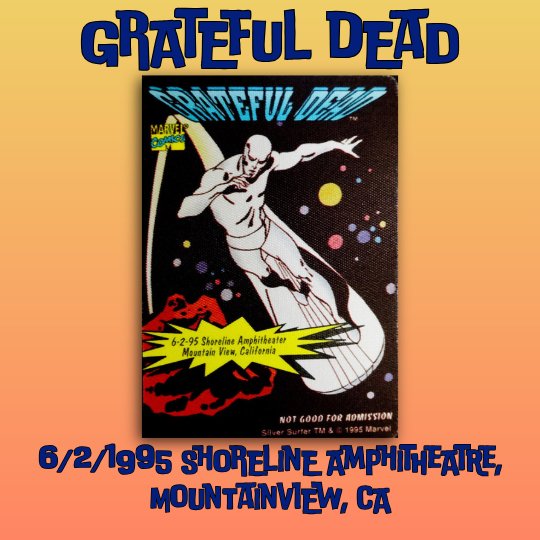
There are going to be some days of the year where 1) there aren't any known Dead shows; 2) There are shows but we don't have any recordings for whatever reason; or 3) there are recordings but the performance might not be the best. This show falls into category 3. Yes, there are some nice highlights - moments where Jerry suddenly "comes alive" and plays with passion and inspiration, but there are also times where he's mumbling words, fumbling the guitar and seemingly "checked out". It's just the reality of Jerry's situation in 1995 when the shows could be inconsistent. Alright, let's break it down. Overall, the entire band is locked in, listening to each other and playing really well, so there's that.
The first set started strong with Alabama Getaway > Greatest Story, and Jerry’s solos were sharp, but his vocals on Candyman felt detached. Schoolgirl was a fun surprise with Bobby fully invested, while Jerry added little and basically phoned it in. Bird Song stretched to fifteen minutes, soaring with the rest of the band driving wave after wave of crescendos as Jerry drifted in and out. Promised Land closed the set with fire, Jerry snapping back into focus.
The second set opened with a tight New Speedway, and Jerry sounded refreshed. That Would Be Something was beautifully played but lost steam at the end. He’s Gone was an absolute mess—Jerry struggled through it, barely contributing to the jam before walking offstage. The Other One was teased but never materialized despite Phil trying to push it forward. Then something special happened. During Drums, the Gyuto Tibetan Monks took the stage, chanting with deep, resonant energy. Shoreline was silent in reverence, and the band followed with an introspective Space, reflecting the monks’ presence. Easy Answers picked things back up, and Standing on the Moon was unexpectedly powerful—Jerry completely locked in, pouring emotion into every lyric. Around and Around slammed the set shut with high-energy rock and roll. The encore, Lucy in the Sky With Diamonds, was warm and dreamy, a fitting close to an unpredictable night.
June 3rd
Start of the June 1976 "comeback" tour (6/3/1976)
6/3/1976 Paramount Theatre, Portland, OR

Kicking off the “comeback tour”, this was the 1st of a 2-show run at the Paramount Theatre. The anticipation was sky high after their year-and-a-half touring hiatus. The Wall of Sound had proved to be too much for the band both financially and physically in 1974, so they mostly took the end of 1974, all of 1975 and half of 1976 off (except for a handful of public performances) to write new music, record and release Blues for Allah which was the most complex music they had ever written. The common opinion about June 1976 is that the band is finding their footing again in a lot of ways. Mickey Hart is being re-introduced into the band full time, and they were introducing complicated and demanding new music after a long break in touring. So, there are some "ups and downs" on this show, to be sure. Nine of the songs performed were only played once or twice before, so they were being a little reserved, but the night featured some truly incredible jamming.
The first set started a bit cautiously, which made sense given the circumstances. The tempos felt slower across the board, likely to help with fluidity, but it sometimes made older songs feel a bit restrained. Harmonies were rough at points, but things opened up as the set progressed. Might as Well made its debut, and Cassidy—while not as tight as it would become—showed real promise. They Love Each Other was slow and dreamy, and the first-ever performance of Lazy Lightning > Supplication stretched into an extended, winding jam. Scarlet Begonias really broke things open, with Phil and Jerry crafting an intricate and shifting musical landscape. Dancin' in the Streets returned after nearly five years, bringing an expanded jam that Keith contributed to beautifully.
The second set started strong with the debut of Samson and Delilah, Phil laying down a unique bass groove that gave it an edge I wish they’d kept in later versions. Crazy Fingers was incredibly smooth, easing into a long, spacious jam that flowed seamlessly into Wharf Rat, carrying that same delicate energy despite its heavier lyrics. The extended Let It Grow, appearing outside of the Weather Report Suite for the first time, was filled with high, spacey playing from Jerry. Help on the Way > Slipknot! > Franklin’s Tower was an absolute highlight, feeling more tranquil than later versions. Slipknot! led into a beautifully refractive jam, with Phil and Jerry moving effortlessly through different spaces while keeping their own distinct pathways. Franklin’s Tower was warm and mellow, stretching the energy into rippling, rolling waves. The encore brought the first-ever performance of The Wheel, which was a great moment but felt somewhat flat in execution compared to future renditions. This would also be the only time they ever played it as an encore. Despite some transitional hiccups, this show delivered incredibly strong jams and some standout performances. The contained energy made sense given the circumstances, but the improvisation reminded me why this band’s live shows are always worth the ride.
June 4th
6/4/1970 Fillmore West, San Francisco, CA

1st of a 4-show run. This is such an interesting period for the band that finds them straddling the original "primal Dead" period and exploring new musical genres, writing new songs and really improving their craft (playing and singing). One of their most iconic albums - Workingman's Dead would be released in 10 days from this show on June 14th, and you can really hear how much the band has honed their skills. Weir's playing and Jerry singing in particular shine on this recording. This is a very nice acoustic - electric set format show with David Nelson and John Dawson on a few songs. I like SHNID 123799 which is a matrix version.
The first set, played acoustically, had some standout moments. Deep Elem, Candyman, Black Peter, and Cumberland Blues all landed beautifully. Wake Up Little Suzie was a fun surprise, and the debut of an up-tempo spin on Swing Low Sweet Chariot gave it some fresh energy.
The second set shifts to electric instruments, and they launched into Casey Jones, delivering its driving rhythm and cautionary tale with vigor. Me & My Uncle followed, offering a concise narrative steeped in Western motifs. Hard to Handle featured Pigpen's soulful vocals and harmonica, infusing the set with bluesy energy. After that, the band performs It’s A Sin for the final time. The last half of the set featured some incredible sequences. St. Stephen > Not Fade Away > Midnight Hour was a highlight, with Not Fade Away morphing into a percussion-driven jam before weaving a Saint Stephen melody in a different key. Bobby’s guitar work was phenomenal throughout. Midnight Hour was unusual—Pigpen seemed a little off, cutting his rap short, but Jerry steered the band into unexpected territory. Pigpen kept hammering out Midnight Hour chords while the rest of the band pushed forward, and they coalesced around a short Mountain Jam theme. Bobby absolutely shined, his lead playing making him sound like a different musician. The jam then flirted with a China Cat theme before circling back to Midnight Hour. The closing Baby Blue is one of my favorite renditions. It was long, slow, and drenched in blues, with Bobby laying down shimmering lead lines that complemented Jerry’s deeply felt vocals. Even with some ragged edges, this show captured an exciting moment in the band’s journey. The jamming was expansive, sometimes unpredictable, but full of glimpses into the magic they were about to refine.
6/4/1976 Paramount Theatre, Portland, OR
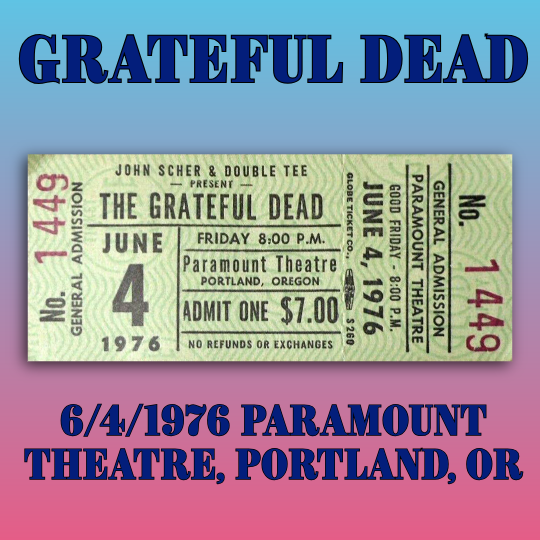
2nd of a 2-show run. The band is tight and in sync for their second show, as they settle back into their groove after a long touring break. There were moments of real tightness and confidence, and some absolutely standout jams.
The first set had a laid-back, yet locked-in feel. Friend of the Devil and Candyman stood out, both played with a soft ease. Lazy Lightning > Supplication was short but sharp, and Mission in the Rain made its debut—pretty, though not yet as polished as Jerry’s later versions with the Garcia Band. One of the biggest moments for me was Help On the Way > Slipknot! > Franklin’s Tower. This version was slightly shorter than the previous night but still a monster, with Slipknot! stretching past eleven minutes and Franklin’s Tower rolling just as long. The improvisation in Slipknot! felt fresh and unrestrained, with the guitars weaving almost flute-like lines. Early versions like this always feel more exploratory to me, with less reliance on structure. Sugaree, at just under nine minutes, was shorter than the massive ‘77 takes but had all the early ingredients of what was coming—Phil stretched the phrasing beautifully, and Jerry leaned into subtle dynamic shifts, adding new textures to the song.
The second set kicked off with some fun surprises. During a drum break in Playing, there’s a quick Dancin’ tease before they pivoted back into the Playing reprise. Bobby makes an announcement about a broken bass drum. The long-overdue return of Cosmic Charlie, missing from the rotation since 1/21/1971 (289 shows), was a great moment, played at a slowed-down, mellow pace. It flowed straight into a fast-moving Let It Grow, then dipped into Drums before hitting the always-stunning Stella Blue. Finally, after the earlier tease, they did go into Dancin’. Wrapping up the set with U.S. Blues, and then a high-energy encore of Johnny B. Goode delivers a rousing finish to the show.
6/4/1977 The Forum, Inglewood, CA

An was an absolute powerhouse show that rivals everything from May, 1977. This one kind of lives in the shadows of the rest of June, 1977 because it only audience recordings circulate, but look for MOTB.0096 which is a nice FOB and comes in both 16-bit and 24-bit transfers of the master tape.
The first set was fantastic, even better than any of the Winterland openers. Tennessee Jed and El Paso were clean and confident, and there was a real spark in Jack Straw and Lazy Lightnin' > Supplication. Jerry’s vocals on Candyman were rich and soulful, and The Music Never Stopped felt explosive, riding that signature 1976-77 energy.
The second set was just one giant highlight. Estimated Prophet > Eyes of the World radiated warmth, blending reggae with jazz and setting the tone perfectly. The groove continued with Drums, rolling effortlessly into a high-energy Good Lovin', with Bobby leading the charge. Terrapin Station was stunning, its grandeur giving way to a chaotic breakdown, spilling into a haunting Playing in the Band, which carried shades of early "Main Ten" jams. Franklin’s Tower burst forward like bright sunlight, shimmering before fading into deep space. China Doll was fragile and haunting, only to give way to the rowdiest, most unhinged Not Fade Away I’ve ever heard—pure fire, leading seamlessly into an emphatic Playing in the Band Reprise. This was a show filled with intensity, beauty, and pure musical force. No doubt, one of the most overlooked gems of 1977.
6/4/1978 Campus Stadium, UC Santa Barbara, CA
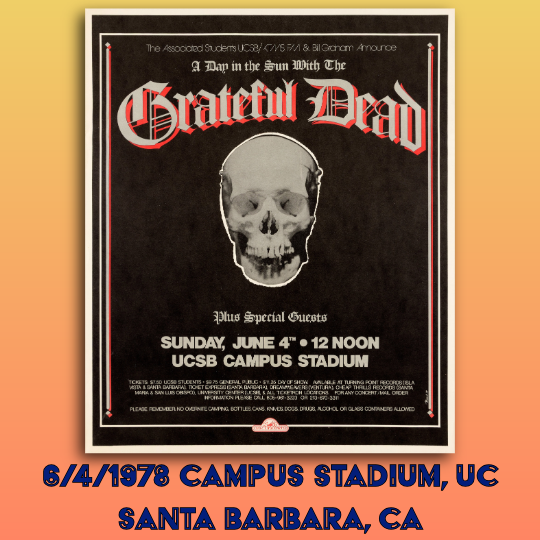
This show is easily one of my favorites—high-energy from start to finish and absolutely worth revisiting. I like the Betty Board mix recording (SHNID 94407).
The first set takes off with a scorching Bertha > Good Lovin', and Jerry’s vocal flourishes add that extra touch of spring ‘78 magic. The whole set feels tight and playful, with plenty of joking between songs. Bobby throwing in the "Uncle Bobo" lyrics during Me & My Uncle is a perfect example. They close it out with Jack Straw, pushing the energy so hard that the PA distorts—it’s one of those powerful endings that hits you like a surge.
The second set keeps the momentum going with Estimated > Eyes, Jerry pouring everything into his guitar and vocals. Space feels more like a jam, and I swear there are some unidentified guests on stage in the mix. Then comes one of the coolest moments—the revving motorcycle engine syncing with Billy and Mickey’s pounding rhythm as they launch into Not Fade Away, one of the hottest versions of ‘78. The Nobody’s Fault But Mine Jam breaks out after 166 shows, Bobby’s slide absolutely dialed in. He plays a couple bars before Jerry jumps in, but the jam is way too short before they snap back into Not Fade Away. The momentum keeps rolling into GDTRFB > Around, and I love the moment when Donna calls out Bobby’s signature stuttering—"Spit it out, Bobby!"—pure hilarity. They slam the ending home hard, easily one of my favorite versions. The encore keeps the party alive. Before kicking off the second round, Bobby gets the crowd to thank Uncle Bobo, and the place erupts. Then comes a ripping U.S. Blues into Sugar Magnolia, one of those absolutely electric versions that sends chills up your spine. Bill Graham’s closing remarks wrap up an incredible summer day and a truly unforgettable show.
June 5th
6/5/1969 - Fillmore West, San Francisco, CA

This June 5, 1969 show at Fillmore West was a solid listen—not the most legendary night in the band's history, but a great snapshot of where they were at the time. It’s a show that has a lot of depth and exploration, and one which finally circulated as a complete recording in 2016.
The first set kicked off with a strong Morning Dew, full of emotion and power. The slower, delicate He Was a Friend of Mine stood out as a rare treat, beautifully played. Cosmic Charlie, oddly placed on its own, added a nice psychedelic touch. After that, they launched into a nice jam segment with Cyrptical > Drums > Other One > Cryptical. One of my favorite moments came in the Cryptical reprise—the guitar lines were soaring and delicate, only to fade into silence with some perfectly restrained feedback.
The second set started unexpectedly with China Cat, rolling forward with energy and sounding like it was itching to merge into I Know You Rider, but that was a transition that wouldn’t appear for another three months or so, on 9/30/1969. Instead, they shift directions into Sitting On Top of the World. Dark Star emerged from the smoke and stretched to 21 minutes, but compared to some of the era’s best versions, it felt a bit unfocused. It had its moments—Jerry’s fingerpicking and Phil’s booming bass shots adding depth—but it never reached full lift-off. Saint Stephen came in strident and aggressive, Bobby throwing in a sharp little spoken interjection of "And that's exactly how it is" after the "One man gathers" lyric. The Eleven had a light, jazzy feel, with Jerry and Phil bouncing intricate lines between each other. Lovelight, running an impressive 27 minutes, saw Jerry pushing his solos with more fire than usual, and the band even played with the rhythm structure for a bit, layering in an unexpected three-chord jam. Pigpen was full of passion, even if his lyrics weren’t his most inspired. Throughout this entire set the transitions kept things moving, and while the playing wasn’t flawless, the sheer energy and creativity of it all make the show absolutely worth the listen.
6/5/1970 Fillmore West, San Francisco, CA

2nd of a 4-show run. This show was definitely uneven, but despite some struggles, it ended on a high note. The acoustic set served as both a warm-up and a great showcase for their country and folk roots. Some of the playing felt rough around the edges, but there were great moments. Dire Wolf was a standard but solid opener, and the acoustic I Know You Rider had a nice, rare touch with Jerry adding the "I'd rather drink muddy water" line. Bobby really stepped up on Silver Threads and Golden Needles, sounding stronger than the rest of the band at that moment. Friend of the Devil was hurt by some feedback issues, but Me and My Uncle stole the set for me—Bobby’s vocals were full of confidence, making it feel definitive. Jerry kept the storytelling vibe going with a heartfelt Black Peter, and the set closed with a raw and driving New Speedway Boogie.
The electric set started off with a solid rendition of Cold Rain And Snow. Easy Wind was also fine, but Cryptical > Drums > Other One was uneven. After a short and clumsy Drums they dove into The Other One, but despite some concerted effort things never fully took off. The energy was there at first, but the jam quickly unraveled. Jerry wasn’t fully engaged, and even with Bobby pushing hard, the rhythm section felt off, the drummers lagging behind. The feedback issues didn’t help, and the band’s frustration was obvious. The jam became completely disjointed, with Bobby trying to pull the second verse together but getting little support. Jerry cut straight into the outro, which just brought more problems, and they finally threw in the towel, leading into a nice rendition of Attics of My Life, a much-needed reset. The harmonies were surprisingly strong, and Jerry’s solo work was full of warmth. Pigpen took over with Hard to Handle and It's a Man's World, both well played if a bit restrained. Uncle John’s Band closed the set nicely, and the double encore of Saint Stephen > Casey Jones felt like classic 1970 Dead—full of energy and determination, salvaging the night and sending things off on the right note.
6/5/1980 Compton Terrace Amphitheater, Tempe, AZ
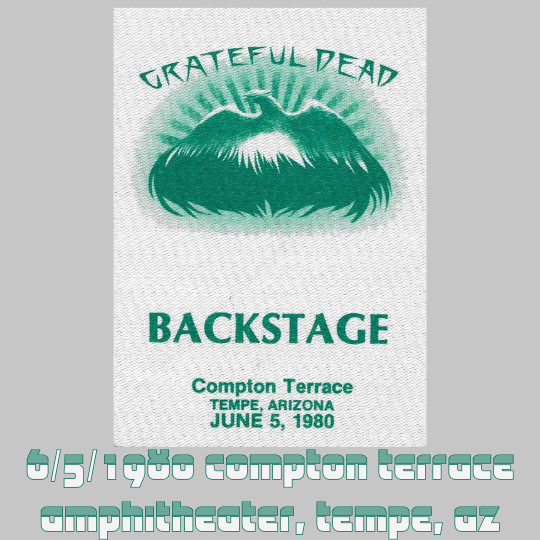
This show had a steady, strong energy from start to finish. No single moment stood above the rest as legendary, but the level of playing was consistently excellent, and the whole night had a satisfying flow. The first set only circulates as an audience recording but I like the Bob Morris FOB (SHNID 106616 which is a 24-bit source).
The first set opened hot with Alabama Getaway > Promised Land, setting the tone for a tight and energetic run. Alabama Getaway was particularly strong, a true rock powerhouse that stood out. Other highlights included They Love Each Other, Althea, and Stranger, all played with clarity and confidence. There was a bit of a rough patch during Mexicali > El Paso, with crackling amps, blown speakers, and some missed lyrics and guitar parts, but overall, the set maintained a solid flow.
The second set carried the momentum, showcasing the band's effortless command of their material. China Cat > I Know You Rider was one of the standout sequences, Phil driving the transition with precision. The jam out of Terrapin was beautifully spacey, stretching things out before sliding into Drums. Space took on an intensely energetic edge, eventually leading into Truckin', which was just exploding with swagger. It was a good night for rock standards—Alabama Getaway, Don't Ease Me In, Truckin', Johnny B. Goode, and U.S. Blues all had an extra punch. Phil’s bass felt more like something you experienced physically than just heard, shaking the whole room.
Music link: https://relisten.net/grateful-dead/1980/06/05?source=2176426 and https://relisten.net/grateful-dead/1980/06/05?source=106079
June 6th
6/6/1970 Fillmore West, San Francisco, CA

3rd of a 4-show run, and the same acoustic-electric format as the other shows. This June 6, 1970 show at Fillmore West had its ups and downs, but when the band hit their stride, they really delivered.
The first set opened strong with Don't Ease, kicking off the night with solid energy. Bobby threw in a first-time tease of The Frozen Logger while Jerry handled a broken string, but it’s dismal and his voice wasn’t quite up for it, and he abandoned it after the first verse. Once they got back on track, Friend of the Devil sounded great, followed by a sweet Candyman. The rest of the set isn’t widely circulated, but what exists makes me hope the rest eventually surfaces.
The second set had plenty of jamming, even if the performance felt uneven. Casey Jones rolled through casually, but things really opened up with an outstanding Dancing In The Streets, featuring a Tighten Up Jam where Jerry’s lead work locked in beautifully with the rhythm section. After the groove-heavy jam, they slipped back into the reprise seamlessly. China Cat Sunflower > I Know You Rider had a sloppy transition—maybe one of the messiest ever—but things picked up quickly with a rare and lively Good Lovin' > New Orleans > Good Lovin' combo. Bobby was fully in showman mode, and Jerry and Billy responded with their own flourishes, keeping the energy high despite a misfired refrain. The momentum shifted into Attics Of My Life, a nice contrast to the previous stretch, and a beautiful rendition that was selected for release on The Golden Road (1965 -1995) box set. Dire Wolf felt rhythm-heavy but straightforward, leading straight into a stomping Alligator. The initial drum jam felt a bit flat, but Jerry and Bobby saved it when they re-entered, trading playful solos. Jerry eventually pushed the jam into deeper territory, shifting themes until the familiar And We Bid You Goodnight melody emerged. It started out uplifting but soon darkened, touching on Dark Star tones before transforming into Turn On Your Lovelight. While the band played well, Pigpen completely stole the moment—his natural ability to guide the song, weaving in raps and tempo shifts, was effortless. He surprised everyone by skipping the expected climax and diving straight into Not Fade Away, which immediately erupted into some of the fiercest playing of the night. When Pigpen threw out, "Tell me a story, Bobby," the band unleashed scorching solos before snapping back into Turn On Your Lovelight, now fully driven by Bobby, who pushed his vocals to the limit. The Uncle John's Band encore was a bit messy, but it still offered a fitting cooldown to close the night.
Music link: https://relisten.net/grateful-dead/1970/06/06?source=2171659 and https://relisten.net/grateful-dead/1970/06/06?source=2171528
June 7th
Janis Joplin joined the band on stage (6/7/1969)
6/7/1969 Fillmore West, San Francisco, CA

This is one of the best shows of 1969 and is packed with standout moments from start to finish. Musically, you'll find some very unique arrangements here, and this is one of the two known times that the legendary Janis Joplin joined the band on stage.
The night began with an acoustic Dire Wolf, raw and unpolished but full of character. Mountains of the Moon followed in a partially acoustic arrangement, setting the mood before a standout version of Dark Star took off, steadily gaining intensity until it hit full boil by the end.
Saint Stephen felt flawless, with Jerry’s a cappella vocal floating over a subtle xylophone backing, adding a delicate, unexpected touch. The relentless energy of The Eleven carried straight into Sitting On Top Of The World, Phil leading the charge with confidence. Doin’ That Rag featured a bright, rhythmic strumming pattern that stood out from other versions, adding an extra spark. Closing the night, Turn On Your Lovelight was legendary. Janis Joplin joined Pigpen, the two trading fiery vocal improvisations, stretching the song past 20 minutes. The whole performance had a magic to it, an effortless flow that made every song feel connected to the next. This is a show that absolutely deserves to be heard.
6/7/1970 Fillmore West, San Francisco, CA
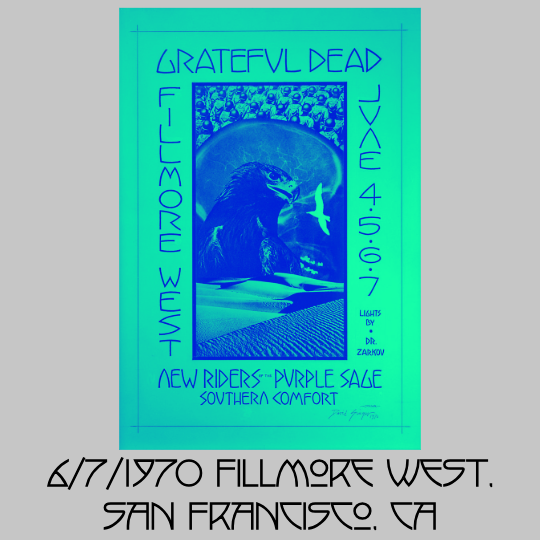
4th of a 4-show run, and following the same acoustic set - electric set format as the other shows. This June 7, 1970 show at Fillmore West had a mix of playfulness and power, shifting between moments of goofing around and some truly standout performances.
The first set kicked off on a festive note with a lively Don't Ease Me In, staying true to its acoustic roots. Silver Threads and Golden Needles followed, with Bobby delivering a strong, sincere vocal performance. There was a bit of clowning around, including his "My Dog Has No Nose" joke before they launched into Friend of the Devil, which felt familiar but still had charm. Candyman lacked Jerry’s usual signature intro lick in the acoustic format, but things really soared with Cold Jordan and Swing Low Sweet Chariot, featuring David Nelson and John Dawson—a highlight for sure. Cumberland Blues was crisp and tight, much like the studio version, while Me and My Uncle felt slightly rushed but still solid. The set wrapped up with a confident New Speedway Boogie, featuring a bluesy jam packed with rarely heard licks, even slipping in some Nobody’s Fault But Mine phrasing.
The second set started off unsteady. Cryptical Envelopment felt sluggish, Jerry’s vocals buried in the mix, and the drum jam collapsed briefly before they rebuilt into The Other One. Bobby missed his cue, and the first jam had Jerry’s methodical lead work clashing against Bobby’s more aggressive approach. Things came together in the second verse, Bobby thrashing shuffles while Jerry built his lines patiently, but it never fully took flight. The jam faded instead of resolving, which felt abrupt, but then transitioned into a rare harmonic sequence leading into Main Ten Jam, where Phil drove the theme beautifully, and Jerry added searing bends. Sugar Magnolia arrived smoothly but was played almost painfully slow, with the band repeating the first verse three times—awkward, but forgivable given it was its first public performance. They kept the comedic mood alive with a brief Louie, Louie Jam, which Bobby abruptly ended, admitting no one actually knew the song.
Pigpen took over with a soulful It’s A Man’s World, bringing out Jerry’s best tone of the night, rich and bluesy underneath Pigpen’s growls. Things stabilized with solid takes on Mama Tried and Sitting On Top Of The World. Cosmic Charlie followed, Bobby improvising an enthusiastic vocal intro that gave it an extra charm. Casey Jones was clean and tight, feeling as crisp as the studio version. The show closed out with a fiery Good Lovin', easily the most focused jam of the night. The transition into the jam was hesitant at first but locked in with pure intensity—Jerry’s soloing blazing while Phil and Bobby took turns driving the rhythm. Mickey’s offbeat fills kept the groove fluid and full-throttle all the way to the reprise. The night had its flaws, but the energy, humor, and standout jams made it a rewarding listen.
6/7/1977 Fillmore West, San Francisco, CA
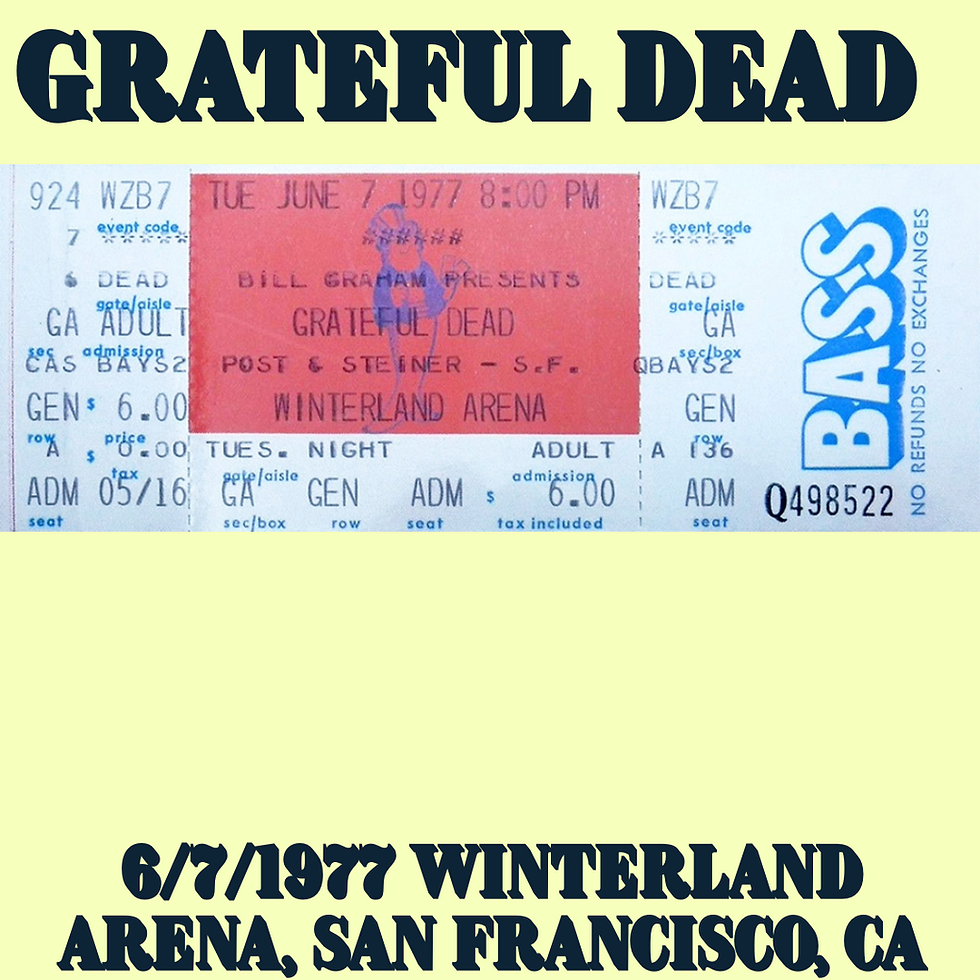
1st of a 3-show run. Officially released on Winterland June 1977: The Complete Recordings. An outstanding show, despite a few technical issues early on. The band powered through and delivered some truly incredible moments. Being the first of three nights leading into the Terrapin Station recording sessions, you could feel them locking into something big.
The first set had a rocky start with equipment issues, but once things settled, the playing was top-notch. Looks Like Rain was its usual ‘77 beauty, and Peggy-O had a delicate, flowing quality. Bobby’s subtle rhythmic quirks gave it a little extra charm. Friend of the Devil was a high point—Jerry’s vocals were stunning, and Keith’s shimmering solo stretched the jam beautifully. The Music Never Stopped closed the set with a perfectly danceable groove, the closing jam packed with the kind of energy that just pulls you in.
The second set was a monster, pushing past two hours and packed with highlights. Scarlet Begonias started off a little rough vocally, but the first jam was smooth and graceful. Phil kicked off Fire on the Mountain with a bass-led transition jam, holding it steady while Jerry layered delicate guitar lines and Keith toyed with the Not Fade Away riff. The whole thing had that loose-but-perfectly-connected feel that made ‘77 jams so special. Fire on the Mountain, a Jam Anthem, was full of warmth, but as was frustratingly common for the year, the closing jam got cut short by Bobby and Phil pushing toward the next song. Good Lovin' kept the energy high, though Bobby still mentioned lingering equipment problems before dropping into Candyman for a cooldown. Estimated Prophet was a force—huge opening, fantastic first Jerry solo, and an open, exploratory jam that dissolved a little sooner than I would’ve liked into He's Gone.
What followed was a jam that had hints of becoming The Other One but instead faded into a soft Drums section. Samson and Delilah, a Jam Anthem, exploded out of Drums with Jerry’s long, fiery intro, Billy and Mickey still loose from their workout. The jam was so strong that, for a moment, it felt like they might just keep pushing it forward instead of heading into the lyrics. Terrapin Station arrived with its usual grandeur, seamlessly leading into Morning Dew, another Jam Anthem rendition, and the last one they played that year. This version was absolutely devastating—haunting vocals, towering emotional weight, and a final jam that was pure catharsis. Around and Around kept the energy high, starting slow and stately before escalating into a controlled explosion. The encore was Uncle John’s Band, packed with emotion and big jams, Donna delivering a fantastic performance. Just when it seemed over, Jerry came back for one more, U.S. Blues, capping off an unforgettable night. This show was massive, full of emotional peaks, beautifully structured transitions, and jams that felt effortless yet powerful. A true gem in an already legendary month.
June 8th
6/8/1969 Fillmore West, San Francisco, CA
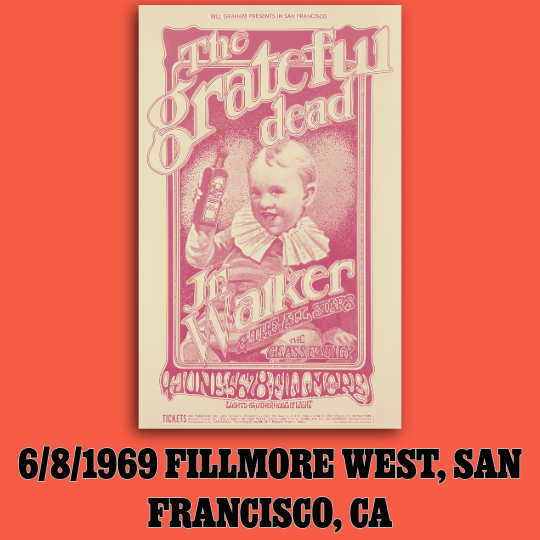
This show was an absolute powerhouse from start to finish, packed with energy and incredible jamming. This show had an incredible mix of powerful jams, unusual collaborations, and raw blues energy, making it a must-hear performance.
The first set was a tight, relentless jam session, running about 47 minutes. Instead of Bill Graham, someone else introduced the band, calling them "one of the fathers of the whole scene." They wasted no time blasting out of the gate with Dancing in the Streets, which included hints of the "Tighten Up" jam that surfaced in 1970. He Was a Friend of Mine stretched to an engaging 12 minutes, Jerry’s vocals rich with emotion and his solos cutting deep. Right after the reprise, the band tore into China Cat Sunflower, setting up a stunning sequence that flowed seamlessly into New Potato Caboose. This alone made the show worth hearing—Phil’s bass solo, the intricate jam in 13, and Jerry’s soaring lead lines were performed with absolute precision. Bobby’s vocals on New Potato Caboose were strong, and it’s a shame the band dropped the song from the rotation forever just a month later on 7/8/1969. Before closing the set with Me & My Uncle, Jerry announced they’d take a break as Junior Walker and the Glass Family took the stage, promising to return for the second set. The version of Me and My Uncle was tight and energetic, more engaging than most I’ve heard, with Bobby throwing in the fun alternate lyric, "He taught me so good, I took that gold, and I left him lying there on the side of the road."
Hours later, after sets by other bands, the Dead returned with an unexpected guest—Wayne "The Harp" Ceballos, lead singer of Aum. Though Aum’s name suggested an East Indian influence, their sound leaned heavily into blues and gospel, which came through during the set. Ceballos led an absolutely monstrous Lovelight, running over 36 minutes, though I’ve heard some say it got a little tedious without Pigpen’s signature rap guiding the song forward. Instead, Ceballos went full vocal theatrics—shouting, moaning, scatting—while Billy Nicks played congas throughout. Interestingly, Pigpen didn’t appear on this version at all, and Bobby only chimed in once for backup vocals.
A major highlight came when Ceballos and Jerry traded licks, with Ceballos scatting a phrase and Jerry echoing it perfectly. Pigpen’s respect for Ceballos was clear when he shouted, "Wayne the harp, Wayne the harp, that's the man, sing pretty good don't he?" at the end of the song. Ceballos then left the stage, and blues guitarist Elvin Bishop stepped in for a loose, blues-heavy segment. First up was The Things I Used to Do, where Bishop and Pigpen had an amusing back-and-forth before Bishop launched into a searing guitar solo. Then came Who’s Loving You, played slow and heavy, with Pigpen and Bishop sharing vocal duties. Jerry might not have been present during these two blues numbers, but Bishop’s playing carried them well. The show returned to classic Dead territory with Cryptical Envelopment > Drums > Other One, played tightly but not standing out compared to other versions from 1969. Instead of looping back to the Cryptical reprise, they immediately slid into Cosmic Charlie, closing out the night in pure psychedelic style.
6/8/1974 Oakland Coliseum Stadium, Oakland, CA
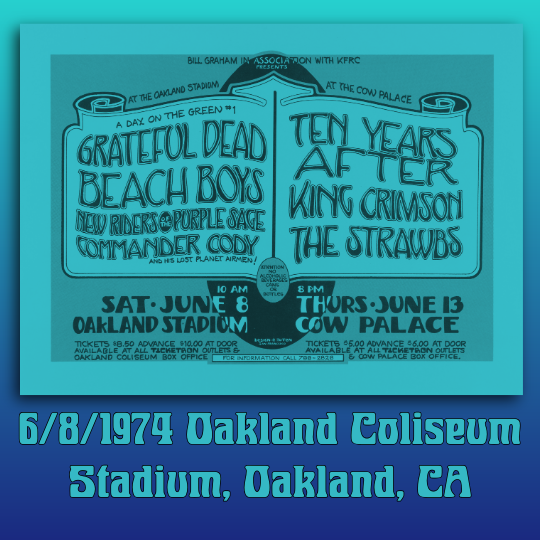
Day on the Green #1, the home of the Oakland A's baseball team and the first time the Dead played there. You can read more about these Day on the Green concerts in Corry Arnold's excellent Lost Live Dead blog here. This June 8, 1974 show at Oakland Coliseum Stadium felt like a perfect summer day—great energy, relaxed vibes, and some truly standout performances. Keith really shines on this show. His playing seems to be extra inspired.
The first set wasn’t the most extended or jam-heavy, but Keith’s touch made it memorable. He was shining on Promised Land, Brown Eyed Women, and especially Greatest Story Ever Told, where his interplay with Jerry felt like a duet. Scarlet Begonias had a fresh and lively bounce, and China Cat > I Know You Rider never fails to deliver.
The second set centered around one of the best sequences of the night—Playing in the Band > Wharf Rat > Playing in the Band. The Playing jam kicked off with Phil leading the charge before Jerry leaned into spacey, Wah-Wah pedal heavy textures. Bobby pushed the tempo forward, and Keith brought in moments of quiet reflection before Phil and Jerry steered things into a jagged, chaotic rhythm. Jerry’s exploration of the Tiger Jam was particularly thrilling—he approached it three different ways before it hit a full boil. The feedback-laced transitions gave way to faster jams led by Billy and Keith, while Jerry and Phil kept the drones alive. Eventually, Jerry hinted back at Playing, leading the band gracefully into Wharf Rat, which was dripping with Phil’s deep bass bombs.
The jam coming out of Wharf Rat had a bluesy edge before slipping back into the Playing reprise. A standalone rendition of Eyes of the World came next, but it was relatively short and a bit underdeveloped for 1974. Still, Phil’s lead work was a joy, and the King Solomon’s Marbles segment gave it extra depth. It seemed like they were gearing up to segue into China Doll, but out-of-tune guitars forced a stop. They shook that off with a powerhouse Sugar Magnolia to close the set. The encore was interesting, transitioning from Casey Jones into Saturday Night, a fun and fitting way to wrap things up.
6/8/1977 Winterland Arena, San Francisco, CA

2nd of a 3-show run at the Winterland, and officially released on Winterland June 1977: Complete Recordings. The energy, precision, and sheer magic of the night made it one of the highlights of an already legendary month.
The first set starts with a solid Bertha > Good Lovin', but the true masterpiece—my personal favorite version ever—is Sugaree. I’ve listened to it countless times, and every single time, it turns my spine to marmalade. The tenderness throughout is breathtaking, with Jerry delivering one of the most exquisite builds I’ve ever heard. His phrasing is so delicate and nuanced, but when he finally hits the crescendo before the last verse, it’s utterly crushing. The interplay between his soft melodic licks and the raw peaks of emotion is completely mesmerizing. The fact that this 16-minute wonder comes so early in the set, without any warm-up, makes it even more remarkable.
The rest of the first set, while not reaching those heights, is still fantastic—Passenger is fiery, Donna’s voice is radiant on Sunrise, and Jack-a-Roe feels sublimely intricate. The Lazy Lightnin' > Supplication suite is well played and has that signature bounce, though it’s not an unusual take. Still, it’s a Jam Anthem version, and delivers plenty of punch.
The second set really blossoms with a stunning Ramble On Rose, Jerry absolutely locked in, his playing and vocals full of warmth. Estimated Prophet is shorter than usual, under ten minutes, but it’s a fitting prelude to the night’s next great peak—Eyes of the World, a breathtaking, nimble, 19-minute journey. Jerry’s fingers dance through the melody, stretching and bouncing with effortless fluidity. After Drums > Other One, the band eases into Wharf Rat in an interesting way—Jerry is deep in his own world, meandering through scales and feedback, while Bobby subtly nudges the song into focus.
It takes about 40 seconds before Jerry finally strums with authority, shifting into full storytelling mode. Not Fade Away follows, played with that wonderfully delicate vibrancy that defines late-70s versions. It’s not as fiery as the legendary September 3rd, 1977 take, but it’s tight, focused, and brimming with funky melodic interludes—echoes of Goin’ Down the Road floating throughout. When they finally transition into Goin' Down the Road Feelin' Bad, the energy is seamless—Donna’s background harmonies are stunning, and Jerry pours everything into both the jams and vocals. They build the song beautifully, leaving my spine slightly melted before Johnny B. Goode explodes to close the set. The encore, Brokedown Palace, is the perfect contrast—gentle, sentimental, and a cool-down after an electrifying ride.
6/8/1980 Folsom Field, University of Colorado, Boulder, CO

You can't skip a show that opens with "Uncle John's > Playing > Uncle John's Band". No way! It's only available as an audience recording but fortunately there are some very good ones. I like SHNID 155741 for the Phil presence on it. This and the previous night were kind of billed loosely as the 15-year anniversary shows. 6/7 was an average show in my opinion, but this one is quite different.
The first set kicks off in spectacular fashion with what I consider the highlight of the entire show—Uncle John's Band > Playing in the Band > Uncle John's Band. The emcee set the tone by calling it the beginning of the "second fifteen years," and Phil wasted no time making his presence felt with a rolling, fluid bass break early in Uncle John's Band. His lines bubble and bounce through the mix, and Jerry responds with pure joy, elevating the interplay even further. The whole moment feels like a conversation between the band and the audience, both smiling at each other.
Rather than returning to Uncle John's Band, they slide effortlessly into Playing in the Band, and it’s absolutely mesmerizing. Jerry guides the jam with his Wah-Wah effects pedal soaked phrasing, creating deep pockets of space for the rest of the band to explore. When Phil suddenly takes control midway through, the jam turns into a swirling vortex, gripping everything around it. It’s moments like this that define exactly what makes the Dead so unique to me. Honestly, the sheer power of this sequence makes the rest of the set feel secondary, though I still enjoyed the punchy Samson and laid-back Althea in the middle. Deal brings things to a fiery close with a tight, well-played finish.
The second set had some great moments as well. Stranger sounds solid, keeping the energy rolling. Estimated Prophet > Eyes of the World follows, and while Estimated has a sharp, biting feel, Eyes is a bit overloaded with Phil—it feels like he’s smothering the mix a bit, though his playing is always impressive. The post-Eyes jam gets weird in the best way, with Jerry and Brent bouncing strange, playful phrases back and forth.
The whole stretch from Drums through Space is engaging, and the final run of Saint of Circumstance > Black Peter > Sugar Magnolia is performed with conviction, making for a strong close to an already memorable night. A rousing Alabama Getaway kicked off a nice double encore. They cooled things down with a poignant rendition of Brokedown Palace to end the show gently.
June 9th
6/9/1973 Robert F. Kennedy Stadium, Washington, DC

This entire amazing show was released on Here Comes Sunshine 1973. This whole show has a wonderful "vintage" presence to it, in part because of the chorus or flange effect on Bobby's guitar which I love. While I have the official release, and it sounds amazing this is one of the rare occasions that I prefer one of the circulating sources more. I prefer the Usborne Matrix version (SHNID 131169) because of the overall presence to it. This was one of those nights where the band felt completely locked in, delivering a mix of wild, exploratory jams and emotionally rich ballads. A true jewel in the 1973 run.
The first set had some truly standout moments. Loose Lucy was a blast, with wild ensemble vocals and a flubbed verse that led to an unexpected bluesy jam—Jerry steering it toward a Let It Rock feel. China Cat Sunflower locked into a groove and melted into a Feelin’ Groovy Jam that was pure velvet, smooth and flowing. Other highlights included Deal, Looks Like Rain, They Love Each Other, Jack Straw, Box of Rain, and Sugaree, each delivered with confidence. One of the stranger moments came in I Know You Rider when Jerry softened the "wish I was a headlight" line rather than his usual scream, catching everyone off guard and splitting the crowd into either stunned silence or excitement.
The second set started with a slow, deliberate He's Gone. At first, some in the crowd seemed restless, but the band stuck with it, letting the harmonies build until they won everyone over with a truly moving vocal finish. The beat picked up, bursting into Truckin’, which carried a loose, almost reckless energy—sloppy in places but totally embraced by the audience. The emotional but imperfect finish drifted into Space, exactly the reset the band needed. Keith switched to an electric keyboard, giving the jam an eerie, floating texture that blended beautifully with Jerry’s careful explorations.
They played around in the ether for a few minutes before Jerry landed on the opening notes of Playing in the Band, materializing out of nowhere—a stunning transition. Keith was all over this version, shaping the jam with his thoughtful phrasing. Jerry clicked on his wah-wah, usually a sign they were heading for the exit, but the band pushed forward instead. A near-Tiger roar emerged, then more deep space, with the rest of the band circling, laying a foundation for Jerry to weave through. He teased, stretching notes suggestively, while Phil barked out a few bombs, nudging Jerry to either move forward or spiral back into open space. Jerry finally gave in, seemingly amused he had baited Phil, and the jam coiled back toward the final theme—Donna wailed, the crowd roared, and they landed the reprise beautifully. Eyes of the World and China Doll were handled with softness and warmth, Jerry delivering delicate lead phrasing throughout. China Doll felt particularly fragile and deeply emotive—definitely worth a focused listen. Sugar Magnolia likely closed things out, cutting off before Sunshine Daydream, with Bobby jokingly telling the crowd to enjoy their tans after the long wait.
6/9/1976 Music Hall, Boston, MA

Officially released on Road Trips Volume 4 Number 5. This is an epic show, and the first of 4 nights at The Music Hall. It also represents the triumphant return of the Dead to the east coast in almost 2 years following their year-and-a-half hiatus, so the mood was energized in the crowd. The band lays out some heavy jamming, and they bring a highly restructured set list and some great breakouts as we'll see. This show was bursting with fresh song choices and deeply inspired interplay between Jerry, Bobby, Phil, Keith, and Donna. If I had a time machine, this one would be on the list.
The first set felt like the band was experimenting with structure, almost as if they were still settling into their post-hiatus groove. Rather than easing in, they dove straight into a series of big jam songs, which made for an exciting shift. The jams weren’t as drawn-out as they’d be later, but there were some truly incredible moments. The Music Never Stopped hit a fiery peak at the end, where it genuinely sounded like Jerry was laughing through his guitar—pure joy pouring out of the notes. Crazy Fingers had an elegantly woven jam, bringing in that signature Spanish flavor, and the eerie interplay between Jerry and Phil gave it a haunting edge.
But the real masterpiece for me was Looks Like Rain. They played it with a slow, stately grace, and the raw emotion was just staggering. The way Keith, Phil, and Jerry locked in was astonishing—listen to how Keith plays a short phrase on piano after the second verse, Phil picks it up instantly, and then Jerry ties it together seamlessly. It felt like a musical relay, each player passing the torch perfectly. The gradual, breathtaking crescendo before the final verse was one of the most fluid and expressive builds I’ve ever heard. Big River rounded things out with a fun, full-tilt gallop to keep things rolling.
By the time the second set kicked off, the atmosphere was electric. Expectations were already blown apart by the first set, and then came the big moment—Saint Stephen, last played on 10/31/1971 - making its grand return after nearly six years. This was a Jam Anthem version, slowed down with a rich, reworked harmony arrangement and a new take on the Ladyfinger bridge. The jam section stretched much longer than earlier versions, lasting nearly seven minutes, allowing the band to really push its edges. If that wasn’t enough, they followed it with Eyes of the World, another Jam Anthem version, and it was absolutely epic. The intro jam alone lasted eight minutes, pulling in chord progressions reminiscent of earlier takes, and it had that up-tempo danceable energy that made these mid-70s versions so irresistible.
The transition into Let It Grow was seamless and beautifully executed. Then came the east coast premieres of Lazy Lightnin' > Supplication, followed by the return of High Time, which hadn’t been played since July 12, 1970. The band’s maturity was evident here—their refined musical approach gave the song a deeply soulful and strikingly beautiful treatment, with Donna absolutely shining in the harmonies. The disco arrangement of Dancin' in the Streets had its East Coast debut next, adding another dimension to Bobby’s repertoire. Wharf Rat was powerful and perfectly placed. Then, the encore—Franklin’s Tower. This was the only time they ever played Franklin’s Tower as an encore, and it dazzled as the final note in an incredible night.
6/9/1977 Winterland Arena, San Francisco, CA

This is the third of the 3 show run, and probably the best of the three. This show was nothing short of spectacular, a pure joy from start to finish. The band was in complete control, radiating confidence and precision in every moment.
The first set delivered classic renditions across the board—flawlessly played, packed with energy, and showcasing the band at their peak. These aren’t the most unpredictable versions, but that sense of mastery is undeniable. Bobby’s interplay breathes extra life into the music, while Phil’s growling bass lines add intense depth. The biggest highlights for me are Half Step, which is beautifully phrased, and Cassidy, with a strong jam—short by modern standards but still powerful. Deal is sharp, with Jerry weaving extra frills into the vocals. Loser is especially haunting, its storytelling richer than usual. The set closes with The Music Never Stopped, an absolute mind-blower, riding that tight ‘77 energy where nearly every version was a show-stopper.
The second set is widely considered one of the best ever, and I agree—it’s simply outstanding. It opens with Samson and Delilah, a solid version that lets them test the waters before the vocal monitors need fixing. Then the real magic begins. Help on the Way > Slipknot! is Dead history at its finest—Jerry’s soaring lead work is crystal clear, Phil’s emphatic bass fills are perfectly placed, and Keith’s spiraling keyboard runs wind through everything in stunning fashion. The transitions are flawlessly executed, every movement purposeful. The segue into Franklin’s Tower keeps the momentum rolling, especially the jam after the second verse—it reaches a euphoric peak before gently landing on a reprise that feels like Jerry is caressing the chorus lines. Even forty-two minutes in, they’re still just getting warmed up.
Estimated Prophet, a Jam Anthem version, follows with Phil dropping a massive bomb to kick things off, Bobby playing it loose and playful. The final space jam slips seamlessly into Saint Stephen, the transition so perfect it feels inevitable. The intro is majestic and drawn out before Jerry glides into Not Fade Away, which rolls straight into Drums. Five minutes later, Saint Stephen resurfaces in a reprise, tightening the circle. At this point, they could have ended with Sugar Magnolia, and no one would have complained. But instead, they go all in, delivering a magnificent version of Terrapin Station, marking the new era with a sense of grandeur. Then they burn the house down with Sugar Magnolia, an absolutely blistering closer. The crowd refused to let them leave without an encore – twice – with U.S. Blues and One More Saturday Night that acted as a final victory lap. They tore through both, completely blowing the roof off before Phil delivered the perfect send-off: “Thank you all and GOOD NIGHT.”
June 10th
6/10/1973 Robert F. Kennedy Stadium, Washington, DC

A 3-set monster show, officially released on Here Comes Sunshine 1973. This infamous show is one of the longest performances ever, and includes some truly incredible music and guest appearances.
The first set opened in grand fashion with Morning Dew, a rare choice for an opener that felt majestic and deliberate. Jerry’s voice was strong, and that alone made the song glow. Beat It on Down the Line ramped up the energy, with Bobby and Donna fully leaning in, though the backing vocals had that rough-around-the-edges ‘73 character—enthusiastic but occasionally off-key. Jerry was dialed in for Wave That Flag, tightening up its final version with a brisk, rocking solo. The Race Is On was introduced by Bobby as "a song for our times," adding a touch of humor to its fast, fun delivery. Row Jimmy was beautifully constructed, Jerry’s vocals effortlessly smooth, and Keith provided delicate, perfect accompaniment. Bird Song was a highlight—after the verses, it unraveled into a rich, atonal jam, Jerry and Keith trading lines while Billy and Phil pushed things in unpredictable directions before Jerry gently reeled it back in. And then there was Playing in the Band—long, spacey, bass-heavy, completely immersive, making it easy to forget that this was still just the first set.
The second set was absolutely packed with incredible moments. It opened with a wonderfully unusual Eyes of the World, Jerry diving deep into his solos with passion, drifting toward dissonance while the band kept him anchored in their fluid rhythmic swing. It created a panoramic jam that felt like a dance across space. A blues-infused interlude led effortlessly into Stella Blue, where Phil set the mood perfectly, shaping the rhythm to give the lyrics maximum emotional weight. Jerry’s final solo was tender and expressive, closing it beautifully. Here Comes Sunshine was pure magic, stretching into a long, hauntingly gorgeous jam that stands as one of the finest versions ever, and Bobby’s playing was especially strong. Jerry had fun teasing his Crybaby wah pedal during an extended segment.
Around and Around was tight, Bobby fully owning the moment with Jerry and Keith right beside him. Then came a deep jam sequence starting with Dark Star—the intro jam was long and unusual, full of teasing, yet never losing its shape. Gentle feedback and a bass solo set the scene for a curious jam before the lone verse, after which Jerry spiraled into an extraordinary section that sounded like psychedelic jungle chatter. The space melted into He's Gone, which had a stately delivery and wonderfully prominent harmonies. A short but sweet jam preceded Wharf Rat, leading into a Truckin' that exploded with a fiery solo. Sugar Magnolia kept the adrenaline rushing, finishing with Jerry unexpectedly layering over the lead-out into Sunshine Daydream—a thrilling high-energy close to the second set.
But they weren’t done. The fact that they returned for a third set made it clear that this was not a typical show. They were joined by Dickey Betts, Butch Trucks, and Merl Saunders from the Allman Brothers Band. They opened with Bob Dylan’s It Takes a Lot to Laugh, It Takes a Train to Cry, played only once before and never again until the ‘90s. It was more mellow than fiery, feeling like a warm-up. But then came That's Alright Mama, which was pure heat—blistering jams blending the Allmans’ and the Dead’s styles effortlessly.
Promised Land was tight, though it felt like a step down in energy, but they quickly regained momentum with Not Fade Away. This version rolled through waves of intensity, merging the laid-back Allman feel with the Dead’s distinct jam-driven approach, creating something entirely unique. Jerry even toyed with Mountain Jam before they launched into Goin' Down the Road. Dickey Betts kicked the band into high gear, and Jerry immediately responded, the two exchanging furious leads. Phil brought things down briefly, leading into Drums, which seamlessly transitioned back into the Not Fade Away reprise—Bobby screaming the final lines with incredible energy. Finally, Johnny B. Goode sent the crowd home on a high note.
6/10/1976 Music Hall, Boston, MA

Officially released on June 1976, this outstanding showcases the band in fine form. They are playing and singing perfectly. This show is a fantastic showcase of the band's polished approach after their extended hiatus. They were clearly focused on refining their singing and arrangements rather than stretching into sprawling jams, and the precision shows in every song.
The first set was packed with energy, though the emphasis was more on tight execution than long explorations. Cassidy and The Music Never Stopped both had rousing deliveries, the latter bursting with exuberance. Mission in the Rain was an absolute highlight—rarely played, yet beautifully constructed, with Phil’s aggressive bass pushing against Jerry’s gentle vocals in a way that gave the song extra weight. Bobby and Donna’s harmonies on Looks Like Rain added an undeniable romance to the moment. The set closed with Might As Well, which was high-energy, a long, rocking ride featuring some delightfully goofy bass lines from Phil.
The second set brought more jamming, though at times, it felt overly rehearsed, lacking the looseness of earlier years. The exception was the Space section after Playing in the Band, which carried genuine unpredictability. The peak sequences were Help > Slipknot! > Franklin’s Tower and Playing > Dancin’, both delivered with precision. Help on the Way was clean and tight, Donna and Bobby’s harmonies staying faithful to Blues for Allah. Slipknot! had a crisp, space-jazz feel, reaching thunderous peaks when they let loose. Franklin’s Tower, while dreamy in its vocal delivery, leaned heavily into its rhythmic repetition, with the jams simply reinforcing the groove rather than branching into new ideas. Let It Grow was a refreshing contrast—Bobby fully throwing himself into the vocals while Phil pushed the first jam recklessly into Drums, a thrilling transition.
The second jam was smoother but featured fantastic ensemble playing. Friend of the Devil had an unexpectedly spacey touch, Keith asserting himself with brilliant ragtime flourishes. For me, the real masterpiece of the night was Playing in the Band. The jam opened up dramatically, dissolving into an eerie quiet. Jerry’s reverbed guitar hovered delicately, while Phil introduced dark, unsettling patterns. As the tension built, Billy and Mickey dropped out completely, leaving a vacuum of silence that made the audience collectively hold their breath. Whispered pre-Tiger Jam howls crept in, Bobby’s chords adding spectral texture, while Phil delivered deep, unsettling rumblings. Then, the energy snapped into a frenzy—like a ghost taking physical form, the band wailed and spiraled upward, feeding off the chaotic energy. The music raged before finally softening into a peaceful, almost meditative resolution.
With Keith leading strange, upbeat patterns, the band started teasing Dancin’ in the Streets, only to pause, restart, and finally slam into it. Despite inspired vocals, some redundancy in the playing made it feel restrained compared to earlier versions. The jam bounced along decently, though lacking the wildness of 1970 takes. The night wrapped up with a lively, fun-loving U.S. Blues, a perfect way to remind everyone that, beyond the refined arrangements and controlled execution, they were still a rock and roll band—always evolving, always pushing forward.
6/10/1984 Cal Expo, Sacramento, CA

This June 10, 1984 show at Cal Expo was an absolute blast from start to finish. The energy was consistently high, and the band felt completely locked in. An excellent show overall. Phil has a strong presence and the entire band is in sync, which means all the songs are well played. I like the Joni Walker/Paul Scotton tape SHNID 105967 for the massive Phil bombs.
The first set was packed with fantastic song choices and sharp playing. Right away, it was clear that the band was in sync, with Phil delivering some especially strong moments. The setlist was an A+ in my book, stacked with back-to-back gems. Highlights for me included a lively Stranger, an absolutely hot They Love Each Other, and a sprawling Bird Song jam that really stretched into space. Minglewood was a full-throttle ripper, while Might As Well closed things out with pure, celebratory energy.
The second set kept things rolling with a smoking China Cat > I Know You Rider to kick things off. The transition jam was fiery, and the whole sequence had a relentless drive. He's Gone > Don't Need Love right before Drums was one of the strongest moments of the weekend, the emotional depth in He's Gone giving way to a surprisingly gripping Don't Need Love.
Space felt charged, with The Other One lurking in the background—at several points, it seemed like Jerry was leading them toward it, but instead, a blistering Truckin' exploded out of the jam, one of my favorite moments in the show. Throwing Stones > Not Fade Away kept the momentum alive, with a strong, pulsing rhythm. Brokedown Palace was the perfect closer, bringing everything down gently while still holding onto the magic. And then there were the Phil bombs—massive, room-shaking energy throughout the show, making it even more immersive. Every time he hit one, it felt like the whole crowd held its breath for a second before bursting back to life. Overall, this show felt tight, powerful, and loaded with standout performances. Definitely worth revisiting.
June 11th
6/11/1976 Music Hall, Boston, MA

Officially released on June 1976, this entire show is a must-listen if you have never heard it. The first set delivers across the board, with each song feeling dialed in and confidently played. Might As Well kicks things off with a punch, setting the tone for a night of celebratory energy. Scarlet Begonias takes on a funky edge, seamlessly rolling into a smooth Looks Like Rain, a transition that feels effortless and perfectly placed. Must Have Been the Roses brings a delicate touch, standing out in its gentle beauty.
But the second set is where the real magic unfolds. Saint Stephen is nothing short of spectacular—one of the best versions in circulation, not just from the later years but in the grand scope of their catalog. It’s soaring, fluid, and precise, packed with tight interplay and a laid-back groove that still pulses with raw energy. The final jam feels endless, effortlessly flowing into Dancin’ in the Streets, which bursts with playful funk. Donna delivers some of her finest R&B vocal work here, shedding the wilder vibrato of earlier Playing in the Band performances. The drumming feels razor-sharp, giving the band a nimble jazz-like feel throughout the jams before they ease into The Music Never Stopped. That version has an undeniable punch, led by Phil’s bass, sharp and commanding. The rhythm section stays light but firm, Jerry plays bright, fleet-fingered phrases, and Keith threads everything together with a strong melodic foundation.
Ship of Fools never drags—Keith’s playing shines in the mix, keeping it moving. Samson and Delilah is quick but potent, with Bobby’s vocals carrying extra weight. Sugar Magnolia bursts with energy, paving the way for Eyes of the World, which feels hypnotic and expansive. The opening jam twirls with jazz-infused looseness, Phil meandering around Keith’s steady melody before the vocals settle in. The post-lyrics jam picks up steam, becoming more aggressive and exploratory. The momentum carries into Stella Blue, though a minor glitch near the end briefly disrupts the flow. Sunshine Daydream is nothing short of electric, raising the roof before Johnny B. Goode delivers the perfect final knockout punch. A fitting, fiery conclusion to an unforgettable night.
6/11/1991 Charlotte Stadium, Charlotte, NC

A top-notch show full of inspired and charged playing with Bruce Hornsby for the whole show. This show was an absolute joy, packed with inspired playing and charged energy, with Bruce Hornsby joining for the entire performance.
The first set was fantastic from start to finish, riding the momentum of its rousing opener. Any show that kicks off with an energized Iko Iko already sets the mood for fun, and this version had that infectious groove that made it one of the band’s most effective crowd-lifters. Bruce’s piano work was a real standout, giving Iko Iko, Walkin’ Blues, and West L.A. Fadeaway an extra layer of depth and fluidity—it honestly felt like two pianists had always been part of the band’s dynamic. Queen Jane Approximately was locked-in, propelled by the rhythmic pulse of Phil, Bobby, Mickey, and Billy while Jerry, Vince, and Bruce floated above, creating an airy contrast. Bruce’s accordion toward the end was pure magic, completely transforming the sound, making it feel like we’d stepped into an outdoor Italian café.
Bird Song was saturated in keyboard melody, serving as a springboard for an excellent jazzy exploration. While the jam clocked in at about seven minutes, it felt much longer—its slightly off-kilter weirdness made it a must-hear moment, with Bruce weaving silken piano lines that seemed tailor-made for losing yourself in the music. The high-octane Promised Land wrapped up the set just as powerfully as it started, driven by wonderful piano interplay and Phil dropping a massive bass bomb to punctuate it perfectly.
The second set kept the heat coming, offering one of the night’s strongest stretches of music. After an extended tuning break, Victim or the Crime kicked things off with force, diving into a dark, sinister mini-jam that was pure psychedelia—chaotic, unnerving, and completely hypnotic. It felt like madness erupting from their instruments, full of wild growls and shrieks, but it eventually shifted into something lighter, like a rising sun after a storm. Then came a killer version of Eyes of the World, gliding along with a slick bounce that made it impossible not to feel joyfully swept up in the groove. The middle jam was infectious, and Jerry’s use of the flute patch created a beautiful, natural-sounding texture. The jam scaled down into a fantastic Looks Like Rain, which was gorgeous, but what came next was even better—Terrapin Station. This was a highlight, with Phil’s steady bass pulse holding everything together, allowing Jerry to fully roam and explore every corner of the song. The rest of the band played in support, weaving their own voices into the mix until the jam turned rambunctious, just before Drums took over.
Billy and Mickey stuck to their dueling drum format, laying down pulses and rhythms before moving to the big drums, where they played a MIDI-fueled percussion Ping-Pong match that bounced across the mix. The panning effects were wild, zigging and zagging through the speakers. Mickey, always the sonic explorer, pushed the drums into pure weirdness, creating distant planetary transmissions that sounded like an alien language—honestly, one of the strangest Drums segments I’ve heard. Space took that vibe even further, a full apocalyptic meltdown rattling everything before softly transitioning into the Playing Reprise, which hovered uncertainly at first before taking shape.
Unfortunately, The Wheel was extremely short, and Throwing Stones had a few sloppy moments, while Not Fade Away felt average before fading out. But don’t let that fool you—the pre-Drums stretch from Victim > Eyes > Looks Like Rain > Terrapin > Jam was long, hot, and absolutely essential. Thankfully, U.S. Blues pulled the energy back up to close the night on a strong note, making sure the show wrapped with the right kind of final punch. Despite a few weak moments, the highs in this show were absolutely worth it.
6/11/1993 Buckeye Lake, Hebron, OH
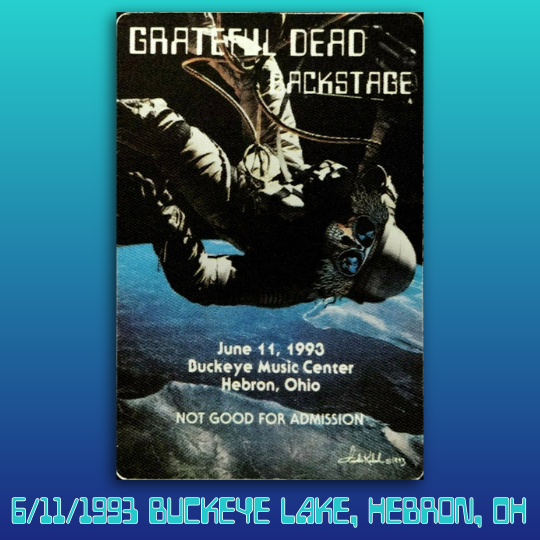
This show had plenty of fire, strong transitions, and well-executed jams. Definitely worth revisiting. Buckeye Lake was one of my hometown venues, along with Richfield Coliseum to the north and I was lucky to see some shows at these great venues. I wish I had seen them all, including this one but I missed this one for some reason I can't recall. The band is dialed in and playing their hearts out for most of it. I like SHNID 157038 which is the Tobin matrix.
The first set kicked off with Jack Straw, which sounded raging—Jerry’s guitar work felt razor-sharp, and Bobby kept the rhythm locked in perfectly. They seamlessly transitioned into Foolish Heart, which had a long, subtly developed jam—it might’ve come earlier in the set than usual, but they played it like a second-set centerpiece, fully leaning in. The Same Thing followed, keeping the fire burning—Bobby sang it with grit, and Jerry’s blistering leads gave it extra punch. Tom Thumb’s Blues, always a pleasure, had Phil’s booming vocals absolutely rolling over the Ohio countryside. So Many Roads brought a delicate warmth, leading into an explosive Promised Land that closed the set with intensity, setting up the second half of the night perfectly.
The second set opened with Eyes of the World, the only version they played that summer—a standalone beauty. It wasn’t as slow as some other ‘90s version, but it was paced just right, giving Jerry room to explore early, shaping the song’s identity before even hitting the first verse. Then came the Playing in the Band > Uncle John’s Band sequence, a classic combo that felt intricate and measured. It wasn’t the most jammed-out version I’ve heard, but they executed it beautifully, carrying momentum through the transitions. The band was fully locked in at this point, right before Drums and Space.
Out of the break came a Wheel > Watchtower pairing, both delivered with strength, before shifting into a relatively rare Black Peter for the era. The infrequent play worked in its favor—this one felt fresh, a moment of raw, emotional storytelling before launching into a powerful Sugar Magnolia. The sheer popularity of Sugar Magnolia seemed to lift the band even higher, everyone pulling for it to peak, and it did. The Black Peter > Sugar Magnolia sequence really tied the set together, bringing everything to a thrilling close. For the encore, they sent everyone home with a smile—Brokedown Palace sealing the night with its perfect, reflective energy.
June 12th
6/12/1976 Music Hall, Boston, MA

Officially released on June 1976, and is a continuation of the high quality Grateful Dead playing from the previous nights. This show carried the signature precision and warmth of the early summer ‘76 performances, blending tight execution with inspired moments throughout.
The first set was impressively long, packed with standout versions from start to finish. Row Jimmy had a delicate sweetness, even with Jerry stumbling over some lyrics. The Music Never Stopped carried a buoyant energy, locking into its groove effortlessly. Mission in the Rain stood out as a rare treat—played only five times, yet it felt right at home in the full-band arrangement. Hearing it here makes me wish they had kept it in rotation longer. Looks Like Rain was another highlight, with Bobby and Donna delivering beautiful harmonies that gave the song extra depth. Bobby’s songs throughout the set had an especially strong presence, feeling polished and fully realized. High Time followed and then Promised Land closed the set.
The second set started with a soaring Wheel, its jam full of blistering piano fills from Keith that gave it an extra spark. Cassidy was missing from my tape, so I jumped straight into the jam that followed. Let It Grow was absolutely on fire, placed perfectly before the Drums segment, giving the set an ideal buildup. The transition into Wharf Rat and Comes a Time was seamless, each song delivering deep emotional weight. Dancin' in the Streets had forceful drumming from the start and led into a hot jam that charged straight into Around & Around, keeping the energy strong. U.S. Blues landed between the two halves of Sugar Magnolia, making for a unique closing sequence that wrapped up the night on a high note.
6/12/1991 Charlotte Stadium, Charlotte, NC

Overall, I thought this was a strong performance with standout moments. The band played with conviction, and while there were a few minor stumbles, they never disrupted the flow. The first set kicked off with a punchy Stranger that immediately set an improvisational tone for the evening. The rhythm subtly shifted into a more swinging feel, a nuanced twist that might go unnoticed but added a unique touch. The chaotic jam at the end stretched things out nicely, setting the stage for deeper exploration. While Peggy-O and C. C. Rider were well played, the real highlights came in the next three songs.
Althea was crisp and precise, every phrase landing exactly where it needed to. The two pianos were evident right away, but Billy and Phil’s locked-in groove gave the song an undeniable momentum. Jerry’s guitar work was sharp and almost aggressive, adding bite to his phrasing. His vocal delivery carried extra weight, stressing each word with intense emphasis. Desolation Row felt dense, Bobby’s rhythm work and Phil’s dry bass notes pushing the song forward with urgency. The way Bobby and Phil led the band gave the whole piece a driving energy, with Bruce’s accordion washing over the top, transforming it into a European-flavored anthem. Loose Lucy was pure fun—a snarling, rollicking time driven by piano and drums. The rest of the set was solid, but nothing reached those peaks.
The second set started off fine, but the momentum really kicked in with Woman Smarter. Bobby pushed the energy with his rhythmic jousting, his guitar out front, constantly churning and propelling the band forward. Bruce and Vince jumped into the fray, weaving piano lines between each other, filling out the sound beautifully. Jerry stepped back, letting the groove develop while tossing in occasional accents. The set pivoted into Drums, but Jerry had other plans, calling for Not Fade Away, which kept the energy alive. Post-Drums, Space was both delicate and surreal. Mickey worked the Beam with precision, sculpting sonic whispers that felt like gentle currents in the air. When the rest of the band returned, a loosely structured, avant-garde chamber music piece took shape—pipe organ, bassoon-like MIDI tones, and Jerry’s eerie string sounds created an atmospheric dreamscape.
They leaned into the MIDI effects in a way that no other band could, crafting something entirely their own. Jerry eased into Goin' Down the Road Feeling Bad with delicate fingerpicking, though Bobby seemed convinced they were heading into Mexicali Blues, making for an amusing moment. The final stretch ramped up dramatically, keeping the momentum rolling into All Along the Watchtower, which took the rock intensity up another notch. Bobby’s rabid vocal delivery added fire, and Jerry’s soloing felt more Hendrix than Dylan, fast and razor-sharp. Then came the crown jewel: Morning Dew. This version was nothing short of stunning. Jerry’s vocals were devastating, Phil’s bass added gravity, and the pianos wove a soft, intricate texture into the backdrop. Jerry’s guitar phrasing carried such an emotional weight—it was like he was wringing every last drop of feeling out of each note.
The repeated "I guess it doesn’t matter anyway" was utterly heartbreaking, pushing this rendition into rare air. This was a Jam Anthem version without question, among the best performances of Morning Dew from their final years. If you treasure this era of the Dead, this one is essential. For the encore, Brokedown Palace carried just as much emotional heft. Bruce’s accordion provided a delicate lift, adding to the song’s already nostalgic feel. It was a proper, heartfelt goodbye to an unforgettable night.
June 13th
6/13/1980 Seattle Center Coliseum, Seattle, WA

This Seattle show from 1980 is an absolute gem. This performance really embodies that year’s characteristic style—tight playing, high energy, and not a lot of extended jamming, but absolutely no shortage of fire.
The first set launches with a fiery Minglewood that drives hard with a funky swagger. Right away, the band sounds locked in. Sugaree follows, and Jerry’s vocals here are exceptional, carrying just the right balance of grit and emotion. Even if the rest of the set doesn’t stand out on paper, it keeps the energy high, making for an engaging listen.
The second set is where things truly peak. The pre-Drums section delivers a sequence that’s unusual for 1980. About fifteen minutes in, we get a China Cat > I Know You Rider, a placement that's rare for this era. This early Brent-era version is scorching, and it’s preceded by a standout Let It Grow, which feels dynamic and tightly woven. The transition into Terrapin Station is seamless, and the jam within Terrapin is a clear highlight. This whole segment carries the kind of momentum that makes mid-set jamming truly special. Post-Drums, the momentum doesn’t let up—The Other One emerges suddenly from Space, short but packed with intensity. Wharf Rat provides a reflective, moving contrast before Sugar Magnolia injects pure joy into the close of the set. The encore keeps the energy rolling with Alabama Getaway, a staple of the era that fits right into the high-energy 1980 vibe.
6/13/1987 County Fairgrounds, Ventura, CA

This Ventura show on 6/13/1987 was rock-solid, with strong performances across the board and a few truly standout moments. The first set kicked off with a smooth Half Step > Walkin' Blues opener that blended precision with a laid-back groove. Bobby’s debut of When I Paint My Masterpiece sent a jolt through the crowd, bringing a fresh energy that was palpable. Friend Of The Devil was beautifully played, and Let It Grow delivered the kind of fire that made it a perfect set closer. The rare Friend of the Devil > Let It Grow sequence was a surprise—an inspired pairing that gave the set an extra spark.
The second set wasted no time, launching right into a deep, funky Shakedown that stretched out beautifully. Estimated flowed effortlessly into Eyes, and the transitions here were particularly seamless. This Estimated > Eyes segment was a high point, brimming with momentum and rich interplay. The Other One arrived like a sudden storm, pulling the energy into darker territory before leading into an absolutely stunning Morning Dew. This was one of those deeply emotional, soul-crushing performances that felt like Jerry was laying it all on the line. A true gem, this version carried an intensity that set it apart. The show wrapped up with a powerful finish, leaving a lasting impression.
June 14th
6/14/1980 Coliseum, Spokane, WA

This is an excellent high energy show! Every song is well played and this is a show that truly embodied the refined musical approach of this era. The first set felt remarkably fresh, with even familiar tunes carrying a renewed sense of energy. Brown-Eyed Women stood out as the clear highlight, with Jerry delivering a vivid, captivating narrative while the band played with a lively, optimistic touch. The song seemed to lift off entirely under its own power, as if the band was completely locked into its essence. Another standout moment was a fiery Don't Ease, driven by Brent’s exceptional keyboard work. This version seemed to emerge organically from the audience clapping in perfect tempo, making for a great moment of shared energy between the band and the crowd.
The second set wasted no time diving into deep grooves, opening with a funky Stranger that was dripping in atmosphere thanks to Brent’s eerie synth textures. Ship of Fools offered a heartfelt interlude, with Jerry’s vocals soothing the crowd in an almost lullaby-like fashion. Estimated took a moment to settle into its groove, but once it did, the rhythmic pulse felt effortless. Eyes of the World came blazing out of the gate—fast, almost chaotic in its exuberance. Jerry’s soloing here was relentless, pouring out notes at a dizzying pace. After that whirlwind, the drummers took center stage, navigating intricate rhythms before the band eased back into melody with a gentle Lost Sailor. Bobby’s hushed vocals gave it an airy, drifting quality before Saint of Circumstance surged forward with electric energy. Stella arrived in its usual slow, beautiful form, creating a moment of quiet reflection before the show wrapped up with a lively Good Lovin' and a celebratory Saturday Night. Every song felt tight, and the energy was undeniable—this is one of those high-powered 1980 performances that’s absolutely worth a listen.
6/14/1984 Red Rocks Amphitheatre, Morrison, CO

Red Rocks is one of the most beautiful places to see a band, and the Dead rarely disappointed here. This was the final of 3 shows at the Amphitheatre and is the best of the bunch in my opinion.
The first set got off to an incredible start with what might be the best version of Iko Iko I’ve ever heard, live or on tape. It had an extra groove, something just a little more locked-in than usual. Brent started it off gently with light keyboard accents, then Phil jumped in, giving the whole thing a honky-tonk bar band feel. They stretched it out wonderfully, making it feel like it could go on forever, and the entire crowd was fully engaged, dancing wildly. After such a stellar opener, Cassidy felt like a slight dip in energy—not bad, just not quite at the same intensity. Roses carried a mournful beauty, with Jerry’s delicate vocals and a truly exquisite solo, though I felt the rhythm section didn’t quite dig in as much as they could have.
Minglewood brought the fire back, with Jerry leading the charge and Brent’s organ shaking things up. His solo was fantastic, with Phil rumbling underneath. It was a longer-than-usual version, giving Bobby plenty of room to work his guitar magic. Brown-Eyed Women started off cautiously but picked up steam, especially when the slide guitar kicked in. Jack Straw had a strange, hesitant intro, almost stuttering before launching into a furious pace. Jerry’s guitar work was dazzling, moving effortlessly across rapid, intricate phrases. Day Job rounded out the set with a rowdy finish—Bobby seemed particularly into it, maybe even more than Jerry. The energy was high as the crowd took a breather before the second set.
The second set wasted no time, opening with an explosive Shakedown Street. The groove was deep, Jerry’s vocals felt a little buried in the mix, but the chorus popped beautifully, with Brent, Bobby, and Jerry interweaving their harmonies. Phil’s bass dominated throughout, holding the song down with weight and power. Jerry’s solo was a flurry of notes, sharp and relentless, before a jagged transition into Playing in the Band. Though it started rough, they quickly found their flow, Bobby pushing hard on vocals while the jam unraveled into quieter, more spacious territory. Brent’s organ paired beautifully with Jerry’s guitar as they explored the theme. Just when it seemed like they were heading for Drums, Brent had different plans, shifting into Dear Mr. Fantasy and dragging Jerry right along with him. The intensity built throughout—the interplay between Jerry and Phil was gripping, and when they returned to the final verses, it felt just as strong as the opening.
The song faded gradually into Drums, where the drummers flirted with a Not Fade Away rhythm before launching into a chaotic and extended percussion segment. Space was mesmerizing, with Jerry repeating a climbing riff through layers of fuzz and distortion. After what felt like a longer-than-usual sequence, he subtly threaded in Playing licks while Bobby floated different chord ideas. The drummers reentered, pushing the jam back into a fiery Playing in the Band reprise. It was brief but intense, with a slight miscue midway through, but they powered through and gently slipped into Black Peter. Jerry’s guitar felt like it was speaking directly to the crowd, with Brent adding soft organ swells underneath. The transition into Throwing Stones was a bit ragged, but the energy was there—Jerry seemed to push the pace, driving a brisk version of the song. The jam midway through had hints of Lovelight, adding a fun surprise. Bobby’s final verse was refreshingly free of the usual echo effects, which I personally never cared for. As soon as the last refrain hit, they moved effortlessly into Not Fade Away, delivering a fiery take before handing the ending off to the audience to clap and chant. For the encore, Bobby stepped up to the mic and made a brief comment about the Stars and Stripes being adopted on this day in 1877 before the band ripped into U.S. Blues. This version had way more punch than the one two nights earlier. The whole band was locked in, Jerry’s emphatic "Run your life!" hitting harder than usual. His solo was bright and animated, even with a slight misstep in timing.
6/14/1985 Greek Theatre, Berkeley, CA

1985 is one of my favorite years for the band. They just have a different sound. Maybe it's the recordings, but they just sound dialed in most of the time. This show is no exception. The band was celebrating their 20-year anniversary with these shows, and there was a lot of excitement in the air along with some renewed "fanfare" around these Berkeley shows.
The first set had a palpable energy, with the Greek Theatre buzzing in celebration of the band's twentieth anniversary. Mickey set the tone with a bizarre, perfectly weird mix of sampled voices as the band walked out, a fittingly strange start. The opener, Dancin' in the Streets, was a nod to their primal era, a welcome surprise even if it didn’t quite catch fire. After that, West L.A. Fadeaway, C.C. Rider, and Peggy-O settled things into a more typical rhythm—solid but not remarkable. Hell in a Bucket took a sudden turn when a chunk of the PA died, forcing the band offstage for nearly twenty minutes while the issue was fixed. When they returned, they pulled out a surprise: Keep On Growing, sung by Phil and Brent. The crowd took a moment to realize what was happening, and while the debut was rough, it was still a fun treat. Jerry wasted no time launching into a rare Stagger Lee, one of the definite highlights of the set. The peak, though, was the powerhouse Let It Grow > Deal medley that closed things out—rich, driving, and full of momentum.
The second set began with something I never expected: Morning Dew as an opener. The atmosphere shifted immediately—it was thick, heavy, almost sacred. The jam started strong, full of tension, but Jerry cut it off suddenly, rushing through the final lyrics and landing off-key in a way that left me puzzled. Playing in the Band followed but didn’t do much to elevate the mood, though China Doll was delicately beautiful. Drums felt sparse, with just Mickey and Billy holding down the pulse, and Space only found direction toward the end—Mickey hammering the Beam with deep reverb that transformed into a wall of sonic dread. Surprisingly, this segment came barely forty-five minutes into the set. Truckin' > Smokestack lacked excitement, but Comes a Time was a rare gift. Even if it wasn’t the most emotionally gripping version, Jerry offering it at all was enough. Finally, the band shook off some of the sluggishness for an excellent Sugar Magnolia closer, full of life and energy. The encore, Day Job, felt obligatory. By that point, the band was mostly on autopilot, and Jerry’s health concerns loomed over the performance in a way that was hard to ignore. Still, despite a few rough patches, the special song choices kept things engaging enough to send us home mostly content.
June 15th
6/15/1976 Beacon Theatre, New York, NY

Officially released on June 1976, this is a very nice performance with a neat setlist to match. It was an exceptionally tight and polished performance, fully representative of the refined sound of this era.
The first set featured a well-curated mix of songs, many of which felt fresh despite their familiarity. Sugaree was clean and precise, though it never quite took off into deep exploration. That said, just about every other tune in this set had a richness to it, like a fully matured vintage. Looks Like Rain stood out, with Donna’s delicate vocals intertwining beautifully with Bobby’s plaintive delivery while Jerry’s lead guitar wove a shimmering backdrop. But the real peak of the set—and maybe the whole night for me—was the stunning sequence of Let It Grow > Drums > Let It Grow reprise > Might As Well. While Billy and Mickey’s duet during Drums didn’t sustain the energy, the surrounding moments more than made up for it. Let It Grow was dynamic and expansive, and the transition into Might As Well felt celebratory, sending the set out on a high note.
The second set kicked off with St. Stephen, played with controlled intensity. The flow was effortless, trippy without getting lost, leading straight into a long, jam-heavy Not Fade Away. I still remember the rush of excitement when the opening chords hit—one of those lottery-winner moments of sheer joy. This version worked itself down into a bluesy shuffle before dissolving into near silence, only to rise back up for a final run through the lyrics before fading into nothingness again. Billy and Mickey offered only a brief drum passage before Jerry moved into what might be the slowest, most drawn-out Stella Blue I’ve ever heard. From that point on, the band felt like a perfectly tuned engine just gliding along. The closing run—Dancin’ > Wheel > Sugar Magnolia > Scarlet Begonias > Sunshine Daydream—was a phenomenal way to wrap things up. Dancin’ in the Street > The Wheel had a particularly sweet flow, effortlessly weaving between grooves. The final medley of Sugar Magnolia, Scarlet Begonias > Sunshine Daydream was nothing short of delightful. A sharp Johnny B. Goode closed things on an energetic note, sending the crowd off fully satisfied.
6/15/1990 Shoreline Amphitheatre, Mountain View, CA

This show is a shining example of the musical skill and excellence that the band could achieve, and the song selection is "bucket list" level for me anyways, minus an obvious "Dark Star" or a few other songs. Overall, this show stands as a shining example of the band's musical depth and excellence, easily among the strongest of 1990.
The first set opened with a brief, spirited tuning before launching into a commanding Help on the Way. The band felt exceptionally tight, and the details in the playing stood out more than in many other versions. The Help on the Way > Slipknot! > Franklin's Tower combination was a major highlight, not just as a relatively rare pairing in 1990 and 1989 but also as a showcase of how effortlessly they could merge technical precision with creative spontaneity. It had that 1977-style polish, with Phil, Brent, Jerry, and Bobby all locking into an intricate, interwoven groove—especially during Slipknot!. Phil was particularly strong here, effortlessly shifting between lead and rhythm bass duties, providing both a foundation and an assertive counterbalance to the soloists. That momentum carried straight into Minglewood, where Brent stole the spotlight, his playing raw and fiery. He stayed front and center for Just a Little Light, which felt meticulously backed by the band, especially Jerry. Desolation Row was another strong, well-balanced ensemble moment, and Ramble On Rose featured some particularly fluid piano runs from Brent—one of the areas where his playing had clearly evolved over time. They closed out the first set with a sleek, driving Hell in a Bucket, a fitting end to a set that showcased the band's unpredictable edge in the best way possible.
The second set kicked off with an electrified Scarlet Begonias that felt more aggressive than expected. Instead of the graceful glide I anticipated, the band tore into it, initially stumbling over their own excitement before settling into a deeper groove. By the time they reached the final verse, it felt like they were already in the transition jam—then they actually were, each member leading the charge at different moments. Fire on the Mountain took its time heating up, easing into the vocals after an extended instrumental buildup. The interplay was sharp, especially between Phil and Bobby, whose driving rhythms gave the song weight. As they slid into the first jam, each player took brief turns steering the music, with Jerry and Brent coming back to work off each other in the second. Brent practically dragged Jerry into more aggressive playing, hounding him with relentless piano runs until Jerry fully leaned in again. That tenacity was what made Brent such a force—his persistent, almost stubborn determination to push Jerry forward.
By the time Fire reached its conclusion, Jerry felt like he was fully soaring. There was an aborted transition—probably into Victim—before they pivoted to Blow Away. This song had the potential to be one of Brent’s most emotionally devastating showcases, though this version didn’t quite reach the heights of 10/12/89. Brent leaned heavily into the rawness, his lyrics and mid-song rap hitting a deeply personal place rather than feeling theatrical. It was clear that he wasn’t just performing—he was living what he sang.
Woman Smarter stretched out beautifully, the first jam flowing with relaxed ease, while the second was a Cajun-infused groove that felt almost absurdly long, as if the Neville Brothers had snuck onstage. At nearly thirteen minutes, this version was completely out of the ordinary. He's Gone was flawlessly executed, Phil anchoring the song with his warm, grounding presence. As it wound down, a brief tumbling jam took shape, fading in and out until Jerry pulled it back into motion. Instead of stepping off, Jerry lingered through the first five minutes of Drums, tossing in angular guitar phrases and MIDI trumpet effects while Billy and Mickey built their rhythms around him. Left on their own, the drummers created a richly layered percussive canvas, seamlessly transitioning into Space.
Brent was conspicuously absent here, a growing habit of his, likely indulging backstage. As The Other One began to take form, Phil’s presence became overwhelmingly dominant, his deep bass tones practically sculpting the jam. But before it could fully develop, Jerry abruptly shifted gears into a smooth Wharf Rat, moving the energy into reflective territory. Around and Around played with expectations, teasing a false ending before roaring back for a final push. Then came Knockin' On Heaven’s Door, a show-closing rendition so powerful, it ranks among the finest I’ve ever heard.
6/15/1993 Freedom Hall, Louisville, KY

A very good show with above average playing and song selection. The first set opened with a monstrous Feel Like a Stranger, immediately pulling me into its swirling, free-flowing jams. Bobby’s vocal echoes were warped into disorienting dub-style cut-ups that gave the song an extra layer of strangeness. Jerry kept the momentum rolling with a surprisingly nimble Althea. This version moved quicker than usual, missing some of its typical loping charm but retaining all its dramatic weight. The set’s strong start made me expect a grand conclusion, but it never fully materialized. Desolation Row, however, was a standout—Bobby sang with noticeably more passion, while Jerry experimented with bizarre split-tone effects, twisting the song into something refreshingly unfamiliar.
The second set brought another standout early on—Crazy Fingers emerged seamlessly from Victim or the Crime, a transition that was unexpectedly graceful despite the jagged energy of Victim. Mickey’s explosive accents made it feel especially unpredictable, though the descent into Crazy Fingers was sublime, like the band slipping into a dream. The sequence of Estimated Prophet > Spoonful > He's Gone was a major highlight, filled with stellar moments. Bobby commanded Estimated with a confident delivery, and Jerry followed with an equally assured solo. The improvisation extended beautifully, Jerry coaxing breathy MIDI flute lines into the jam, though I hated seeing it cut short for Spoonful. That said, this was one of the rare occasions when Spoonful had real bite—it avoided its usual sluggishness, transformed by dynamic interplay and an undercurrent of tension.
He's Gone delivered smooth vocals and a winding outro, setting the stage for yet another of ‘93’s sprawling Drums > Space explorations. This one completely enveloped me—the shifting stereo panning sent sound jolting across the mix, while cryptic fragments of conversation surfaced, only to vanish back into the void. When structure returned, it led to a lively The Last Time, which was fun, though unsurprising. The real climax arrived with Morning Dew, a deeply emotional take, Jerry’s voice carrying an aching sincerity. His guitar swelled into a classic crescendo, cementing this version as truly special. After that catharsis, the encore Gloria was pure celebration—one final, raucous send-off to wrap the night. The whole thing felt like a joyous finale, the perfect way to head out into the night with a smile.
BTW, If you're not yet familiar with Jam Anthem versions of songs you can read all about it in Deadology II by Howard Weiner. Check it out here along with all his other great books.
And that's all for now! Of course, if you want to follow along in your very own copy of my book On This Day In Grateful Dead History: A Daily Listening Journal I still have some copies available here. Once they're sold out, I won't be getting any more made. The costs of printing and shipping has almost doubled in the last few years since I had them printed, and I've decided it's just not worth it. So get one now while you can! https://www.gratefuldeadbook.com/tigdh


Comments