June Grateful Dead Show Listening Guides Part 2


Welcome to this month's Grateful Dead Show Listening Guides!
This is part 2 (of 3) of the June Listening Guides.
We're covering June 16th - June 26th in this post.
June 1st - June 15th can be found here.
June 27th - June 30th can be found here.
If you like these reviews and you want to support me, please consider buying a copy of my book On This Day In Grateful Dead History: A Daily Listening Journal. They're $50 and I offer free shipping if you subscribe to my mailing list, where you'll get these writeups delivered. No spam, I promise!
Over time, as I've written these listening guides, I marked up my copy of the book like this:

The underlined songs are the ones I'm calling out as highlights (songs names that are bolded) in the listening guide, and the songs highlighted in yellow are the ones that Howard Weiner has identified as Jam Anthem renditions. I also write notes in the space provided if I'm feeling inspired or if there are any updates such as newly released material. Ultimately you can use it however you want, but this was my original intent with the book.
By the way, if you're new here, this is my month-by-month archive of my listening guides that gives you the most interesting and significant facts from Grateful Dead History, along with reviews of the music. If you'd like to stay up to date on new reviews and other information, you can subscribe here:
June
For the month of June, the band's history is incredibly dense, featuring heavy touring schedules and pivotal moments that span their entire career. In my opinion, this month really showcases the Dead's evolution, from the primal psychedelic era of 1969 to the polished, massive stadium shows of the 1990s.
One of the most significant threads running through these reviews is the "comeback" tour of June 1976. After a touring hiatus that lasted nearly a year and a half, the band returned with renewed energy and a reworked repertoire, playing multiple nights at venues like the Paramount Theatre in Portland, the Music Hall in Boston, and the Capitol Theatre in Passaic. I found the reviews of these shows to highlight a band that was finding its footing again, balancing tight, rehearsed arrangements with the exploratory jamming they were known for. The June 1976 run also featured the only time the band performed "Happiness Is Drumming," which eventually evolved into "Fire on the Mountain".
Another major highlight is the June 1974 Wall of Sound era. The reviews describe these shows as massive and crystal clear, with the band delivering marathon performances. The experimentation during this period was intense, with unique jams like the "Mind Left Body Jam" and the debut of Phil Lesh and Ned Lagin's electronic "Seastones" segment.
The show reviews also points to some deeply emotional and historic milestones. We see the end of an era with Pigpen's final show on June 17, 1972, at the Hollywood Bowl, where he unfortunately didn't sing any of his signature songs. On the other end of the spectrum, we have a nod to the very beginning with Phil Lesh's first show on June 18, 1965, when the band was still The Warlocks. There are also poignant moments from the later years, such as the 1991 shows featuring Bruce Hornsby and Vince Welnick, which I think offered some of the most complex instrumentation of that era, including a rare "Eyes of the World" opener.
I also noticed a recurring theme of special guests and unique collaborations in June. Janis Joplin joined the band on stage in 1969 to sing with Pigpen, and the Gyuto Tibetan Monks made a fascinating, one-time appearance during a "Drums" segment in 1995. The month also saw the band playing in unique locations, like a high school auditorium in Anchorage, Alaska, in 1980, and the massive 20th-anniversary shows at the Greek Theatre in 1985. Whether it was the acoustic sets of 1970 or the MIDI-infused jams of the 90s, June seems to be a month where the Dead were constantly pushing their boundaries.
Significant historical events in Grateful Dead History for June
RIP Vince Welnick (6/2/2006)
Start of the June 1976 "comeback" tour (6/3/1976)
Janis Joplin joined the band on stage (6/7/1969)
Pigpen's last show (6/17/1972)
Phil Lesh's first show (6/18/1965)
Robert Hunter's birthday (6/23/1941)
First Performances
Might as Well (6/3/1976), Lazy Lightning > Supplication (6/3/1976), Samson & Delilah (6/3/1976), Wheel (6/3/1976), Mission in the Rain (6/4/1976), Swing Low Sweet Chariot (6/4/1970), Sugar Magnolia (6/7/1970), Masterpiece (6/13/1987), Keep On Growing (6/14/1985), It Takes A Lot To Laugh It Takes A Train To Cry (6/10/1973), That's Alright Mama (6/10/1973), Stella Blue (6/17/1972), Crazy Fingers (6/17/1975), Help On The Way (6/17/1975), Slipknot! (6/17/1975), Franklin's Tower (6/17/1975), Victim Or The Crime (6/20/1988), Foolish Heart (6/19/1988), Watchtower (6/20/1987), Blow Away (6/20/1988), I Will Take You Home (6/19/1989), Seastones (6/23/1974), Big RxR Blues (6/24/1970), Why Don’t We Do It In The Road (6/27/1984), Gentlemen Start Your Engines (6/26/1988)
Final Performances
It’s A Sin (6/4/1970), Wave That Flag (6/10/1973), To Lay Me Down (6/28/1992), Mission in the Rain (6/29/1976)
Only Performances
Gyuto Tibetan Monks chanted during Drums (6/2/1995), Franklin’s Tower as an encore (6/9/1976), Happiness Is Drumming (6/28/1976), Eyes of the World opener (6/17/1991)
June Grateful Dead Show Listening Guide Index
Index of all 59 shows reviewed for June 16th - June 26th. Click the link to jump to the listening guide, or just scroll down.
June 16th
6/16/1974 Des Moines State Fair Grandstand, Des Moines, IA

A portion of this show was officially released on Road Trips Volume 2 Number 3 Bonus Disc. This three-set Wall of Sound monster show is full of amazing moments. If you're a Phil fan, you'll love this show because he's front and center in most of the mixes that circulate. I can't imagine how it must have felt seeing the band do these incredible 3 set Wall of Sound shows... Legendary!
The first set bursts to life with Phil right up front, driving the sound with inventiveness and depth. His presence elevates Beat It on Down the Line, Black-Throated Wind, El Paso, and It Must Have Been the Roses, adding a rich texture throughout. Bertha and BIODTL stand out with sharp, lively execution, while Scarlet Begonias delivers a beautifully jammed performance, Jerry steering the momentum. Hearing China Cat > I Know You Rider as a Jam Anthem version is an absolute treat, giving the transition a gripping sense of movement.
The second set is nothing short of monumental, anchored by a sprawling nineteen-minute Eyes of the World and an awe-inducing twenty-eight-minute Playing in the Band. Eyes breathes with elegance, Phil pushing the jam into stunning passages while Jerry toys with the Stronger Than Dirt theme, weaving it into the improvisation. The way they slide into Big River is totally unique, taking an unexpected turn that keeps things fresh. Playing in the Band is a classic 1974 epic, an essential listen. The Tiger jam at its core plunges headfirst into deep space, spiraling further into abstraction. Jerry and Phil weave together shifting themes, balancing tension and release as they inch back toward the Playing reprise. The whole sequence feels like a journey through the cosmos.
The third set keeps nothing in reserve, hitting hard from start to finish. Truckin' is a force of nature, rolling through a Nobody's Fault jam before teetering on the edge of a Caution jam. Just when it seems poised to explode, Phil redirects the energy, slowing it into passages that foreshadow material later found on Blues for Allah. The jam slides into a striking Mind Left Body Jam, seamlessly shifting moods. The final stretch brings Wharf Rat, deeply emotive, followed by a rousing Goin' Down the Road, sending the show off in proper fashion.
6/16/1985 Greek Theatre, Berkeley, CA

This was the 3rd of a 3-show run at the Greek Theatre, and this was by far the best of the three shows. The band finally gave the crowd what they'd been waiting for: something special to commemorate the band's 20 year anniversary.
The first set didn’t blow me away overall, but there were definitely moments that stood out. I loved the opening pairing of Midnight Hour > Bertha—a perfect nod to Pigpen and the band’s early days. While Midnight Hour stayed fairly controlled and never really caught fire, Bertha soared, carried by a bright and lively groove. After that, they proceeded to pull out Walkin’ Blues for the first time since 5/28/1982 (196 shows). Some good but average renditions of Tennessee Jed, Brother Esay, Big Railroad Blues, and Looks Like Rain followed. They seemed to be in a bit of a hurry with these songs. After that, Half Step emerged and the energy shifted. This song to me was another highlight, shimmering with warmth. They quickly transitioned into a short but punchy Promised Land to close the set.
The second set was where the real magic unfolded. The energy was thick in the air, and the band wasted no time diving in, kicking things off with Scarlet Begonias > Fire on the Mountain. This was a perfect call—the jam was sprawling, lush, and matched the eighty-degree, bright-but-overcast sky in a way that felt almost surreal. Fire on the Mountain had an extra psychedelic flair thanks to Healy’s reverb-heavy effects on Bobby’s vocals, adding that trippy 1980s Dead texture. Samson and Delilah upped the heat even more, with Jerry ripping through his leads effortlessly. And then came the moment nobody saw coming—Cryptical Envelopment. The eruption in the crowd said it all. The first time played since September 23, 1972—801 shows ago—a genuine shock. People embraced, some in tears, fully understanding the weight of the moment. Jerry’s voice was tentative, and the band felt slightly unsettled as they moved through Cryptical, but that hesitation quickly faded as they launched into The Other One. This was a Jam Anthem version—full force, razor sharp, pure psychedelic chaos. The air felt thick, alive, electric.
After Bobby’s verses, the Cryptical Envelopment reprise landed beautifully, building to a triumphant peak. For the late-era Dead, it really didn’t get heavier than this. The set shifted as Mickey and Billy took over. Mickey worked his balaphones while Billy hammered massive bass drums, building layers of hypnotic rhythm. The atmosphere grew stranger—Jerry returned with his envelope filter, Bobby scraped his pick against the strings, and Mickey added eerie wind chimes and bird calls. Brent played sparingly, while Jerry laid down a ghostly lullaby, floating through the thick ambience. Out of nowhere, a sampled voice cried, "Bobby… Bobby," followed by a screeching wave of feedback. Then, Jerry began picking at Goin’ Down the Road Feelin’ Bad, easing everyone out of the swirling weirdness. Just as things started moving, a prerecorded Phil suddenly blurted, "You know what I means," sending a ripple of confused laughter through the crowd.
The energy in Goin’ Down the Road skyrocketed, with Jerry igniting the jam and the crowd fully unleashed. As the song wound down, the band hovered in a moment of loose strumming, waiting on Bobby to call the next tune. Then, another pre-recorded voice, Mickey’s deep laugh—"HA, HA, HA!"—rang through the speakers. With that, Bobby ripped into Miracle, Phil dropping heavy bombs while Jerry’s guitar screamed. The set pressed on with Wharf Rat, where Jerry’s rough, worn voice actually felt perfectly placed—his delivery raw and real. The heaviness surged again. Just as the final jam was reaching its peak, another surprise—Phil’s voice cutting through with a sarcastic, "HEY, HEALY!" catching even some of the band off guard. Lovelight followed, with Jerry firing off frantic solos behind Bobby’s wild vocal antics. Bobby pulled the band down, tried to launch into a rap that didn’t quite land, then built things back up for one final push before closing the set. Walking away, it was hard to tell if we had just witnessed something profoundly heavy or simply one of the strangest Dead shows ever. Fitting for a Sunday, Jerry closed the night with Brokedown Palace, a gentle gospel hymn to send us all home in quiet reverence.
6/16/1990 Shoreline Amphitheatre, Mountain View, CA
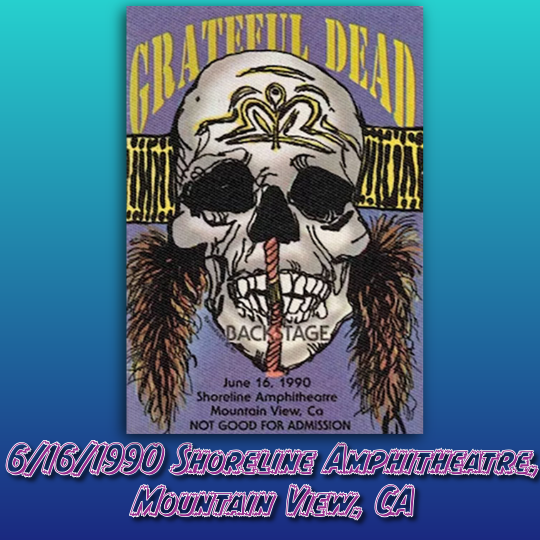
Officially released on View from the Vault, Volume 3. This show was packed with surprises and standout moments, easily one of the more unique performances of its era. The first set carried a sense of unpredictability from the start. Let The Good Times Roll set the tone with lighthearted energy, but things got serious fast when Truckin' emerged—a rare placement for the song in the first set. The crowd responded instantly, roaring with excitement as the groove unfolded. This version had a distinctly West Coast feel—mellow, relaxed, and deeply familiar, like something comforting from home. Instead of its usual rowdy ending, the jam drifted smoothly before Jerry pulled everyone back for a laid-back but firm reprise.
Touch of Grey kept the momentum rolling, solid and confident, before Big River turned up the intensity. Bobby was on fire, his rhythmic playing fueling a rapid, galloping pace. Friend of the Devil took a more introspective turn, stretched out and full of intricate phrasing. Then came a gorgeous Cassidy, where Jerry steered the jam into unexpected spacey territory, a long and eerily hypnotic passage. Boss Man was an interesting shift—Jerry’s semi-sneering vocal delivery felt rare, adding an extra bite to the performance. The biggest surprise came at the end—Saturday Night as a relatively rare first-set closer. It was a kind of throwback to late-1971 when there was a string of concerts from October, 1971 through December 31, 1971 that the band played Saturday Night to close the first set. They would randomly select Saturday Night as a first set closer 10 more times after this show, up until 7/14/1990. In any case, the placement certainly feels fresh here, and the band played it with extra punch, Brent delivering a particularly fiery organ solo.
The second set wasted no time getting into deep waters. Phil came out swinging with bold runs to spark China Cat, and the jam started at a brisk pace, gradually building. Then, Jerry flicked on the MIDI flute, and suddenly, the music soared into a long, spacey passage, stretching beyond typical territory. As it evolved, Phil locked in with Jerry, throwing out sharp counterpoints and eventually pushing the whole groove forward with striking force. I Know You Rider arrived smooth and strong—not a wild version, but played with undeniable precision and energy. We Can Run felt a bit shaky, needing some polish, though its chorus remained catchy. Estimated Prophet was an absolute standout—Phil’s basslines twisted and turned, sneaky and playful, like an elaborate obstacle course built for dancing. Bobby leaned deep into his vocals, pushing the song into a richer emotional space. The jam was molten, full of Phil’s signature phrasing that felt both unpredictable and hypnotic. Bobby’s vocal improv at the end—high-pitched yelps and wild squeals—was strange in the best way.
The transition jam started heading into an odd, intriguing place, and I was hoping the band would follow it further. Instead, Terrapin took over. It was an earnest, well-played version, though Jerry’s vocals strained a bit, dulling some of the power. Mickey and Phil took control, injecting new life into the closing jam, sending it into a fierce, locked-in drive. Jerry’s MIDI textures pushed things in a fresh direction, and then came the real surprise—one of the longest post-1975 jams the band has ever played. Primitive is the best word for it. The whole thing was driven by toms and bass drum, Phil locking into a deep, groove-oriented space, shifting patterns just slightly enough to create constant movement. Bobby repeatedly sparked fresh transitions, keeping the music in motion. The drummers wove in and out, the MIDI swirling into stranger realms. These jams felt distinct—similar to post-Terrapin excursions but carrying their own unique flavor.
Eventually, the drummers fully exited, and Space took hold. The band returned and, almost imperceptibly, melted into China Doll. Jerry rushed the first line, humorously misplacing it, but quickly found his footing and turned in an expressive, heartfelt lead. Sugar Magnolia took a moment to heat up, but once it did, the crowd was fully locked in, with Phil dropping massive bass bombs and Jerry tearing into classic rock ‘n’ roll leads. The set wrapped up with tight energy—one of the longest, most fascinating second sets I can remember. To close things out, Baby Blue was simply gorgeous, the final touch to an already exceptional night.
June 17th
Pigpen's last show (6/17/1972)
6/17/1972 Hollywood Bowl, Hollywood, CA

This would be Pigpen's last show. He doesn't have much presence and doesn't sing any of his signature songs. There aren't any soundboard tapes of this one that circulate, but fortunately there's a decent audience tape (SHNID 116272) that is a Charlie Miller remaster.
The first set was long and fast-moving, packing in thirteen songs with plenty of standout moments. One of the clear highlights for me was the crisp, energetic China Cat Sunflower > I Know You Rider sequence, played with effortless momentum. Playing in the Band also stood out, feeling especially strong and exploratory. But perhaps the most memorable moment was the debut of Stella Blue, a genuinely beautiful rendition that captured something singular—maybe because it was Pigpen's last show. Jerry's crooning was rich and emotive, while Phil’s percussive bass provided a solid foundation for Pigpen’s eerie organ flourishes. There’s a haunting quality to this version that I don’t think they ever quite recreated, making it one of my absolute favorites.
The second set had its share of highlights as well. Pigpen stepped up for his only vocal performance of the night with Rockin’ Pneumonia, a bittersweet moment considering the circumstances. The sequence of Truckin’ > Other One > Ramble On Rose was a major standout for me, delivering intensity and fluid transitions. And closing it all out, Sugar Magnolia was pure fun—high-energy and bursting with that carefree celebratory spirit, a fitting way to end the night.
6/17/1975 Winterland Arena, San Francisco, CA
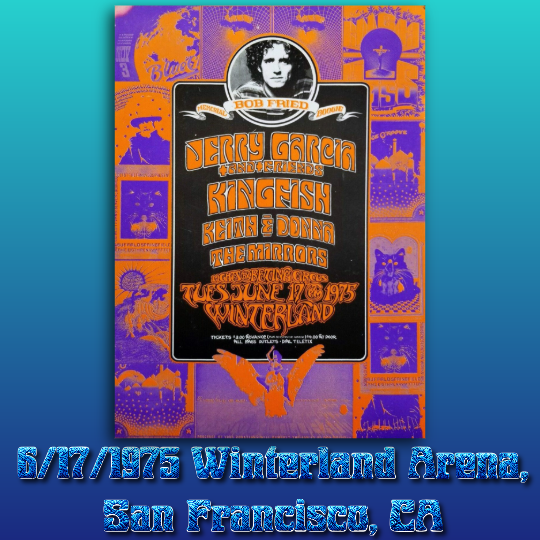
This was a benefit concert called the Bob Fried Memorial Boogie, and was organized to help the family of Bob Fried, a renowned concert poster artist who had died earlier that year. "Jerry Garcia and Friends" were billed, so many people (correctly) guessed that this would be most or all of the members of the Grateful Dead. The band had been in the studio working on a lot of new songs for Blues for Allah. This show was a landmark moment, brimming with electricity and significance—an undeniable highlight that paved the way for the band's eventual return, even if regular touring wouldn’t resume for another year. I like the Derek McCabe matrix (SHNID 97079)
The first set opened with Bill Graham’s legendary introduction "From Marin County - Jerry, Bob, Mickey, Bill, Phil and Keith for you", setting the stage for something extraordinary. Right away, we were treated to the first performance of Crazy Fingers, and it was nothing short of breathtaking. Delicate, weightless, and beautifully melodic, this version remains one of the finest I’ve ever heard. The set continued with a mix of high-energy staples, including a bass-heavy Deal and a fired-up Me and My Uncle, both major standouts. But the pinnacle of the set arrived with the debut of Help On The Way, presented here as an instrumental with no lyrics yet. It was tightly played, dripping with musical finesse as it melted into a deep, moody Slipknot!. I loved how Slipknot! unfolded—slow, expansive, packed with intricate improvisational themes. Keith’s electric piano was stunning, adding layers of texture and warmth that elevated the entire progression. Then came Franklin’s Tower, fully realized and bursting with joy. This version had a rolling, almost reggae-infused groove, slower in tempo but undeniably infectious. Keith’s keyboard work was equally prominent here, enriching the sound while the band joyfully cycled through the chorus, Jerry grinning ear to ear.
The second set was defined by an extended instrumental journey—Blues for Allah stretched across half an hour, pulling the audience into deep, uncharted waters. At its heart sat a mesmerizing Stronger Than Dirt, also known as King Solomon’s Marbles. The percussion break was fiery, though it didn’t quite reach the explosive heights of their Kezar performance a few months earlier. As the night wore on, the band closed things out with a spirited Sugar Magnolia, followed by an encore of U.S. Blues that was pure celebration—bright, boisterous, and a clear signal that the Dead would be back, stronger than ever.
6/17/1976 Capitol Theatre, Passaic, NJ

1st of a 3-show run. Officially released on Dave's Picks Volume 28. I consider this 6/17/1976 Capitol Theatre performance to be truly exceptional, with the entire show flowing effortlessly from start to finish. It’s one of those nights where everything just clicks.
The first set offered plenty of standout moments, with Music Never Stopped, Scarlet Begonias, and Promised Land shining the brightest. Looks Like Rain and Row Jimmy provided beautifully paced breathers, letting the energy shift into a more delicate and introspective space.
The second set is where things truly took flight. Help On The Way was a perfect opener, flowing seamlessly into a sublime Slipknot! before lifting off into a powerful Franklin’s Tower. The pairing of Dancin’ and Samson was drenched in funk, with Jerry pulling out some of his most intense and psychedelic jam work of the night. The energy cooled slightly with Ship Of Fools and Friend of the Devil, both delivered with deep emotion and warmth. Lazy Lightnin’ and Let It Grow brought things back up again, surging with momentum. The fire really returned with an explosive Let It Grow, stretching into Drums before circling back to Let It Grow and finally winding down into a soulful Wharf Rat. This show carried such a perfect balance of precision and exploration, making it one of the finest performances of the era.
6/17/1991 Giant's Stadium, East Rutherford, NJ

Officially released on Saint of Circumstance. Buckle up, this is going to be a crazy ride! This show at Giants Stadium on June 17, 1991, is nothing short of spectacular. Many people regard this as an all-time "Top 20" show, and I say they're not wrong.
The first set starts with a jaw-dropping surprise—the only time in the band's 30-year history that Eyes of the World opened a show. The crowd erupts as Jerry starts strumming, his solo work unraveling with inspiring elegance. This version hovers just shy of pure transcendence, a radiant moment that feels almost untouchable. The last time Eyes appeared in a first set was back in August 1975, making this placement even more extraordinary. Walkin' Blues follows with a larger-than-life presence, saturated with energy and drive. Brown-Eyed Women delivers a funky and fluid performance, Jerry spinning the lyrics with effortless charm, his phrasing crisp and emotive.
As it winds down, Bobby teasingly picks at a subtle Dark Star theme, sending a ripple of excitement through the band and audience. But rather than follow through, they pivot into a stunning Masterpiece, which, despite being flawlessly delivered, leaves a lingering sense of Dark Star unfinished. Loose Lucy is another knockout—a bluesy gem where Jerry’s vocals hit that sweet, playful tone. Right before Cassidy, the band flirts with the Dark Star theme yet again. Cassidy itself is pure fire, the jam stretching toward fevered intensity, weaving through grand, almost symphonic textures. This is one of those "best of" renditions, a peak version in every sense. Might As Well closes the set with tight drumming, vibrant piano, and Jerry’s fiery delivery, sending things off on a high.
The second set launches into a loose, floating jam, immediately leaning toward Dark Star territory. The interplay builds a swirling musical vortex before spilling into a Saint of Circumstance that is nothing short of perfection. Jerry’s playing soars, his notes cutting through like waves cresting at full height. I’d be hard-pressed to find a better version anywhere. As the jam runs its course, Jerry shifts into Ship of Fools, his voice dripping with emotion, stretching each lyric with heartfelt weight. Just as Truckin' feels inevitable, Jerry slides into a full Dark Star Jam, a rare and fleeting moment of transcendence—the first of its kind since June 1974. They soon lean into a punchy, fired-up Truckin', Bruce tossing in piano fills reminiscent of Dark Star. Though not an extended version, its energy is undeniable, and it moves seamlessly into what might be the best New Speedway Boogie ever played. Smooth transitions, sharp phrasing, and an incredibly rhythmic solo elevate it beyond any earlier renditions.
As Jerry’s final words fade, Bruce steers the jam toward a spacey pocket, gently twirling until a stretched-out, deeply immersive Uncle John’s Band takes shape. This version clocks in at over 20 minutes, rich with exploration, Bruce’s organ adding a distinctive touch. The final jam blows wide open, double-time keyboards, jazzy drumming, and the altered Uncle John's theme pulsating through musical detonations—it’s right on the cusp of the show’s pinnacle moment. A sharp Other One tease flickers through, Vince channeling T.C.’s carnival-like playing, while Jerry expands the sound into a complex, swirling realm. Suddenly, the Dark Star Theme explodes into full bloom, floating like pure harmonic weirdness, stretching across the soundscape while Jerry’s guitar cries out. The intensity fades as an Other One tease gently takes hold, moving the music toward Drums > Space. Mickey and Billy craft deep, throbbing rhythms, using an array of flute, wood blocks, claves, and haunting piano tones, creating a minimalist yet fiercely raw backdrop for Space.
Then, emerging from the quiet, China Doll appears—one of the most emotionally stunning versions of the later years. Jerry’s sheer presence and delicate vocal phrasing elevate this moment into something unforgettable. Bruce sneaks in yet another Dark Star tease, making it clear they are playing with the audience’s expectations. Playing In The Band Reprise follows, Phil’s pulsing bass lines locking the band into place as Bobby takes things home. There's another fleeting Dark Star quote before they burst into a sharp Sugar Magnolia, capping off the set in style. For the encore, the band holds nothing back—The Weight is an outright triumph. From the first notes, it’s clear they are locked in, delivering a fully charged rendition. Jerry leads off with confidence, followed by seamless harmonized vocals. Bruce’s phrasing is exquisite, sending chills, while Phil and Bobby handle their parts with equal precision. Bruce stretches the piano jam into deep, expressive territory, throwing everything he has into the final push.
June 18th
Phil Lesh's first show (6/18/1965)
6/18/1965 Frenchy's, Hayward, CA

No recording exists and we have no set list either, but this would be Phil's first show with the band, which went by the name The Warlocks at this time. Dana Morgan, Jr. was out of the band, apparently because he wasn't very good. I always wonder how that conversation went. Jerry and some other musicians were teaching at Dana Morgan Sr's music store called Dana Morgan & Son. The store was located in downtown Palo Alto, CA at 534 Bryant Street. A few years ago I was in town for work and decided to meet my cousin in Palo Alto and we walked past that infamous storefront. Today it's an Asian restaurant, but it was fun to imagine Bobby hearing music coming from the music store and serendipitously meeting Jerry there. Here's an interesting blog article about the music store.
6/18/1974 Freedom Hall, Louisville, KY

Officially released on Road Trips Volume 2 Number 3 and the bonus disc. This is a legendary show, and like many other shows from this time period there really aren't any bad moments. It’s packed with peak moments and a level of musical interplay that was second to none.
The first set kicked off in a playful mood, despite a few mix issues. Bobby’s comment about the Venusian spy set the tone for a loose, humorous start. Beat It on Down the Line was lively, but what really grabbed me was Jerry sneaking in a playful nod to My Old Kentucky Home during his solo. Then things got serious—Eyes of the World arrived with dazzling elegance, effortlessly jazzy and articulate, easily ranking among the best versions I’ve encountered. Phil opened the jam with a buoyant lead, while Jerry crafted a delicate counterpoint, their interplay seamless and conversational. The way they echoed each other’s phrasing was pure magic. Right on its heels, China Doll delivered another standout performance, haunting and deeply resonant. The entire Eyes > China Doll sequence was a masterpiece.
The second set expanded even further into uncharted territory, led by a confident Weather Report Suite with Phil at the helm. The Let It Grow jam was thrilling—it accelerated, broke down into space, and rebuilt itself, shifting with a sense of controlled chaos. From there, jagged rhythms carried the band into a tense, compact Other One, which opened up into an intense and unpredictable jam. At times, it felt like the band was deliberately playing in multiple tempos at once, layering intricate patterns that defied expectations. As the energy reached a peak, things took a sharp left turn into an unconventional space blues jam—a fusion I rarely hear in their improvisational explorations. This segment was packed with dense, dissonant textures that gave way to an instrumental It’s a Sin, a moment of release before the band drifted back toward more structured ground.
They wrapped the set with a deeply moving Stella Blue, bringing a sense of warmth and reflection after the wild ride. For the encore, Morning Dew delivered pure catharsis. Jerry and Phil were locked in, shaping the song with perfect intuition, crafting its instrumental and vocal moods with incredible depth. Each phrase felt purposeful, each moment carried weight. It was the ideal closer to a performance that was daring, unpredictable, and overflowing with inspiration. The adventurous approach—constantly breaking out of conventional jam structures—was evident throughout, with Jerry and Phil leading the charge, pushing each other higher.
6/18/1976 Capitol Theatre, Passaic, NJ

Officially released on Grateful Dead Download Series Volume 4. This is the second of three performances as the Capital Theatre and kind of lives in the shadows of the next night, but there are some great moments here. While it may not have the same level of extended jamming as the next evening, the focus on precision and vocal richness makes it a standout performance.
The first set delivers some excellent moments. Music Never Stopped, Sugaree, Crazy Fingers, and Mission In The Rain all shine, each played with finesse and attention to detail. Seeing Crazy Fingers pop up in the first set is an unusual treat, given that it was more commonly slotted later.
The second set is where the magic truly unfolds. The sequence of St. Stephen > Not Fade Away > St. Stephen > Eyes is nothing short of spectacular. Every transition is seamless, the band locked into an effortless flow. The harmonies on St. Stephen and The Wheel are delivered with care, Donna’s vocals especially standing out for their warmth and precision. Not Fade Away may not reach cosmic levels, but for a June ‘76 performance, it rocks with drive and purpose, Keith’s piano adding a refreshing brightness.
Eyes takes an unusual turn, with Phil cranking up the intensity while Jerry and Keith keep the momentum of Not Fade Away rolling forward. The intro is strikingly long, carrying a jazzy, minor-key passage reminiscent of the outro from August 13, 1975. It feels like a callback to their pre-hiatus arrangements, stretching the song’s boundaries in ways rarely heard elsewhere. This might be the longest intro to Eyes I’ve ever come across. After that peak moment, the band seems to recognize they’ve hit their stride for the night. Drums provides a brief reset before easing into heartfelt versions of The Wheel and Sugar Magnolia, both played with a sense of closure and satisfaction.
6/18/1983 Saratoga Performing Arts Center, Saratoga Springs, NY

This 6/18/1983 performance at Saratoga Performing Arts Center was a powerful one, especially the second set, which delivered some truly exceptional moments. I like SHNID 154660 for the second set, which is a remaster of the infamous uncut Jeff Silberman DAT master tape. Too bad he couldn't get his rig up to the balcony for the first set! For that, I like SHNID 148043, the Clugston-Miller tape.
The first set got off to a strong start with Bertha rolling right into Jack Straw, an opening combination that carried plenty of energy. Bird Song stood out with its spacious, drifting feel, while the pairing of Bucket into Deal provided a punchy closing stretch.
The second set was where the magic really happened. It kicked off with a monster Scarlet into Fire, and I have to say, this Scarlet Begonias was as fine as any I’ve ever heard. Fire on the Mountain stretched out beautifully, long and majestic, riding a rich wave of intensity. Playing in the Band followed, delivering a massive, space-bound journey that felt deeply exploratory. This was an absolutely standout version. Wheel emerged from Space with a powerful, emotional presence before transitioning into a graceful reprise of Playing In The Band, jammed out in classic form. Morning Dew carried an emotional weight, its raw power accentuated by deeply resonant bass. The set closed with Throwing Stones into NFA into Touch Of Grey, which, while solid, felt a bit anticlimactic after such a remarkable opening stretch. Wrapping up the night, a double encore of Don’t Ease followed by Saturday Night sent everyone off in proper fashion.
June 19th
6/19/1976 Capitol Theatre, Passaic, NJ

Officially released on June 1976. This legendary performance showcases the band's power at this time in their career. The band is completely polished here, and you get flawless versions of every song here. That said, some people feel it might lean a little too clean, missing some of the usual unpredictability and risk-taking, but it certainly is a smooth ride.
The first set kicks off with an absolutely stunning Help > Slipknot! > Franklin’s Tower opener. Slipknot! arrives barely four minutes in, settling into a spacey, open-ended groove that sets a hypnotic tone. But the real centerpiece of the set—and arguably the entire show—is the monumental Playing in the Band closer, stretching over 18 minutes. Bobby stumbles on the lyrics early, but it hardly matters once the jam unfolds. The interplay is mesmerizing—Billy and Mickey lock in, Phil drops thunderous bombs, and Jerry leads the charge into a freewheeling, anything-goes breakdown that feels reminiscent of the wild energy of 1972-73. At one point, Jerry teases "Tiger" while the band spirals deeper into chaotic brilliance. Then, as they begin ramping up, Jerry drives the band back into the reprise mid-flight, barely pausing for breath. It’s an exhilarating moment.
The second set keeps the momentum rolling. Might As Well bursts with energy, and High Time is an absolute gem—Donna’s harmonies hit just right, giving it a soulful, gospel-infused lift. The lively sequence of Let It Grow > Dancin’ > Cosmic Charlie is an undeniable highlight, with a particularly sharp transition between Let It Grow and Dancin’ that stands out. And hearing Cosmic Charlie is always a treat, its quirky charm making for a perfect close to an electrifying night.
6/19/1980 West High Auditorium, Anchorage, AK

The first of 3 shows in the tiny 2,000 seat West Anchorage high school auditorium. The dead decided to haul their equipment up to Alaska for the first time to catch the summer solstice and play some music. How they landed on this place as a venue is a mystery to me but many people who attended these shows say they were absolutely the best concerts they've ever been to. A can't imagine seeing the band perform in a high school auditorium. It must have been incredible! I've looked for pictures, and haven't been able to find any, but I'm sure they're out there. If you have any, let me know. We'd love to include them on jerrybase.
The first set had a few technical hiccups early on, with Jerry’s guitar initially missing from the mix, but once things settled, the playing felt tight and well-paced, leaning slightly toward the relaxed side. They Love Each Other was warm and soulful, a standout moment early on. Cassidy was frantic and sharp, crackling with energy, while Music Never Stopped closed things out in monster fashion, easily one of the highlights. Alabama Getaway > Promised Land made for a strong pairing, bringing an extra jolt of energy to round out the set.
The second set wasted no time kicking into gear with China Cat > I Know You Rider, played with solid ensemble chemistry across the board. Seeing C. C. Rider pop up—only the fourth-ever version—was a nice treat, and Brent’s blues solo gave it real weight. Jerry’s guitar finally returned in the mix during this song, which made a noticeable difference. Peggy-O was an unexpected delight in the second set, a rarity since 1977, and Jerry delivered a beautifully nuanced vocal performance alongside an elegant solo that made this version shine.
The typical Sailor > Saint pairing flowed smoothly into Drums, where Jerry briefly joined in with a rhythmic solo. As his staccato phrasing fired off, Billy and Mickey locked in, setting up an inspired Wharf Rat that carried real emotional depth. The post-Drums jam had potential but didn’t fully materialize, as the band opted for a more straightforward route with Miracle > Bertha > Good Lovin', played tightly but without much exploration. They wrapped up the show with U.S. Blues, a bright and punchy encore that felt like the perfect send-off for their first night in Alaska.
6/19/1988 Alpine Valley Music Theatre, East Troy, WI

1st of a 4-show run. The first of 4 performances at the infamous outdoor amphitheater. Overall, a solid show with some great moments.
The first set opened strong with a crisp Half Step > Stranger combination that set a lively tone. Good Time Blues, also known as Never Trust A Woman, carried an extra spark, full of energetic playing. The real moment of exploration arrived with Bird Song, where the music took a deeper dive, weaving traces of Dark Star into its atmospheric path. I even caught hints of early MIDI-like textures sneaking into the mix, adding a distinct flavor.
The second set kicked off with the debut of Foolish Heart, played deliberately but a bit on the slower side. It was clear the band had worked on it, delivering a careful performance even if it didn’t fully soar. Playing in the Band ran a smooth seven minutes before shifting into Uncle John’s Band—a transition that felt a little loose but still held together well. The Drums/Space segment was solid throughout, though Jerry seemed slightly fatigued as the set progressed. Even so, the band kept things tight through the closing stretch.For the encore, Knockin’ on Heaven’s Door was the perfect send-off, delivered with warmth and soul, making sure everyone walked away feeling fulfilled.
6/19/1989 Shoreline Amphitheatre, Mountainview, CA

2nd of a 3-show run. This 6/19/1989 Shoreline Amphitheatre show was nothing short of a great performance, overflowing with eloquent and impassioned improvisation. The first set opened with a lively, if slightly restrained, Feel Like a Stranger > Franklin’s Tower > Walkin’ Blues sequence. Jerry’s slide work added a rich texture to both Franklin’s Tower and Walkin’ Blues, while Brent’s keyboard tones shifted wildly, bouncing between pulsing organ, crisp piano, and even an eerie violin-like effect. The set moved smoothly, with newer tracks holding their own against the classic staples.
We Can Run carried an undeniable urgency thanks to Brent’s impassioned vocal delivery, though lyrically it leaned into the obvious. Still, its dangerously infectious melody made an impression. When Push Comes to Shove delivered a concise yet flawless Jerry solo—exultant, joyous, not a single wasted note. The real peak of the set, though, was an expansive Bird Song, stretching over 14 minutes, unraveling in sprawling, restless waves. Brent and Jerry shadowed each other beautifully, while Billy and Mickey shifted between light jazz-inflected skips and heavier rhythmic attacks. The jam moved from airy openness to dense, borderline claustrophobic passages. It may not be the most transcendent version I’ve heard, and Bobby’s vocals wobbled a bit, but musically, it was mesmerizing.
The second set wasted no time igniting. China Cat Sunflower was steady, but the jam leading into I Know You Rider was pure exhilaration—Billy and Mickey dialed up their intensity, unleashing a relentless rhythmic barrage. Brent floated between shimmering synth layers and icy piano runs, eventually handing the spotlight to Jerry, who wrapped it all up in classic fashion. Without pausing, they lunged into a fiery Playing, propelled by thunderous drumming. The jam leaned less on Jerry’s lead playing and more on the band’s cohesive interplay, with Brent throwing in crucial flourishes and Bobby even experimenting with a panpipe-esque MIDI guitar tone.
Just as quickly, it melted into a luminous Crazy Fingers, sung with deep emotion, Jerry’s solo spare yet rich with intent. The transition back into the Playing reprise carried a thrilling energy, leading straight into a stark, otherworldly Space segment. The contrast of heavy, measured percussion against distant metallic tones created a hypnotic effect, though the moment was fleeting—before long, things drifted toward I Will Take You Home, which, despite Brent’s sincerity, has never quite been my thing. They more than made up for it with All Along the Watchtower, an all-out sonic assault where Billy and Mickey tore into the rhythm with reckless abandon. Jerry’s phased, wailing lead ripped through the mix, matched by Brent’s swirling organ.
Black Peter provided a stark emotional contrast, a fragile reprieve that gradually pulled the audience into its haunting depths. Vocally, Jerry’s delivery was uneven, but instrumentally, the song sparkled with tension and release. Bobby pushed himself through Throwing Stones > Not Fade Away, his voice nearly spent but still managing to rally for a strong finale. Not Fade Away stretched longer than usual, carrying a hypnotic pulse as the band milked every last drop of energy. The encore was the perfect send-off—Knockin’ On Heaven’s Door
6/19/1991 Pine Knob Music Theatre, Clarkston, MI

This Pine Knob 1991 performance was an engaging listen, packed with dynamic playing and some truly compelling moments. Officially released on Grateful Dead Download Series Volume 11.
The first set kicks off strong with Stranger, a particularly hearty rendition featuring angular licks and a gritty vocal from Bobby. They Love Each Other stumbles slightly in its pacing but is redeemed by some delicate piano flourishes from Hornsby. Minglewood is a real standout for Bruce and Vince, brimming with an upbeat, almost Motown-like feel—far from the sluggish versions I’ve heard elsewhere in the ‘80s. Dire Wolf is short, sweet, and surprisingly bouncy, making for a rare treat given its infrequent appearances that year. Jerry flubs a lyric, skipping "cut my deck to the king of spades," and throws in an extra measure of riff, as if to balance things out. Queen Jane sparkles thanks to Bruce’s accordion, elevating the song beyond its usual range, while Jerry pushes his part early and often. Ramble On Rose takes an unexpected turn with MIDI horns, giving it a barrelhouse flair that surprisingly carries over into Promised Land. There’s a brief dropout at the beginning, and by the end, the momentum fades slightly as the set winds down around the fifty-minute mark.
The second set starts with an extended tune-up, where Bobby makes it clear Victim is coming. This version is powerful, focused, and capped by a long, eerie outro. When the unmistakable opening notes of Scarlet emerge from the chaos, it feels like a phoenix rising, though Jerry stumbles through some lyrics. The transition into Fire is energetic, but the song loses some of its drive once fully underway. Fire eventually wraps up and the band jumps straight into Man Smart (Woman Smarter). Bruce’s accordion injects some lively New Orleans-style flourishes, adding a celebratory vibe. The drummers take over next, guiding the sound into squeaks and squawks after a tape flip.
The jam that follows is anything but spacey—pure rhythmic riffing, with driving instrumental voices and bold, locked-in jamming. This continues for several minutes before gracefully landing into a beautifully delicate Stella Blue. Phil is remarkable throughout, outlining sparse chord voicings that shape the song’s emotional depth. Jerry leads Stella with aching beauty, his phrasing perfectly measured. As it winds down, Bobby carries his notes forward into a subtly altered pattern, leading naturally into The Other One. The shift feels organic, the song launching with a swift and muscular intensity. This Other One is short, barely over seven minutes, but every second is packed with dense, driving force. At the conclusion of the second verse, the band halts briefly before exploding into a rock-heavy Johnny B. Goode, closing the set with a sharp, energetic punch. Finally, Mighty Quinn brings everything full circle, restoring balance and sending everyone home on a high.
June 20th
6/20/1974 The Omni, Atlanta, GA

This 6/20/1974 Omni performance in Atlanta had its ups and downs. The first set was solid but nothing groundbreaking, while the second set took the show into much more adventurous territory, making it a standout.
The first set had its moments, but Phil was easily the star. His lively stage banter, enthusiastic vocals on I Know You Rider, and consistently excellent playing made him the driving force throughout. He shined especially on It Must Have Been the Roses and To Lay Me Down, bringing depth to both. Scarlet Begonias felt short, with a jam that never quite settled into a groove. The most compelling stretch of the set came with China Cat Sunflower > I Know You Rider. Phil opened China Cat with thunderous bass bombs, steering the jam alongside Bobby while Jerry gradually wove himself into the mix. By the time the jam reached I Know You Rider, Phil and Jerry were completely locked in, their interplay seamless. Other strong moments included the Truckin’ Jam and Slipknot Jam, both adding some much-needed flair to an otherwise straightforward set.
The second set is where things really took off. It opened with a lively Truckin’, shifting into a fast-paced, Jerry-led jam that teased Nobody’s Fault before building into the signature Truckin’ crescendo. Just as it seemed ready to slide into Nobody’s Fault, Billy and Bobby subtly rerouted the rhythm, pulling the music into a different blues direction while Jerry lingered at the edge. From there, Bobby, Keith, and Billy broke things down entirely, pushing into a spacey exploration. Jerry took control, layering a beautifully abstract solo while Bobby and Keith added delicate accents, crafting an airy jam that carried hints of Stella Blue. Jerry then flipped into Wah Wah mode, with Phil jumping in to add pounding, searching bass leads. Bobby and Jerry started sculpting a Tiger, but it never fully formed—instead, the jam unraveled into a fast passage that Keith kicked into motion.
Jerry responded by escalating it further, but the energy eventually dissolved into shifting tempos, leading gracefully into Eyes of the World. Eyes was played with its usual elegance, but Phil’s initial lead was particularly rich and extended, adding an extra layer of depth. The absolute high point of the night came after the final Stronger Than Dirt jam inside Eyes. As Keith and Jerry subtly shifted the band away from the song, the rhythm broke down and reassembled into a spacious, mid-tempo jam led by Keith, Billy, and Jerry. Then, Jerry steered things into an incredibly trippy Slipknot jam—the theme was clear, but the tempo and melody bent in fascinating ways, stretching out unpredictably. As the Slipknot jam slowed, it melted seamlessly into China Doll, with Phil guiding the transition beautifully.
6/20/1980 West High Auditorium, Anchorage, AK

2nd of a 3-show run. This performance was a standout, overflowing with invention and energy from every band member. I’d go as far as to say it outshines the previous night’s show. The entire show is one big highlight.
The first set wasted no time locking into a groove, keeping things packed with excitement right from the start. Jack Straw delivered a strong opening, rolling effortlessly into a long, loose Franklin’s Tower filled with fluid, bubbling guitar work. The pace barely let up as cowboy tunes charged through before settling into Friend of the Devil, played cleanly but without surprises. Then came Let It Grow, and the energy ramped up. This version showed just how much Jerry, Bobby, Phil, Billy, Mickey, and Brent were dialed in, each contribution blending seamlessly. Althea stretched out beautifully, with hot lead lines that reminded me why this song reached its peak so early in its life. The set wrapped up with a standout sequence—Sailor > Saint > Deal—that felt like the perfect closer.
The second set burst into motion with a fiery Alabama > Greatest Story Ever Told, setting the tone for what quickly turned into an explosive jam inside Estimated. The intensity built with each passing moment until the band subtly eased into The Other One. Their approach was more sneaky than dramatic—no thunderous entry, just gradual momentum until the song mysteriously faded into silence. Billy and Mickey reclaimed control with an intricate drum segment, giving way to a mesmerizing post-Drums jam. Jerry and Bobby’s guitars spun around each other in a swirling, Middle Eastern-like space, almost reminiscent of their Egypt explorations.
Brent stepped in with an organ tone that carried shades of Merl Saunders, nudging the jam into funkier territory before landing into Not Fade Away. This was the moment where the set really took flight—Jerry and Bobby pushed out sharp, bluesy slide tones while the NFA beat simmered underneath. Not Fade Away roared with relentless drive, the between-verse jamming reaching thrilling heights. Black Peter was raw and searing, while Johnny B. Goode exploded with unrelenting force—Jerry was absolutely on fire throughout. Each song pushed the energy higher, turning the final stretch into a powerhouse sequence that cemented the show’s brilliance.
6/20/1983 Merriweather Post Pavilion, Columbia, MD

Overall this was an absolute powerhouse, with the second set reaching a level of transcendence that few performances achieve. Phil is especially on fire for this show, and he subsequently sets Jerry on fire! Or maybe it was the bolt of lightning that hit the stage during the show? I like the Clugston-Miller 24-bit remaster of Jim Vita's FOB (SHNID 163432).
The first set delivered a steady stream of highlights, kicking off with a punchy Minglewood, followed by a heartfelt They Love Each Other and an energetic Brother Esau. Tennessee Jed stood out as particularly vibrant, and the set wrapped up with a strong, driving Music Never Stopped that left the crowd fully engaged.
The second set was pure magic. I even heard that a bolt of lightning struck the stage during the show, which might explain the wild, electrified energy coursing through the band. It felt like something beyond coincidence. When Phil is firing on all cylinders, the entire band feeds off that energy, and this was one of those nights where he was absolutely in command. China Cat > I Know You Rider pulled me in completely, the transition fluid and full of momentum. The ride continued with a gripping He’s Gone > Truckin’ > Jam, stretching into Bobby’s "Little Star" rap out of a sprawling Space, eventually exploding into The Other One. This set had a dreamlike quality, where time felt suspended and every musical decision carried weight. The encore sealed the night with a stunning Baby Blue, the perfect way to cap off an unforgettable journey. If you want to hear this show in all its glory, I highly recommend checking out the Clugston-Miller 24-bit remaster of Jim Vita’s FOB (SHNID 163432)—it captures every ounce of the magic.
6/20/1987 Greek Theatre, UC, Berkeley, CA

The 2nd of a 3-show run. This performance was remarkably strong, especially given that Jerry was still recovering from his coma. It felt like a pivotal moment for the band, and Brent’s evolving sound played a crucial role in shaping the night. There was a sense that maybe Jerry was still on the mend for these shows since they were only 6 months after his coma comeback. Everyone was certainly happy to see him again though.
The first set was nearly flawless, though it felt a bit short. Highlights included a lively Bucket > Franklin’s, a deeply heartfelt Loser, and a beautifully sprawling Bird Song. Every song carried a sense of precision while still allowing room for expressive moments.
The second set is where the magic truly unfolded. It kicked off with a vibrant Iko Iko, followed by a well-executed Looks Like Rain that slid effortlessly into Deal. Brent’s transformation was especially noticeable here—he abandoned the toy-piano tones of previous years and fully embraced a rich, throaty Hammond organ sound, giving Deal and other classics the depth they deserved. After Drums, the band charged into Gimme Some Lovin’, which had become a full-fledged showstopper after thirty or so public performances. Then came the first performance of Watchtower, and unlike many early attempts, this one felt confident, fluid, and sharp, with Jerry delivering a fast, biting solo.
The Wheel carried a solid, steady energy before giving way to a ferocious Other One, played at a blistering pace. Bobby’s steel-drum effect and manipulated vocals—though once intriguing—were starting to feel a little worn. The set could have ended with the expected Sugar Magnolia, but Jerry threw in a surprise, leading into a deeply satisfying Wharf Rat before finally closing the show with a picture-perfect Sugar Magnolia.
6/20/1988 Alpine Valley Music Theatre, East Troy, WI

2nd of a 4-show run. This performance stood out as a strong one, with a noticeable improvement in Jerry’s playing from the previous night. The first set opened against the backdrop of heavy rain, but the band didn’t let the weather dampen the mood. Phil set the tone with a warm and heartfelt Box of Rain, instantly lifting the spirits of the crowd. Jerry’s harmonies on Memphis Blues were vibrant, though a little loose in spots, but his final solo on Loser completely reassured me that he was back in better form. The set wrapped up with a fiery Cassidy > Don't Ease Me In, delivered with sharp focus and energy. At just forty-five minutes, the set felt brief, but it left the audience eager for more.
The second set launched with an early, raw version of Victim or the Crime, still finding its footing just days after its debut. Cumberland Blues followed, injecting some pep into the flow. Then came the first-ever performance of Blow Away, and it felt like a real moment—fresh, full of life, and clearly a song destined to grow into something bigger. From that point on, the band stayed locked in, moving through the set with precision. Jerry’s stamina was on full display, especially in Wharf Rat, where his vocals carried a raw power that made it one of the defining performances of the night.
6/20/1991 Pine Knob Music Theatre, Clarkston, MI

Officially released on Grateful Dead Download Series Volume 11. The Grateful Dead’s June 20, 1991 show at Pine Knob Music Theatre was a remarkable one, especially for its adventurous second set, which stands out as one of the most unique of the era.
The first set kicked off with a strong Touch > Greatest, Vince’s vocals surprisingly prominent on Touch, almost working as a duet with Jerry at times. That energy carried into a short, chunky Greatest, where Bobby’s guitar snarled with an edge that immediately caught my attention. After a quick tuning break, Peggy-O arrived with a mellow, flowing grace, Bruce’s accordion giving it a lovely Old World charm. Mexicali Blues followed, bursting with spice and vibrant soloing that leaned heavily into its south-of-the-border feel. As it wrapped up, the band seemed to be considering Cumberland Blues, but instead pivoted into a countrified Maggie’s Farm, which carried a playful looseness. Bird Song closed the set, shuffling along with organ accents that added a rich texture. While the jam lifted off, it never quite reached the soaring peaks.
But the second set—that’s where things got truly special. Opening with Throwing Stones was an incredibly rare move, only the second time ever, which immediately set the tone for an unpredictable night. Midway through the song, as Bobby chanted "ashes, ashes," the unmistakable groove of Iko bubbled up—an incredible transition that felt completely natural. Bruce’s accordion returned, transforming the song into a lively, New Orleans-flavored dance party. The crowd went wild, and as if to match that energy, the band launched into Watchtower—another unusual pre-Drums placement. The jam was fierce, stretching through three blistering solo sections before settling beautifully into Standing on the Moon. Hornsby’s grand piano phrasing set the stage perfectly, Phil’s pacing giving the song an emotional depth that made it one of the most breathtaking moments of the night. At the end of Jerry’s final solo, he smoothly slipped into He’s Gone, though the energy briefly dipped here—perhaps missing its usual vocal refrain before heading into Drums.
This Drums sequence felt entirely distinct from the previous night, drenched in electronic jungle effects, MIDI weirdness, and heavy feedback-laden textures. The Wheel emerged from the haze, played with care but relatively straightforward, before Bobby steered things toward I Need A Miracle, a solid but unremarkable reading. The real moment of redemption arrived with Wharf Rat, which soared with strength and emotion, powerful and commanding in all the right ways. As its final notes settled, the band slipped effortlessly back into the final portion of Throwing Stones, bringing things full circle before diving headfirst into the Bo Diddley beat of Not Fade Away. The outro kept the audience fully engaged, dissolving into hand-clap-driven participation. And for the encore, Brokedown Palace was a perfect, soothing way to close such an unusual and remarkable set.
June 21st
6/21/1976 The Tower Theatre, Upper Darby, PA

Officially released on Grateful Dead Download Series Volume 4. I thoroughly enjoyed the Grateful Dead's June 21, 1976 performance at The Tower Theatre in Upper Darby, PA. This show marked a fantastic return to Philadelphia after their "retirement," and it absolutely delivered.
The first set carried an undeniable energy, with the Philly crowd buzzing in anticipation after a two-year absence. The excitement was palpable, especially with the newly reworked versions of older songs and fresh material from Blues for Allah in circulation. The Music Never Stopped kicked things off with an undeniable groove—Bobby leaned into his vocals, and Phil and Jerry locked into playful, dueling exchanges. Sugaree stood out as an absolute highlight—slow and sweet but locked into a deep hypnotic pulse. Jerry’s vocal delivery was especially convincing, drawing out the emotional depth of every lyric. Mama Tried felt more structured than earlier, looser versions, giving it a slick, polished feel. Brown-Eyed Women landed in familiar territory, solid but without surprises, though its closing phrasing had a delicate touch. Cassidy leaned into its spacier undertones, Jerry’s swirling leads adding an almost surreal texture.
Row Jimmy kept things deliberate and patient, Donna’s backing vocals standing out beautifully, while Jerry’s slide work took intriguing turns. Looks Like Rain maintained the mellow flow, with Jerry and Keith weaving in a delicate duet during the break. Scarlet Begonias was received with explosive enthusiasm, leading into a bouncing, airy jam—more soothing than wild. Lazy Lightnin’ > Supplication showcased the band’s evolving sense of rhythm, though I was disappointed that Supplication cut off so abruptly; an extended jam felt warranted. Candyman dragged a little, but Keith’s refined fills kept it compelling. Promised Land closed the set with an overdue burst of energy—Keith hammering the ivories while Jerry finally unleashed a scorching solo, the first true firework since the opener.
The second set opened with The Wheel, which, while predictable, felt refreshingly dreamy and fluid. Mickey’s drumming stood out on Samson and Delilah, locking the band into an undeniable groove as they started to hit their stride. The peak of the show for me arrived with the Help on the Way > Slipknot! > Franklin’s Tower sequence. Help on the Way felt just right—a first-time Philly performance that swung effortlessly, sharp in execution and edgy. The jam out of Help was pure gold, loosely structured and stretching beautifully into the cosmos. Slipknot! provided the perfect bridge, leading into an infectiously joyful Franklin’s Tower—Jerry’s sparkling solos and Phil’s fluid bass lines elevating every moment. It Must Have Been the Roses slowed things down considerably, almost too much, causing most of the crowd to settle into their seats.
Dancin’ in the Streets shook things back to life, its unmistakable disco groove transforming the venue into full-on disco mode. The jam spiraled into deep, dark descending scales, characteristic of the era, commanding full attention. As Dancin’ faded, a tape cut clipped the first notes of Wharf Rat, but Jerry took his time shaping the song’s dirge-like, brooding feel. Around and Around entered at a slow gallop before kicking into double-time, offering the relentless rock punch the set needed. Johnny B. Goode rounded things out with a strong finish.
6/21/1980 West High Auditorium, Anchorage, AK

3rd of a 3-show run at this tiny high school auditorium. This show was on the Summer Solstice, so in Alaska it was daylight all day with the "midnight sun" shining. The energy felt dialed in, and there was a surreal atmosphere surrounding the performance.
The first set maintained a tight flow. A Jam Anthem version of Sugaree opened in a bold fashion, rich in tone, setting the mood effectively. Minglewood immediately cranked up the energy more—Bobby gave a nod to "These Alaska girls," and both he and Jerry delivered strong solos. Me & My Uncle > Big River fired on all cylinders, brimming with energy. Lazy Lightnin' > Supplication pushed the pace to thrilling levels, yet the band held firm, delivering precise execution both vocally and instrumentally. Brent stood out here, delivering excellent backing vocals and shining on Far from Me, which built impressively by its conclusion. Feel Like a Stranger carried an unusual up-tempo drive, its funk-jazz jam providing a standout moment. While Terrapin > Playing is often pointed to as a set highlight, I found Far from Me and Feel Like a Stranger to have the most impact. The set maintained a high level of consistency, though the deeper jamming didn’t fully emerge until Playing in the Band, where the improv finally stretched its wings.
The second set kicked off with a fast, high-energy burst from Big Railroad Blues and Samson, setting a lively tone. Terrapin followed with a particularly strong reading, leading into Playing in the Band, where the jam opened up beautifully, bubbling and expansive—exactly the kind of exploration the set had been waiting for. After Playing in the Band, the band continued to deliver solid performances, though the standout moments had largely passed.
June 22nd
6/22/1973 P.N.E. Coliseum, Vancouver, Canada

Officially released on Pacific Northwest'73-'74. This entire show is one massive epic performance. While it leaned heavily on song structure, the two major jams—one closing the first set, the other deep in the second set—were both long, exploratory, and truly excellent.
The first set delivered strong highlights, with a Jam Anthem rendition of Bird Song standing out and Jerry’s rhythm work on Deal adding an extra layer of depth. Bobby was locked in throughout, playing with sharp precision. The true peak of the set came with Playing, stretching to 13 minutes of fast, dark, and quietly intense jamming. Around the 11-minute mark, the band shifted into mysterious minor-key tonalities before navigating a beautifully delicate approach back into the Playing reprise to end the set.
The second set took things even further. The first seven songs were all high energy, including a standout rendition of Greatest Story Ever Told, then culminating in a colossal jam that felt like a performance unto itself. It kicked off at the end of He's Gone, where the bluesy vocal outro gave way to a gospel-like sermon before launching into a fiery Truckin'. The closing section of Truckin' dissolved into a soaring jam, first driven by Phil’s bass, then Billy on drums, followed by Jerry’s guitar carving out new paths. Phil returned for another deep bass solo before the full band locked in again, pushing the improvisation into thrilling territory. From there, The Other One surfaced briefly before melting into pure psychedelic chaos—disjointed, eerie, and completely unpredictable. Then, out of absolute silence, Phil resurrected The Other One with a stark, exposed bass lick, setting up a breathtakingly smooth transition into Wharf Rat. This entire sequence—He's Gone > Truckin' > Nobody's Fault Jam > Other One > Wharf Rat—stood as the show’s defining moment.
6/22/1974 Jai-Alai Fronton, Miami, FL

Partially officially released on Dave's Picks Volume 34 Bonus Disc. This performance at the Jai-Alai Fronton in Miami, FL, is a solid show overall, even if it doesn’t quite hit the stratospheric heights of other legendary performances from the era. But there are some meaty standout moments to be had here.
The first set delivers strong highlights, with Scarlet Begonias bursting with energy, its solo and jam reaching exhilarating peaks. Playing in the Band takes its time unfolding, but once it locks in, Phil drives the closing section with some truly commanding bass work, making it a worthwhile journey.
The second set is where the show really shines. China Cat > I Know You Rider is full of bright, fluid interplay, with Phil anchoring the transition beautifully. The extended jam sequence of Eyes > Wharf Rat > Sugar Magnolia is the heart of the set—Phil’s lead in Eyes of the World is absolutely the high point of the entire night, carrying the jam into breathtaking territory. The transition into Wharf Rat is seamless, unfolding in a way that feels both delicate and expansive, adding an introspective depth before the high-energy close.
6/22/1976 The Tower Theatre, Upper Darby, PA

Partially officially released on Grateful Dead Download Series Volume 4. This was a truly excellent show, delivering a top-tier listening experience with outstanding jams that perfectly encapsulate the band's 1976 spirit.
The first set opened in an unusual way with U.S. Blues, typically a common encore, giving the show an immediate twist. The pairing of Crazy Fingers > Comes a Time was absolutely stunning, played with delicate phrasing and sung with gentle precision. Big River kept the momentum flowing fast, while Looks Like Rain carried a soft elegance. Ship of Fools was a rare inclusion, its choppy rhythm reminding me of Row Jimmy—not the typical delivery, but an intriguing shift in feel. Taken together, these elements made for an above-average first set, setting the tone for the night.
The second set launched deep into the cosmos with Playing in the Band, drifting into truly spacey territory before Mickey and Billy redirected the groove, reeling everything back toward earth with shifting rhythms. Just as the jam seemed grounded, Jerry and Bobby began winding into The Wheel, leading the band right back into a swirling, far-out sonic space. Phil dropped massive bass bombs during and after the "bound to cover just a little more ground" chorus, adding extra weight to the transition before the band locked back into Playing in the Band, wrapping it neatly.
The ethereal Eyes of the World > Dancin' in the Streets sequence embodied the loose, teetering feeling that defined the best jams of the year. Phil’s loping bass lines served as the perfect foil to Jerry’s fluid solos, dancing atop Bobby’s steady rhythm and Keith’s sudden, subtle flourishes. Around and Around leaned heavily on Bobby’s signature stops and starts, which always elevate the song for me, while Keith took a more prominent role here, delivering sharp, well-placed fills. The night closed with a smooth and well-paced Goin’ Down the Road Feelin’ Bad, followed by a fiery One More Saturday Night, ending things on a high-energy note.
June 23rd
Robert Hunter's birthday (6/23/1941)
6/23/1974 Jai-Alai Fronton, Miami, FL

Partially officially released on Dave's Picks Volume 34. The first set was solid from top to bottom, and Jerry made some really intriguing choices. I thought Cumberland Blues was full of energy, and To Lay Me Down hit that sweet, emotional spot. But the one that completely floored me was Let It Rock— the only time Jerry played this song with the Grateful Dead, and it was absolutely electric. The Weather Report Suite was deeply jammed and acted almost like a launchpad for what followed. Let It Grow into China Doll created this haunting close to the set that felt both tender and expansive. And then came the debut of Seastones—what a wild ride. Its dense electronics and droning tones made even the weirdest feedback jams from earlier years sound tame.
The second set took the experimentation even further. It opened with a graceful, free-flowing jam that found its way into a lovely Ship of Fools, with Phil stepping up melodically while Jerry and Keith colored in the edges. The heart of the set, though, was that hypnotic twenty-five-minute Dark Star Jam that eventually slipped into a Jam Anthem rendition of Spanish Jam. The Dark Star Jam floated in and out of gravity, built around this revolving figure from Jerry that Keith kept echoing in perfect counterpoint. At one point, it seemed like Jerry was hinting at heading back into Dark Star, but Billy drove the band forward into Spanish Jam instead. That Spanish Jam was an absolute Jam Anthem—Jerry and Phil traded radically different lead lines that somehow meshed into one surging wave, and it just soared. From there, a long, fiery jam led directly into one of the most inspired versions of U.S. Blues I’ve heard—big, bold, and full of momentum. And the cherry on top was a spirited Uncle John’s Band that sent the whole room off glowing.
6/23/1976 The Tower Theatre, Upper Darby, PA

Partially officially released on Dave's Picks Volume 28. This show stands as one of the finest performances of the year—tight, powerful, and nearly flawless from start to finish. The first set kicked into gear with a smooth, flowing The Music Never Stopped. I’ve always thought Donna brought something extra to this one, her vocal interplay adding so much texture. Sugaree had a bouncy ease to it, and the whole band locked in quickly. Jerry was on point during a tight and upbeat Big River, his guitar lines slicing clean. High Time was one of the more soulful renditions I’ve heard, with Donna’s harmonies soaring right beside Jerry. Brown-Eyed Women and Lazy Lightnin' > Supplication were executed with confidence and nuance. The rhythmic detour in the Supplication jam caught my ear—Phil and Bobby steering the group into some unusual but compelling territory.
The second set started a little gently—Samson and Delilah didn’t quite pop the way it sometimes does, but Might As Well came through with a joyful punch. Things really caught fire with a commanding Let It Grow, which exploded post-Drums and then melted into an ultra-funky and beautifully played Cosmic Charlie. The crowd was clearly feeling it—by this point, the place was buzzing. After a quick reset, the band launched into an incendiary Saint Stephen > Not Fade Away pairing. Saint Stephen felt totally dialed in—complex but locked—and Not Fade Away was pure catharsis, a Jam Anthem with the band peaking together in full blaze before Jerry steered them right back into the Saint Stephen reprise.
The transition into Dancin’ in the Streets was seamless, and that spacey funk groove lifted everything even higher. The Wheel followed with its usual swirl of reflective calm and otherworldly tone. Closing the night, Johnny B. Goode tore the roof off in straight-ahead rock fashion. Like the shows surrounding it, there was no encore—but honestly, there didn’t need to be. To me, it was the most jammed-out, vibrant performance of the year, rivaled only by the Orpheum closer a month later.
6/23/1990 Autzen Stadium, University of Oregon, Eugene, OR

Officially released on Dave's Picks Volume 44. This show hit me as one of the most deeply engaging and emotionally charged performances of 1990. Even though a few individual versions don’t necessarily eclipse their more iconic counterparts—like the legendary 3/29/90 Eyes of the World from Without a Net—the flow, playing, and unique setlist choices make this one an essential listen.
The first set pulled me in right away with a brooding, powerful Stranger that closed with a dense, mean little jam. Things stayed edgy with a slick, meandering West L.A. Fadeaway, and I got a real jolt from the bouncy Cumberland Blues, one of only three that year, and a welcome shakeup from the usual Big River out of Me and My Uncle. The inclusion of They Love Each Other and Far from Me—each played only a handful of times that year—added extra flavor. And Jerry, freshly shorn, brought serious bite to his leads all night. His tone felt sharp-edged and alive, giving even the quieter numbers a spark.
The second set felt like an extended suite from beginning to end. It eased open with a loose, Caribbean-tinged drum prelude before sliding into a mellow Eyes of the World. This version—over sixteen minutes long—was laid back, washed in those signature 1990 tones, full of bubbles and curls. As it faded out, I got swept right into a gorgeous Looks Like Rain, which may be my favorite rendition of the post-hiatus years. Bobby’s vocal was practically operatic—strong, vulnerable, and utterly in control—while Jerry added bends and MIDI horn swells that gave it emotional lift. Then came Crazy Fingers, floating down like mist from the storm of Looks Like Rain. Jerry’s voice cracked a little, but his guitar work was deliberate and clean. The outro dissolved perfectly into Playing in the Band, and suddenly the whole mood shifted. Jerry broke out the Wah Wah pedal early, then shifted into MIDI trumpets as the rest of the band spiraled into dissonance. Bobby added his own twisted effects, Brent layered in angelic textures, and eventually Jerry found a breathy flute tone that matched the jam’s drifting windiness. It wasn’t a cohesive jam in the traditional sense, but the soundscape was mesmerizing.
When Uncle John’s Band emerged from the haze, it was like a sunbeam piercing clouds—a beautiful contrast to the chaos of Playing. Jerry lays down a fuzzy, charged solo, but what came before felt elemental, as if all the fury of the previous jam was being channeled inward. Uncle John’s Band followed, which slipped into a full Playing Reprise before Drums—rare for the time, and such a satisfying touch. After The Wheel, I Need a Miracle brought the intensity roaring back, and this is one of the punchiest versions I’ve heard. The jam segment of the song stretched and burned, and Jerry’s fanning was explosive. That led perfectly into Morning Dew, and even though the tempo was a little brisk and the groove tight, Jerry’s delivery was heart-wrenching. His final solo started hushed, then surged—distorted chords colliding with the band’s military drum cadence, creating a truly apocalyptic climax. It was overwhelming in the best way. Saturday Night brought it all back to earth with a smile, letting everyone dance off the emotional weight.
Music link: https://relisten.net/grateful-dead/1990/06/23?source=2185639June 24th
6/24/1970 Capitol Theatre, Port Chester, NY

Early and Late shows. These shows were truly something else—an unforgettable double-dose of magic, with the early and late sets each offering their own kind of brilliance. I wish someone would compile a complete source out of all the circulating sources because they're so fractured. But I'll tell you what sources to go to in order to hear as much as possible from this historic show. By the way, there are some mislabeled tapes of 7/10/1970 that say they're from this show, but are not. Before we get too far, I want to point out that the setlist in the book for the Late acoustic show requires an update. It's missing Monkey & Engineer, The Rub, Silver Threads and Golden Needles after Deep Elem. There aren't any soundboard recordings of these shows that circulate but Ken and Judy Lee's "Port Chester Resurrection Project" tapes are the most complete (SHNID 23062), and are very listenable in my opinion, and they even include the NRPS set. "Thank a Taper", indeed!
To hear the Early show electric set check out SHNID 124175, which I think sounds the best. The only other available option is SHNID 32710 but I think it sounds muddier. To hear the Late show acoustic set check out SHNID 145261. Now that we have listening choices out of the way, highlights for the early show are the entire acoustic set and Casey Jones, Black Peter and Other One > Cosmic Charlie.
The Late show is what this date is mostly known for. Highlights are the first performance of Big RxR Blues (a unique acoustic version with Pigpen on the harmonica. It's probably my favorite version because it sounds so different), Deep Elem, Friend Of The Devil, Candyman Cumberland. The entire electric set is incredible, high energy and perfectly played. My favorite segment is the Dark Star through the end. You have to check it out! These are incredible shows and I hope the Vault tapes, if there are any, will surface some day.
Music link: https://relisten.net/grateful-dead/1970/06/24
6/24/1973 Portland Memorial Coliseum, Portland, OR

Officially released on Pacific Northwest '73-'74: The Complete Recordings. First set is a scorcher all the way but there are highlights throughout. You can feel how dialed-in the band was, even when the seams show.
The first set wastes no time bringing the intensity with a punchy Promised Land. I loved the renditions of Box of Rain and Big RxR Blues here back to back—they felt especially fresh and tight. But the show really took flight for me with China Cat Sunflower > I Know You Rider, which turned into a wild romp. It started fairly tame, but by the transition bridge, Jerry completely blew the doors off, launching into a scorching jam that barreled full speed into I Know You Rider. The band was in total sprint mode—Bobby hammering rhythm with wild intensity, Jerry throwing out lines like he was trying to break the sound barrier, and everyone daring the others to keep up. The whole thing got so frenzied it felt like a friendly brawl on stage. Keith won the round for me with some gloriously unhinged comping, throwing off just enough to send Jerry into a delightfully messy, off-key verse. And then, as if to wave goodbye to the chaos, they dropped into Around and Around, where Keith once again went into liftoff mode.
The second set kept the energy burning. Greatest Story Ever Told > Bertha felt like an opening sprint. Jerry and Keith were absolutely lighting each other up during Greatest Story, trading fast, bright phrases while Donna’s wails pushed everything higher. Bertha didn’t let up—Billy and Phil kept the tempo driving, and Jerry’s soloing was frantic and sharp, trying to keep ahead of the wave. And then we hit the centerpiece: Dark Star > Eyes > China Doll. The Dark Star was wide open and exploratory, shaping itself with those slow-rolling 1973 textures, and Eyes of the World locked in immediately with that unmistakable groove and light-footed momentum. The jam sparkled—Phil’s leads were front and center, and the entire thing blossomed out like a Jam Anthem in slow motion. China Doll landed like a gentle exhale after all that color and intensity, a beautiful, quiet close to a wild run.
6/24/1976 The Tower Theatre, Upper Darby, PA

The 3rd of 4 shows at The Tower Theatre. This one tends to fly under the radar, but I think it’s an excellent show—bursting with energy, thoughtful improvisation, and plenty of carryover magic from the night before.
The first set opened with Cold Rain and Snow, and right away you can tell the band was dialed in—tight groove, clear mix, and a great balance across the board. Jerry, Bobby, and Keith were in constant communication, and Donna’s harmonies added a lovely touch during the chorus. Then came Big River, which absolutely took off—Jerry's solo tore through the track, but it was Keith who surprised me most, taking the spotlight and absolutely owning it. That final break had Jerry and Bobby tangled up in one of those knotty, exhilarating jams where they seem to be daring each other to stumble—totally thrilling. Friend of the Devil brought things down a few notches. The new arrangement with its weightier rhythm section and slower pace didn’t quite click for me—Donna’s vocals came on a bit strong in places. Cassidy picked things back up with its intricate rhythm and space for Jerry to flutter around the edges. Despite some radio interference, it came through fine. It Must Have Been the Roses followed with quiet grace, then Bobby launched into Lazy Lightnin', and from there we were off the map. The segue into Supplication felt both funky and surreal—chunky grooves woven into dream-state flourishes. That whole segment stood out as one of the set’s true peaks.
Tennessee Jed hit its mark perfectly, especially the way Jerry leaned into his guitar and the instrumental break, which is relaxed but full of personality, each player adding thoughtful touches. Looks Like Rain sounded much like it had before the ’75 hiatus, though Mickey’s more rigid drumming gave it a new twist during the chorus. Scarlet Begonias had a bit more heft than it did on previous shows, with Jerry stretching out over Phil’s rolling bass and Keith chiming in perfectly. Donna’s vocal section was short but nicely bookended with psychedelic jamming. The band rode the momentum into Promised Land, and Keith again stepped out with a honky-tonk two-verse solo that led into Jerry’s blazing finale. They closed the set hot.
The second set kicked off with Help on the Way and led to a smooth landing into Slipknot!, where things got deeply cosmic. The jam took on an Eastern tinge—shimmering, searching, and spacious—and built into one of the most satisfying Slipknot! out there. It led perfectly into a bright and joyful Franklin’s Tower, where Jerry’s playing seemed to hit every sweet spot, and Keith stayed way up in the mix, adding all kinds of color. Samson and Delilah came barreling in with the drummers locked and loaded, pushing the rest of the band to really dig in. Then came Wharf Rat, and Jerry’s vocal was aching and immersive, totally pulling me into the moment. Keith, again, lifted the back half with some gorgeous runs as the jam eased into a soft landing, transitioning seamlessly into Dancin’ in the Streets. This Dancin’ took off after the disco intro, veering into a jam thick with groove and strange angles. Jerry floated above Bobby’s tight rhythm work, and the jam gradually unraveled into cascading chromatic lines before circling back to the refrain. They eased into Sugar Magnolia next, and while the intro was syrupy-slow and the jam a bit tame, it still carried plenty of swagger. Sunshine Daydream wasn’t quite a roof-blower, but it had enough spark to light up the room one last time. No encore tonight—but honestly, they didn’t need it.
6/24/1983 Dane County Coliseum, Madison, WI
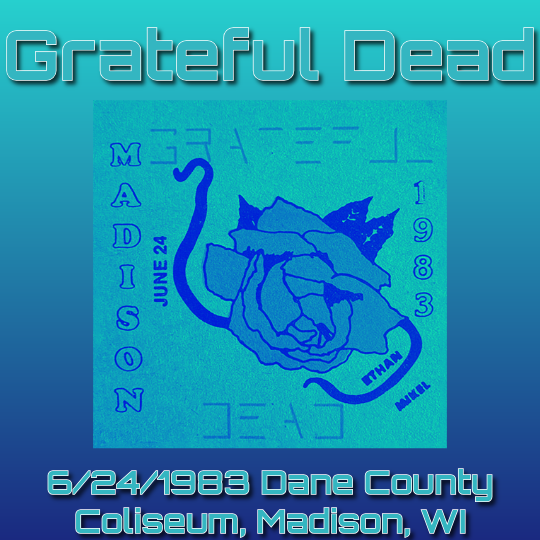
This was the smallest venue of the '83 tour, and maybe the intimacy made for such an incredible show. The entire first set is strong but there are highlights throughout. The first set started strong and never let go. Right out of the gate, Shakedown Street sent a jolt through the crowd, and the whole room lit up. It wasn’t just a good version—it was a Jam Anthem rendition. They stretched it wide open, and you could feel the band letting the groove guide them rather than the other way around. Brown-Eyed Women followed and hit just right, sharp and joyful, with Jerry’s phrasing carrying that perfect mix of sweetness and edge. The whole set had a contagious momentum.
The second set turned the intensity up—it was pure fire. After Bobby’s “Take a step back” moment, the band cracked into a magnificent Help on the Way. The Slipknot! jam was expansive and well-shaped, Jerry weaving long melodic threads that tied the whole thing together. Franklin’s Tower might not be as intense as some recent renditions, but it still had a satisfying bounce. The shift into Sailor > Saint brought a surprise—Bobby threw in a rap about freedom during Sailor that was different. Saint built to an epic peak, with Phil absolutely shaking the rafters.
Then, just as things were settling, Bobby led a brief, whimsical jam that reminded me of Sage and Spirit, before Billy and Mickey dove into a short but tight Drums. Truckin’ came next, and Jerry was locked in—not just during the solos, but lacing flourishes between verses like he was narrating the tale. And then came the emotional high point: Morning Dew. The way Phil detonated those low-end bombs, and Jerry slowly built the tension through his leads—it hit like a wave. This was another Jam Anthem version in every sense: graceful, explosive, and deeply felt. They capped the night with Johnny B. Goode, and honestly, I just sat there grinning after listening to this show. It was one of those shows that reminded me why I keep chasing the music.
6/24/1985 River Bend Music Center, Cincinnati, OH

Officially released on 30 Trips Around The Sun. An overall excellent show, with above average first set but the second set is incredible. The first set gets cooking right away with a blazing Alabama Getaway, and Jerry wastes no time showing off some serious fire. Greatest Story follows nicely, keeping the momentum alive, and then Minglewood drops in with that smoky swagger and those “bluegrass fillies” flourishes that always make me grin. But it was Brother Esau that truly stood out for me—maybe even the best version they ever pulled off. The intro had this slick, techno-funk groove from Billy and Mickey that just leapt out of the speakers. Afterward, Bobby cracked a joke about a “hostage ending,” complete with wildly warped vocals, promising a raffle winner would get to “hold the rhythm section hostage”—just classic Bobby. Loser hit with some sharp edge, and then Let It Grow soared—pure fan paradise, with Jerry really tearing into his leads. I also loved Tennessee Jed, and They Love Each Other went long and loping, in that relaxed, joyful way only the ‘80s versions could. The whole set wrapped up in just over an hour, but packed with highlights.
The second set was something else entirely—start to finish, it was locked in. Iko Iko stretched out gloriously and gave us a rare treat: Bobby actually sang a verse—“Say Dixie boy, on the battle front, Brother John ya-ya”. Samson kept the fire going and flowed smoothly into a buoyant He's Gone, played with a smile rather than the usual somber sway. The harmonies were loose and fun, and Bobby and Brent added some gorgeous touches. Then came the transition—perfectly smooth—into Smokestack Lightning, and it clicked together with such precision. That version was fierce, too. What followed made my jaw drop—Cryptical Envelopment. It was brief, but the surprise alone had the place buzzing. It led naturally into a solid drum segment with Mickey and Billy going full tilt, and then straight into Beamspace chaos: hints of The Other One, weird animal sounds, clown horns—it was glorious mayhem.
Then, out of nowhere, Comes A Time drifted in like a warm breeze, delicate and full of soul. And right as that dream ended, The Other One finally showed up in full force, bursting out with incredible ensemble drive—classic thunder-and-lightning playing. The band wasn’t done—Jerry lifts us right into a massive Wharf Rat, which is passionate and raw, anchored by perfect backing vocals. That slid straight into a fiery, abbreviated Around and Around, and the energy rolled right over into Good Lovin', packed with gusto and some extra lyrical flair from Bobby. Even after all that, they had juice left for an enthusiastic U.S. Blues encore. The whole second set clocked in around 90 minutes, and not a second felt wasted.
6/24/1990 Autzen Stadium, Eugene, OR

A banger of a show—powerful from top to bottom and a perfect snapshot of how strong the band was during this stretch. They balanced Built to Last material with a healthy dose of classics, and Jerry especially seemed to be running on a different kind of fuel.
The first set came out swinging. Help > Slipknot! > Franklin’s was the early crown jewel. The Help intro might’ve been a little loose, but the jam found its legs fast—Jerry slicing through with sharp, decisive phrasing. Loose Lucy felt like a celebration, revived and full of bounce, and Masterpiece was delivered with heart. Let It Grow absolutely sparkles—those MIDI mariachi horns and spiraling runs.
The second set felt very deliberate—less sprint, more story. Foolish Heart led things off gracefully, shimmering and measured, and then they pivoted into Man Smart (Woman Smarter) with a burst of upbeat, percussive energy. Jerry’s MIDI tones were all over this one—punchy horn stabs that gave it an almost cartoonish joy. Standing on the Moon settled everything into a more introspective space. It hadn’t yet become the showstopper it would eventually be, but it still landed. I was especially struck by Box of Rain—it slotted in perfectly. Then came Estimated, and this was the turning point. The jam spanned from swirling tension to trance-like calm, and Bobby let loose at the end before they eased into He’s Gone.
What really got me here was how they sidestepped the usual singalong close—instead, they pushed forward with dark colors from Brent and Phil, hinting at danger around the bend. No bomb drop from Phil this time, but the build into The Other One was masterful—slow, coiled, ready to strike. Once it arrived, the whole band exploded into it like they’d been holding back all night. It felt spontaneous, fierce, perfectly unhinged. Then came Wharf Rat, and this one punched hard. Jerry’s tone was thick and overdriven, Brent leaning into his Hammond in gritty tandem, creating this swirling vortex of sound. The feedback melted into a rollicking Sugar Magnolia, and even with a few stumbles, the joy was off the charts. Brent carried the middle jam with that rolling piano, and the tune just beamed. As the end of the show is eminent, the Brokedown Palace encore sends us home—it was tender, rich, and exactly what the moment called for.
June 25th
6/25/1978 Autzen Stadium, Eugene, OR

This was the band's first performance at the large stadium where the University of Oregon football team plays. This was also the first return to Eugene following their incredible performance at MacArthur Court on 1/22/1978. This show is packed with vibrant playing and full-throttle energy, even if it doesn’t quite eclipse that legendary MacArthur Court gig.
The first set had a handful of standouts. Promised Land came charging out with that familiar swagger, and Passenger was sharp and explosive. But it was Peggy-O that really drew me in—Jerry’s vocal delivery felt especially heartfelt, and the phrasing in his solo had just enough ache to it.
It’s the second set that truly made this show for me. Ken Babbs kicked things off with some wild local storytelling that, I imagine, only hyped up the crowd even more. The momentum carried straight into Samson, which had a tight groove and a crisp vocal from Bobby. Then came the long-form stretch of Estimated > Eyes, and I have to say, this Estimated felt unusually expansive for ’78. The Eyes that followed was playful, light on its feet, and I chuckled when Jerry teased Bobby and Donna to “get it right!” after a little lyric slip. Donna, though, was excellent all set—her vocal timing was spot on, and she threw in those signature wails at all the right moments.
Drums > Space brought the strangeness in all the right ways, and learning that Ken Babbs’ Thunder Machine was in the mix only adds to the legend for me. If the Santa Barbara “motorcycle jam” was oddball chaos, this felt like purposeful weirdness—and it hit the mark. The transition into Not Fade Away > Goin’ Down the Road > Around and Around brought the heat. Goin’ Down the Road in particular was a total scorcher, and one of those moments where the band sounded like they might actually combust from the sheer energy. By the time they crashed into Around, the whole thing was a runaway train.
6/25/1983 St. Paul Civic Center, St. Paul, MN

This one hit me as a truly great show—packed with vivid energy and memorable moments throughout. I like SHNID 142363, the Holbrook 24-bit recording. The first set has a strong flow right from the jump. There was a brief PA hiccup during West L.A. Fadeaway, but that didn’t dim the vibe. The Jack Straw > They Love Each Other pairing was smooth and full of well-phrased interplay—especially Jack Straw, which felt fully dialed in. Cassidy really stood out to me as a highlight. The jam felt expansive without wandering, and the whole band was locked in. Big Railroad Blues galloped out of the station with that unmistakable rockabilly kick—absolutely rollicking. The real stretch came with a lively Lazy Lightning > Supplication > Might As Well run. The Supplication jam had a swinging looseness to it, full of bend and bounce, and Might As Well exploded from the downbeat with Brent’s honky-tonk piano leading the charge. The closing refrain was tight and joyful—a strong way to end the set.
The second set brings plenty more to enjoy. Touch of Grey opened things up, and although Jerry missed a line during the bridge, they powered right into a thundering Samson and Delilah, with the drummers hammering away—definitely one of the set’s highlights. Ship of Fools came in sweet and slow, showcasing Jerry’s heartfelt delivery. Then after a quiet breather, Men Smart, Women Smarter launched, and this one stopped me in my tracks. The tightest version I’ve ever heard. That reprise—“let us put men and women together”—had Billy carving the beat with laser precision, hitting every syllable, even tossing in some extra fills. This version might just be my all-time favorite. From there, Uncle John’s Band rolled out with a jam that had Bobby working a raw, gritty tone, almost abrasive in a good way. The rhythm section kept pushing, really giving the tune some teeth.
Drums followed and was kind of subdued—a reversal of intensity, given how active they’d been earlier. Into Space, the band started teasing The Other One without Phil, and the jam briefly flirts with a Dark Star tease before dropping into Throwing Stones. This rendition doesn’t blow me away, but Goin’ Down the Road Feelin’ Bad is a banger—Jerry ripped into it, and the whole place lit up. It was Saturday, so of course Bobby launched into the perfunctory One More Saturday Night. Jerry cranked the riff into overdrive during the finale, repeating it louder and louder as the song wrapped. By the way, if you’re curious to know, there were only 69 times the band did NOT play One More Saturday Night on a Saturday from the first performance of the song on 10/19/1971 through the final show on 7/9/1995. But I digress. And for the encore, a surprisingly moving Baby Blue. It came across more delicate than usual—honest and well-paced. The whole night left me buzzing, but if I had to pull just one track to spotlight, it’d be Men Smart, Women Smarter. It’s that good.
6/25/1985 Blossom Music Center, Hebron, OH

Blossom is my local premier outdoor venue that's located in the immediate vicinity of the Cuyahoga Valley National Park. Unfortunately I never got to see the Grateful Dead perform here, but I have been fortunate to see about 20-ish other shows here, and the sound is always great. This Blossom '85 show struck me as a real under-the-radar standout—a performance brimming with sharp song choices, tight playing, and a good bit of character. This show is standout for the song selection and the performance.
The first set hit the ground running. Right away, they launch into Day Tripper—the only time they opened a show with that song. The drum warm-ups made the launch even more satisfying. It settled into a simmering West LA Fadeaway, then took off again with a crackling C. C. Rider—Jerry was clearly feeling it, tossing out fanned leads and riffs like he had something to prove. Dire Wolf stood out as the only version of the summer and came off sounding especially bright and buoyant, full of ringing guitar lines. Beat It on Down the Line felt timeless and super-charged. Row Jimmy slowed things down with a lazy sway, but it never lost its shape. Then things ramped back up with a gritty Me and My Uncle, where Bobby’s vocals hit like a punch in the face. That led straight into a churning Big River with Brent firing away on the keys. The momentum didn’t let up—Jerry snapped right into Big Railroad Blues, one of the set’s peaks for me, loaded with punchy fanning and grit. Jack Straw followed, full of tasty call-and-response textures between Bobby, Jerry, and Brent, and then they barreled into Might As Well to seal the frame. I’ve heard some accounts suggest the set ended with a fiery Lazy Lightning > Supplication instead, and if so, that would’ve been a fantastic closer too.
The second set picked up with no less heat. Gimme Some Lovin’ felt like a jolt—Phil and Brent took the reins with real authority. From there, the band dropped into a tight twelve-minute China > Rider, short but snappy, and it kept the pulse going. A short breather followed, then Playing in the Band opened into a sleek, evolving jam that glided naturally into Drums. The Drums segment is rather interesting—loaded with electronic chirps and metallic weirdness that set the mood beautifully for Space. Hints of The Wheel peeked through during the ambient swirl, and sure enough, they leaned into it fully—tender and patient, before slipping effortlessly into the Playing reprise. That callback tied things together in a way that brought me right back to the first set energy. Then came a hushed, aching China Doll, played with a gentleness that kept the entire crowd breathless. Even without a harpsichord, the texture was still there. Sugar Magnolia rolled in tall and loose—plenty of swagger but not overly tight. Bobby’s antics didn’t add much, but the music still cooked. This version earned Howard Weiner’s Jam Anthem designation because it expands well beyond its standard framework. Finally, Touch of Grey sent us home in high spirits.
June 26th
6/26/1973 Seattle Center Arena, Seattle, WA

Officially released on Pacific Northwest '73-'74: The Complete Recordings. This show is an absolute gem—relaxed, immersive, and beautifully paced. The playing is measured and patient, and it gives everyone room to breathe, and the result is a standout performance.
The first set opens with a slow-rolling but snappy Casey Jones that sets the tone just right. Right away I could tell Bobby was in a special space—his rhythm work was adventurous, inventive, and downright contagious. He’s showing off his rhythmic motif and it seeped into everything that followed. Phil picked up on it immediately, orbiting around Bobby’s lines with his own elastic counterpoint. Other highlights for me included a raw-edged Greatest Story, a delightfully clipped Mexicali Blues, a sleepy but elegant Row Jimmy, and a dreamy China Cat > Rider with tons of sparkle. And then there’s Playing in the Band, which pulled me in with its gradual pressure build—never rushed, just constantly coiling inward. Jerry found this sax-like tone that he twisted into expressive bursts, and at one point Phil mirrored it, the two of them colliding in this joyful little whirlpool before gently letting it go.
The second set shifts into another gear without losing that shared ease. They Love Each Other and Big River get the momentum back up right away. Black Peter hits a snag—there’s a big chord misfire that derails it—but the band regroups quickly, and Here Comes Sunshine more than makes up for it. That first jam emerges, reaching for some wild open space. In the second half, Jerry slips in a Dark Star tease so slick you have to really listen for it, but nobody else on the stage caught it, and the whole band pushes forward. He's Gone emerges as a major highlight—its ambient sway and gospel lift give it this bittersweet grace, like a farewell that everyone’s in on. Jerry bends his strings just right, and suddenly we’re charging into Truckin', brash and blazing. The jam that follows feels like it could veer anywhere—one moment blues, the next hovering near The Other One. Billy drops out for ten seconds, and Phil stakes the claim for The Other One with one note that changes everything. They drop in effortlessly, and though the groove is driving, Phil’s playing has a chaos to it—hammering savage thumps that keep Jerry peeling deeper.
After transiting the final segment of the song, Jerry redirects the band into Bobby McGee without warning. It’s such a playful move, and it seems to catch Bobby off guard. The result of that is that the song gets that spacious second-set treatment, drifting out and then snapping back as Phil launches them into The Other One once again. From there, it all unspools. Keith moves to electric piano, and things turn jazzy and slinky. Jerry starts throwing punches, scraping out sharp-edged leads while Phil directs traffic. Eventually, the full theme returns and they finally hit the first verse. Jerry leans into the wah-wah, and suddenly the band just dissolves—Billy drops out, Jerry goes into a manic orbit, and releases a Tiger Roar. It only lasts a moment, but it’s visceral and raw, the feedback swelling until Jerry unleashes this barrage of shrieks, all dissonant and primal. The rest of the band scrambles to catch the current as they wrap themselves into Jerry’s chaotic spiral. It’s pure catharsis—release and rupture—and when it finally breaks, the audience sounds stunned. Then, out of the smoke, Sugar Magnolia barrels in with that familiar crash, and the whole crowd exhales together. It’s not just a great show. It’s one of those nights where the band opens a door and invites the rest of us into a different kind of space.
6/26/1974 Providence Civic Center, Providence, RI

Partially officially released on Dick's Picks Volume 12. This show was an absolute monster—one of those performances that just refuses to let up. The energy never dipped, the jams were inventive and wild, and the audience was right there with them every step of the way.
The first set was a marathon—fifteen songs and absolutely no filler. The tempo was high, the band locked in. Scarlet Begonias stood out with a joyful bounce and bright jam, and Weather Report Suite flowed like silk into Let It Grow, then rolled down gently into It Must Have Been the Roses. That entire stretch had a real through-line of emotional and musical patience. Somewhere in there, Bobby spun out the "Tomb of the Unknown Speaker" story, adding that signature moment of weird charm. Later, Seastones brought the unexpected—full-on siren howls and drone textures that sounded like the Wall of Sound itself was shorting out.
The second set was where things really lifted off. They opened with a freeform Jam that slid like vapor into China Cat Sunflower, and this was no typical version—it absolutely qualifies as a Jam Anthem. Phil, Jerry, and Keith spent the first few minutes slowly sketching out a dreamscape, pulling light out of deep space before lighting the China Cat flame. The transition into I Know You Rider was classic '74 magic, featuring that unmistakable Uncle John’s Band-themed jam that always gets me. The Rider soared, with the whole band playing dynamically and peaking on the “headlight” line while the crowd lit up in full roar. That version easily ranks among the all-time greats.
From there, the show turned into pure Dead alchemy. A Beer Barrel Polka tuning bubbled up as a playful interlude, and then boom—Truckin’ came barreling in with swagger and heat. The jam that followed kept giving. Phil tore into a fierce solo that led without hesitation into his signature Other One rumble. The song never fully arrived, though—the band veered left as Billy and Bobby steered them into Spanish Jam, another undeniable Jam Anthem. It kept shifting: The Other One peeked back in, then themes that felt like Tiger, even flashes of Playing in the Band, all swirling into a thick, exploratory soup. Eventually, Wharf Rat emerged gently from the haze, offering a moment of reprieve before Sugar Magnolia brought the house down with its joyful urgency. And then the encore—Eyes of the World. What a sendoff. The groove was radiant, Phil’s bass was up front and lyrical, and the whole thing glowed. They only closed with Eyes twice, and this was the second—making it not just rare, but the perfect final treasure of a show that gave us everything.
6/26/1976 Auditorium Theatre, Chicago, IL

1st of a 4 show run at the Auditorium Theatre. This 6/26/1976 show has always felt a little uneven to me—of the four nights at the Auditorium Theatre, this one doesn’t hit quite as hard overall. Still, there’s a lot here to enjoy.
The first set kicks off with a charged-up Promised Land, immediately setting an up-and-down tone that continues throughout. Mama Tried and the Lazy Lightnin' > Supplication combo both stand tall—tight, well-delivered, and full of momentum. But Tennessee Jed really seems to drag; the pace is just too sluggish and it doesn’t have that edge that can really spark a fire during that song. That said, Peggy-O was lovely—slow and heartfelt in a way that worked. What stood out was the contrast between Bobby’s punchier numbers and Jerry’s more spacious, drawn-out contributions, almost as if they were pulling in different directions.
The second set was a much smoother ride. Playing in the Band opens it up with strong vocals before gliding off into a deep and airy jam, far removed from the core melody. That spacey stretch eventually settled into a slow-burning Saint Stephen and it came across as unhurried and stately. The final “answer man” refrain lingered long enough to open the door to The Wheel, which turned gently before winding into a compact instrumental break and back into the Playing reprise. Then came a fiery Samson and Delilah to jolt the room upright. To me, the emotional peak of the show is Crazy Fingers > Stella Blue. That transition is magical. Both were played slow, with aching beauty, and the feeling never wavered—they cast a long spell, and I was completely in it. From there, Around and Around started languid but quickly jumped into high gear, slamming straight into Saturday Night without even blinking. They closed it all out with a quick, tight U.S. Blues, which felt like the last celebratory burst of the night.
6/26/1987 Alpine Valley Music Theatre, East Troy, WI

This one had that raw edge I crave—a full-tilt, high-voltage night that felt like Alpine Valley had shaken off its mellow ‘78 skin and emerged electric. The first set lit the fuse early. Feel Like a Stranger > Franklin’s Tower was a unique way to start, and considering it had been a year since Stranger took the opener spot, it felt like the band meant business. The transitioning Franklin’s was powerful and the band had clearly snapped into place, and judging by the roar when Stranger ended, the crowd felt it too.
Walkin’ Blues was a fun detour—Brent noodling with synth tones and having a good time—and it was cool to hear it still relatively fresh after its long shelf life. The middle stretch—Row Jimmy, Tons of Steel, Push Comes to Shove—kept things steady but didn’t quite break the surface tension. That came with Cassidy, which hit like a lightning bolt. Winds kicked up, dust was dancing in manic spirals, and then—boom—the storm let go and we dropped into a blistering Deal. That one is intense, bordering on chaotic, making it a highlight for sure.
The second set wasted no time getting airborne. China Cat > I Know You Rider felt charged with purpose, and Brent’s synth sax gave China Cat this funky lift that worked surprisingly well. Rider was white-hot, especially on the “wish I was a headlight” line. Estimated Prophet was pure color and density—Phil and Brent pushing to the front, and Bobby’s “CALIFORNIA!” shout had extra intensity. Brent’s B-3 solo glided above the chaos with power and grace, and Bobby’s spiraling vocal refrains were both ridiculous and perfect. Jerry snuck into Eyes of the World mid-scale, and it opened clean and bold. Post-outro, Brent unleashed his sampler and turned the stage into a living, howling beast—like a jungle of tape loops snarling into Space.
Gimme Some Lovin' > The Wheel felt soaring and life-affirming, pure collective release. And then—All Along the Watchtower. It was only their second time playing it, but they’d already found its teeth. Jerry dug in, and the drummers were clearly having a field day. The descent into Black Peter was unexpected and a bit shaky, but Brent leaned into it with a strange, theatrical flair that somehow worked. Sugar Magnolia wrapped the whole thing up with full Alpine firepower, blowing the place wide open one last time. The encore was a straight-forward version of Touch of Grey. No frills, no curveballs—just Jerry waving goodbye with a wink.
6/26/1988 Civic Arena, Pittsburgh, PA

A lively, well played show throughout. The band is "on" from the get-go. This show was vibrant and consistently well-played from the moment the lights went down. The first set took off with a breezy Mississippi Half-Step Uptown Toodeloo—Phil punching through in all the right places, giving it lift. My aviator friends will understand this as the moment at which we say “rotate”. That tumbled into a gritty Little Red Rooster, with Bobby and Brent throwing down and trading sharp lines. From there, it felt like the whole band was in sync. I’m not the biggest When Push Comes to Shove fan, but Jerry’s knowing drawl always gets me humming along.
The Mama Tried > Big River > Cumberland Blues triple punch was one of the set’s real high points—brimming with propulsion and sweat. That whole sequence had this rolling rhythm that pulled me right in. Then came a nice surprise: the debut of Brent’s Gentlemen Start Your Engines. I actually think this one had real promise—it’s punchy, darker, and lyrically richer than Tons of Steel ever was. The grit didn’t feel out of place at all. After that, they dug into a chugging Big Railroad Blues, which set the stage perfectly for a tight, well-jammed The Music Never Stopped to close things out on a high.
The second set took a moment to warm up, but once it found its footing, it delivered. Touch of Grey felt workmanlike and didn’t quite sparkle—however, the Playing in the Band > Uncle John’s Band > Playing in the Band stretch was easily the heart of the set for me. The first Playing came in slow and slippery, drifting in loose circles until Jerry gently hinted toward Uncle John’s, and the band folded in behind him. Uncle John’s Band itself had a warm, sing-along feel—nothing revolutionary, but totally satisfying—and when they eased back into Playing, the reprise carried more punch, a joyful full-circle moment. The Drums segment was intense, which made the shift into the airy textures of Space all the more pronounced.
Dear Mr. Fantasy emerged slowly, full of ache, and swelled beautifully. Brent’s vocal energy in the Hey Jude Coda was huge—the whole band met him there. Then Jerry pulled us back under with a heavy-hearted Black Peter, slowing things down for one last emotional swing. But the moment Turn On Your Lovelight hit, the mood turned on a dime—crowd ready to blow, and the band answered with full steam. For the encore, Jerry came back out with a tender, unhurried Black Muddy River, a fitting goodbye to a show that had traveled all over the map but never lost its way.
BTW, If you're not yet familiar with Jam Anthem versions of songs you can read all about it in Deadology II by Howard Weiner. Check it out here along with all his other great books.
And that's all for now! Of course, if you want to follow along in your very own copy of my book On This Day In Grateful Dead History: A Daily Listening Journal I still have some copies available here. Once they're sold out, I won't be getting any more made. The costs of printing and shipping has almost doubled in the last few years since I had them printed, and I've decided it's just not worth it. So get one now while you can! https://www.gratefuldeadbook.com/tigdh


Comments