June Grateful Dead Show Listening Guides Part 3


Welcome to this month's Grateful Dead Show Listening Guides!
This is part 3 (of 3) of the June Listening Guides.
We're covering June 26th - June 30th in this post.
June 1st - June 15th can be found here.
June 16th - June 26th can be found here.
If you like these reviews and you want to support me, please consider buying a copy of my book On This Day In Grateful Dead History: A Daily Listening Journal. They're $50 and I offer free shipping if you subscribe to my mailing list, where you'll get these writeups delivered. No spam, I promise!
Over time, as I've written these listening guides, I marked up my copy of the book like this:

The underlined songs are the ones I'm calling out as highlights (songs names that are bolded) in the listening guide, and the songs highlighted in yellow are the ones that Howard Weiner has identified as Jam Anthem renditions. I also write notes in the space provided if I'm feeling inspired or if there are any updates such as newly released material. Ultimately you can use it however you want, but this was my original intent with the book.
By the way, if you're new here, this is my month-by-month archive of my listening guides that gives you the most interesting and significant facts from Grateful Dead History, along with reviews of the music. If you'd like to stay up to date on new reviews and other information, you can subscribe here:
June
For the month of June, the band's history is incredibly dense, featuring heavy touring schedules and pivotal moments that span their entire career. In my opinion, this month really showcases the Dead's evolution, from the primal psychedelic era of 1969 to the polished, massive stadium shows of the 1990s.
One of the most significant threads running through these reviews is the "comeback" tour of June 1976. After a touring hiatus that lasted nearly a year and a half, the band returned with renewed energy and a reworked repertoire, playing multiple nights at venues like the Paramount Theatre in Portland, the Music Hall in Boston, and the Capitol Theatre in Passaic. I found the reviews of these shows to highlight a band that was finding its footing again, balancing tight, rehearsed arrangements with the exploratory jamming they were known for. The June 1976 run also featured the only time the band performed "Happiness Is Drumming," which eventually evolved into "Fire on the Mountain".
Another major highlight is the June 1974 Wall of Sound era. The reviews describe these shows as massive and crystal clear, with the band delivering marathon performances. The experimentation during this period was intense, with unique jams like the "Mind Left Body Jam" and the debut of Phil Lesh and Ned Lagin's electronic "Seastones" segment.
The show reviews also points to some deeply emotional and historic milestones. We see the end of an era with Pigpen's final show on June 17, 1972, at the Hollywood Bowl, where he unfortunately didn't sing any of his signature songs. On the other end of the spectrum, we have a nod to the very beginning with Phil Lesh's first show on June 18, 1965, when the band was still The Warlocks. There are also poignant moments from the later years, such as the 1991 shows featuring Bruce Hornsby and Vince Welnick, which I think offered some of the most complex instrumentation of that era, including a rare "Eyes of the World" opener.
I also noticed a recurring theme of special guests and unique collaborations in June. Janis Joplin joined the band on stage in 1969 to sing with Pigpen, and the Gyuto Tibetan Monks made a fascinating, one-time appearance during a "Drums" segment in 1995. The month also saw the band playing in unique locations, like a high school auditorium in Anchorage, Alaska, in 1980, and the massive 20th-anniversary shows at the Greek Theatre in 1985. Whether it was the acoustic sets of 1970 or the MIDI-infused jams of the 90s, June seems to be a month where the Dead were constantly pushing their boundaries.
Significant historical events in Grateful Dead History for June
RIP Vince Welnick (6/2/2006)
Start of the June 1976 "comeback" tour (6/3/1976)
Janis Joplin joined the band on stage (6/7/1969)
Pigpen's last show (6/17/1972)
Phil Lesh's first show (6/18/1965)
Robert Hunter's birthday (6/23/1941)
First Performances
Might as Well (6/3/1976), Lazy Lightning > Supplication (6/3/1976), Samson & Delilah (6/3/1976), Wheel (6/3/1976), Mission in the Rain (6/4/1976), Swing Low Sweet Chariot (6/4/1970), Sugar Magnolia (6/7/1970), Masterpiece (6/13/1987), Keep On Growing (6/14/1985), It Takes A Lot To Laugh It Takes A Train To Cry (6/10/1973), That's Alright Mama (6/10/1973), Stella Blue (6/17/1972), Crazy Fingers (6/17/1975), Help On The Way (6/17/1975), Slipknot! (6/17/1975), Franklin's Tower (6/17/1975), Victim Or The Crime (6/20/1988), Foolish Heart (6/19/1988), Watchtower (6/20/1987), Blow Away (6/20/1988), I Will Take You Home (6/19/1989), Seastones (6/23/1974), Big RxR Blues (6/24/1970), Why Don’t We Do It In The Road (6/27/1984), Gentlemen Start Your Engines (6/26/1988)
Final Performances
It’s A Sin (6/4/1970), Wave That Flag (6/10/1973), To Lay Me Down (6/28/1992), Mission in the Rain (6/29/1976)
Only Performances
Gyuto Tibetan Monks chanted during Drums (6/2/1995), Franklin’s Tower as an encore (6/9/1976), Happiness Is Drumming (6/28/1976), Eyes of the World opener (6/17/1991)
June Grateful Dead Show Listening Guide Index
Index of all 22 shows reviewed for June 26th through June 30th. Click the link to jump to the listening guide, or just scroll down.
June 26th
6/26/1973 Seattle Center Arena, Seattle, WA

Officially released on Pacific Northwest '73-'74: The Complete Recordings. This show is an absolute gem—relaxed, immersive, and beautifully paced. The playing is measured and patient, and it gives everyone room to breathe, and the result is a standout performance.
The first set opens with a slow-rolling but snappy Casey Jones that sets the tone just right. Right away I could tell Bobby was in a special space—his rhythm work was adventurous, inventive, and downright contagious. He’s showing off his rhythmic motif and it seeped into everything that followed. Phil picked up on it immediately, orbiting around Bobby’s lines with his own elastic counterpoint. Other highlights for me included a raw-edged Greatest Story, a delightfully clipped Mexicali Blues, a sleepy but elegant Row Jimmy, and a dreamy China Cat > Rider with tons of sparkle. And then there’s Playing in the Band, which pulled me in with its gradual pressure build—never rushed, just constantly coiling inward. Jerry found this sax-like tone that he twisted into expressive bursts, and at one point Phil mirrored it, the two of them colliding in this joyful little whirlpool before gently letting it go.
The second set shifts into another gear without losing that shared ease. They Love Each Other and Big River get the momentum back up right away. Black Peter hits a snag—there’s a big chord misfire that derails it—but the band regroups quickly, and Here Comes Sunshine more than makes up for it. That first jam emerges, reaching for some wild open space. In the second half, Jerry slips in a Dark Star tease so slick you have to really listen for it, but nobody else on the stage caught it, and the whole band pushes forward. He's Gone emerges as a major highlight—its ambient sway and gospel lift give it this bittersweet grace, like a farewell that everyone’s in on. Jerry bends his strings just right, and suddenly we’re charging into Truckin', brash and blazing. The jam that follows feels like it could veer anywhere—one moment blues, the next hovering near The Other One. Billy drops out for ten seconds, and Phil stakes the claim for The Other One with one note that changes everything. They drop in effortlessly, and though the groove is driving, Phil’s playing has a chaos to it—hammering savage thumps that keep Jerry peeling deeper.
After transiting the final segment of the song, Jerry redirects the band into Bobby McGee without warning. It’s such a playful move, and it seems to catch Bobby off guard. The result of that is that the song gets that spacious second-set treatment, drifting out and then snapping back as Phil launches them into The Other One once again. From there, it all unspools. Keith moves to electric piano, and things turn jazzy and slinky. Jerry starts throwing punches, scraping out sharp-edged leads while Phil directs traffic. Eventually, the full theme returns and they finally hit the first verse. Jerry leans into the wah-wah, and suddenly the band just dissolves—Billy drops out, Jerry goes into a manic orbit, and releases a Tiger Roar. It only lasts a moment, but it’s visceral and raw, the feedback swelling until Jerry unleashes this barrage of shrieks, all dissonant and primal. The rest of the band scrambles to catch the current as they wrap themselves into Jerry’s chaotic spiral. It’s pure catharsis—release and rupture—and when it finally breaks, the audience sounds stunned. Then, out of the smoke, Sugar Magnolia barrels in with that familiar crash, and the whole crowd exhales together. It’s not just a great show. It’s one of those nights where the band opens a door and invites the rest of us into a different kind of space.
6/26/1974 Providence Civic Center, Providence, RI

Partially officially released on Dick's Picks Volume 12. This show was an absolute monster—one of those performances that just refuses to let up. The energy never dipped, the jams were inventive and wild, and the audience was right there with them every step of the way.
The first set was a marathon—fifteen songs and absolutely no filler. The tempo was high, the band locked in. Scarlet Begonias stood out with a joyful bounce and bright jam, and Weather Report Suite flowed like silk into Let It Grow, then rolled down gently into It Must Have Been the Roses. That entire stretch had a real through-line of emotional and musical patience. Somewhere in there, Bobby spun out the "Tomb of the Unknown Speaker" story, adding that signature moment of weird charm. Later, Seastones brought the unexpected—full-on siren howls and drone textures that sounded like the Wall of Sound itself was shorting out.
The second set was where things really lifted off. They opened with a freeform Jam that slid like vapor into China Cat Sunflower, and this was no typical version—it absolutely qualifies as a Jam Anthem. Phil, Jerry, and Keith spent the first few minutes slowly sketching out a dreamscape, pulling light out of deep space before lighting the China Cat flame. The transition into I Know You Rider was classic '74 magic, featuring that unmistakable Uncle John’s Band-themed jam that always gets me. The Rider soared, with the whole band playing dynamically and peaking on the “headlight” line while the crowd lit up in full roar. That version easily ranks among the all-time greats.
From there, the show turned into pure Dead alchemy. A Beer Barrel Polka tuning bubbled up as a playful interlude, and then boom—Truckin’ came barreling in with swagger and heat. The jam that followed kept giving. Phil tore into a fierce solo that led without hesitation into his signature Other One rumble. The song never fully arrived, though—the band veered left as Billy and Bobby steered them into Spanish Jam, another undeniable Jam Anthem. It kept shifting: The Other One peeked back in, then themes that felt like Tiger, even flashes of Playing in the Band, all swirling into a thick, exploratory soup. Eventually, Wharf Rat emerged gently from the haze, offering a moment of reprieve before Sugar Magnolia brought the house down with its joyful urgency. And then the encore—Eyes of the World. What a sendoff. The groove was radiant, Phil’s bass was up front and lyrical, and the whole thing glowed. They only closed with Eyes twice, and this was the second—making it not just rare, but the perfect final treasure of a show that gave us everything.
6/26/1976 Auditorium Theatre, Chicago, IL

1st of a 4 show run at the Auditorium Theatre. This 6/26/1976 show has always felt a little uneven to me—of the four nights at the Auditorium Theatre, this one doesn’t hit quite as hard overall. Still, there’s a lot here to enjoy.
The first set kicks off with a charged-up Promised Land, immediately setting an up-and-down tone that continues throughout. Mama Tried and the Lazy Lightnin' > Supplication combo both stand tall—tight, well-delivered, and full of momentum. But Tennessee Jed really seems to drag; the pace is just too sluggish and it doesn’t have that edge that can really spark a fire during that song. That said, Peggy-O was lovely—slow and heartfelt in a way that worked. What stood out was the contrast between Bobby’s punchier numbers and Jerry’s more spacious, drawn-out contributions, almost as if they were pulling in different directions.
The second set was a much smoother ride. Playing in the Band opens it up with strong vocals before gliding off into a deep and airy jam, far removed from the core melody. That spacey stretch eventually settled into a slow-burning Saint Stephen and it came across as unhurried and stately. The final “answer man” refrain lingered long enough to open the door to The Wheel, which turned gently before winding into a compact instrumental break and back into the Playing reprise. Then came a fiery Samson and Delilah to jolt the room upright. To me, the emotional peak of the show is Crazy Fingers > Stella Blue. That transition is magical. Both were played slow, with aching beauty, and the feeling never wavered—they cast a long spell, and I was completely in it. From there, Around and Around started languid but quickly jumped into high gear, slamming straight into Saturday Night without even blinking. They closed it all out with a quick, tight U.S. Blues, which felt like the last celebratory burst of the night.
6/26/1987 Alpine Valley Music Theatre, East Troy, WI

This one had that raw edge I crave—a full-tilt, high-voltage night that felt like Alpine Valley had shaken off its mellow ‘78 skin and emerged electric. The first set lit the fuse early. Feel Like a Stranger > Franklin’s Tower was a unique way to start, and considering it had been a year since Stranger took the opener spot, it felt like the band meant business. The transitioning Franklin’s was powerful and the band had clearly snapped into place, and judging by the roar when Stranger ended, the crowd felt it too.
Walkin’ Blues was a fun detour—Brent noodling with synth tones and having a good time—and it was cool to hear it still relatively fresh after its long shelf life. The middle stretch—Row Jimmy, Tons of Steel, Push Comes to Shove—kept things steady but didn’t quite break the surface tension. That came with Cassidy, which hit like a lightning bolt. Winds kicked up, dust was dancing in manic spirals, and then—boom—the storm let go and we dropped into a blistering Deal. That one is intense, bordering on chaotic, making it a highlight for sure.
The second set wasted no time getting airborne. China Cat > I Know You Rider felt charged with purpose, and Brent’s synth sax gave China Cat this funky lift that worked surprisingly well. Rider was white-hot, especially on the “wish I was a headlight” line. Estimated Prophet was pure color and density—Phil and Brent pushing to the front, and Bobby’s “CALIFORNIA!” shout had extra intensity. Brent’s B-3 solo glided above the chaos with power and grace, and Bobby’s spiraling vocal refrains were both ridiculous and perfect. Jerry snuck into Eyes of the World mid-scale, and it opened clean and bold. Post-outro, Brent unleashed his sampler and turned the stage into a living, howling beast—like a jungle of tape loops snarling into Space.
Gimme Some Lovin' > The Wheel felt soaring and life-affirming, pure collective release. And then—All Along the Watchtower. It was only their second time playing it, but they’d already found its teeth. Jerry dug in, and the drummers were clearly having a field day. The descent into Black Peter was unexpected and a bit shaky, but Brent leaned into it with a strange, theatrical flair that somehow worked. Sugar Magnolia wrapped the whole thing up with full Alpine firepower, blowing the place wide open one last time. The encore was a straight-forward version of Touch of Grey. No frills, no curveballs—just Jerry waving goodbye with a wink.
6/26/1988 Civic Arena, Pittsburgh, PA

A lively, well played show throughout. The band is "on" from the get-go. This show was vibrant and consistently well-played from the moment the lights went down. The first set took off with a breezy Mississippi Half-Step Uptown Toodeloo—Phil punching through in all the right places, giving it lift. My aviator friends will understand this as the moment at which we say “rotate”. That tumbled into a gritty Little Red Rooster, with Bobby and Brent throwing down and trading sharp lines. From there, it felt like the whole band was in sync. I’m not the biggest When Push Comes to Shove fan, but Jerry’s knowing drawl always gets me humming along.
The Mama Tried > Big River > Cumberland Blues triple punch was one of the set’s real high points—brimming with propulsion and sweat. That whole sequence had this rolling rhythm that pulled me right in. Then came a nice surprise: the debut of Brent’s Gentlemen Start Your Engines. I actually think this one had real promise—it’s punchy, darker, and lyrically richer than Tons of Steel ever was. The grit didn’t feel out of place at all. After that, they dug into a chugging Big Railroad Blues, which set the stage perfectly for a tight, well-jammed The Music Never Stopped to close things out on a high.
The second set took a moment to warm up, but once it found its footing, it delivered. Touch of Grey felt workmanlike and didn’t quite sparkle—however, the Playing in the Band > Uncle John’s Band > Playing in the Band stretch was easily the heart of the set for me. The first Playing came in slow and slippery, drifting in loose circles until Jerry gently hinted toward Uncle John’s, and the band folded in behind him. Uncle John’s Band itself had a warm, sing-along feel—nothing revolutionary, but totally satisfying—and when they eased back into Playing, the reprise carried more punch, a joyful full-circle moment. The Drums segment was intense, which made the shift into the airy textures of Space all the more pronounced.
Dear Mr. Fantasy emerged slowly, full of ache, and swelled beautifully. Brent’s vocal energy in the Hey Jude Coda was huge—the whole band met him there. Then Jerry pulled us back under with a heavy-hearted Black Peter, slowing things down for one last emotional swing. But the moment Turn On Your Lovelight hit, the mood turned on a dime—crowd ready to blow, and the band answered with full steam. For the encore, Jerry came back out with a tender, unhurried Black Muddy River, a fitting goodbye to a show that had traveled all over the map but never lost its way.
June 27th
6/27/1976 Auditorium Theatre, Chicago, IL
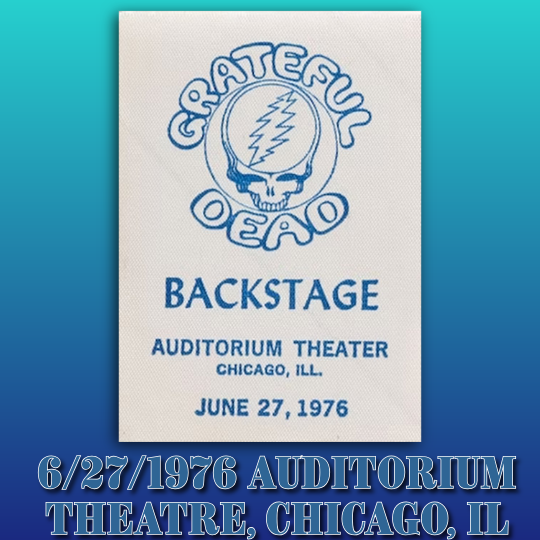
This was the 2nd of a 4 show run at the Auditorium Theatre. Here we have a fine show an energetic, tightly played performance that felt like it was firing on all cylinders, especially compared to the more laid-back vibe of the previous night.
The first set opened with a confident and lively Cold Rain & Snow, typically a harbinger of good things to come when shows that start that way. This was no exception. The pace stayed strong with a snappy Big River, followed by an elegant and well-executed Lazy Lightning > Supplication—fluid and sharp, with just the right amount of fire. Looks Like Rain gave us a breather without dropping the emotional temperature, and Donna sounded particularly beautiful throughout. Might As Well wrapped the set with a burst of joy, leaving me feeling like something special was still waiting in the wings.
The second set was the kind of stretch I live for—focused, exploratory, and deeply satisfying. Let It Grow > Drums > Let It Grow opened with purpose, the band diving right in post-break with fierce cohesion and plenty of breath in the jam sections. That settled into a slow-bloom Wharf Rat that carried a heavy, drifting elegance. But the clear high point for me came next: an expansive, interstellar Help on the Way > Slipknot! > Franklin’s Tower that excels in the “jamming” category. Help was brief but pristine, and the Slipknot! segment hit a cosmic note—it felt like space jazz unfolding in real time. Franklin’s Tower took its time, unhurried and glowing, and in the midst of it was a five-minute stretch that really hit me. It felt like the moment where their loose improvisational style began to shift toward something more deliberate, more intentional. That quiet transformation carried real emotional weight. Then they came back swinging with a punchy Samson and Delilah, followed by a seamless lift into Sugar Magnolia, bursting right out of Franklin’s final groove. After a quick pause, they brought it all home with a bright, tight U.S. Blues—the kind of encore that leaves no doubt you just witnessed something real.
6/27/1983 Poplar Creek Music Theatre, Hoffman Estates, IL
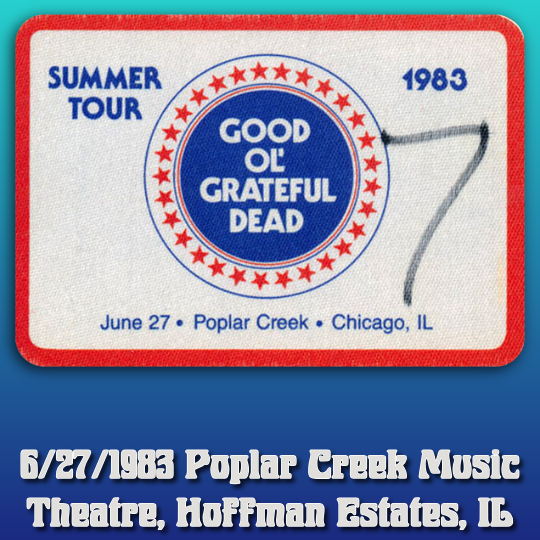
The 1st of a 2 show run at this venue. This show and the next night were the only time the band ever played in this venue that holds about 25,000. It was a nice outdoor venue in the suburbs of Chicago, but would close in 1994. This show crackles with energy and enthusiastic playing throughout.
The first set was no slouch. It ran a little long but was packed with momentum. Bertha > Promised Land got things moving fast, a one-two punch that immediately dialed in the crowd. Mid-set, Bird Song took flight in a beautifully jammed, subtly layered, and perfectly placed way. Cold Rain & Snow rolled right into the seventh-ever Hell in a Bucket, which still felt a bit unrefined at that stage—loose around the edges, almost like it hadn’t quite decided what it wanted to be yet. Still, I appreciated that they kept pushing without a pause. Then Jerry stepped up with a fiery Sugaree to close it all out—despite a stumble on the first verse, he pulled it together fast, and the jam more than made up for it. Sugaree closed the first set only eight other times, so that gave it an extra twist of surprise.
The second set started with a full-on firestorm. Scarlet Begonias > Fire on the Mountain was absolutely a monster version in my book. Jerry’s solo in Scarlet took everything up a notch—as he makes the whole place levitate. The segue into Fire was flawless; Jerry hit that flange and suddenly we were riding the wave. Estimated Prophet followed and stretched out wide and colorful, the band exploring every inch of its space before drifting into Truckin'. They hold off slipping into Space a little longer than usual. Even though the set remained tight and well played after that, nothing quite matched the electricity of that Scarlet sequence. That was the summit.
June 28th
6/28/1974 Boston Garden, Boston, MA

Partially officially released on Dick's Picks Volume 12. This is a monster of a show that peaks during the second set. The first set is all fine (it is '74 Wall of Sound after all) but average for the time. This show felt like a total marathon to me—one of those nights where everything peaks just right, especially in that phenomenal second set. The highlight was easily the massive, forty-three-minute jam suite that felt like it cracked open time itself.
The first set didn’t quite lift off for me overall, though it had some fine moments. Half-Step was a sweet opener—crisp, with a nice bounce—but after that, it felt like the band was almost sprinting through songs like Roses, Jack Straw, and Beat It On Down The Line. They were clean, but a little rushed. The set just never quite settled into a groove. That said, Seastones was a totally different animal—howling, shrieking, full of chaos and sci-fi menace. I only wish the tape captured it better, because the audience source I heard just doesn’t do it justice.
But the second set—that’s where this show jumps into the stratosphere. It’s framed as a Sugar Magnolia sandwich, and it’s delicious. Sugar Mag bursts out strong, and instead of closing it out, they break into the first-ever second set Scarlet Begonias, which glows with color. Phil’s playing is endlessly melodic and nuanced, and Jerry dances between grounded grooves and floating runs. The jam flows between bright propulsion and deep, spacey drift. Donna keeps it light—her scat section is brief and tasteful. Not long after, To Lay Me Down emerges with a soft shimmer. Phil’s bass keeps it steady, and Jerry and Donna blend beautifully.
Then comes the centerpiece: a towering Weather Report Suite, and I’d argue it’s the best version of the June run. Prelude is stately, Bobby and Phil guiding it with quiet grace, and Jerry’s slide on Part One complements Bobby’s vocal delivery perfectly. But it’s Let It Grow that detonates everything wide open. The jam stretches into a half-hour journey—starting fast and tight, then spiraling into abstract patterns as Phil drops out and Jerry’s wah-wah sounds grow eerie and spectral. Then it shifts again into a full-on Mind Left Body Jam. Billy drives it hard, while Phil returns and nudges them in his direction, but instead, Jerry tags a brief Dark Star motif. They tease it out into a short but unmistakable Dark Star jam. After breaking down into deep space, a jazzy ¾ rhythm kicks in, then fades into raw feedback and distorted leads, hinting at a fierce and fleeting Tiger. That howl eventually gives way to a swift, bouncing jam that stumbles happily into U.S. Blues—a thunderous re-entry from interstellar chaos. From there, it’s straight into Promised Land, then Goin’ Down the Road, which strolls gracefully through a We Bid You Goodnight theme before sliding without pause into Sunshine Daydream. That’s the top slice of the sandwich—scorching, joyful, and triumphant.
6/28/1976 Auditorium Theatre, Chicago, IL

3rd of a 4 show run at the Auditorium Theatre. This infamous show was a truly unique and magical experience for anyone who was lucky enough to attend. This June 28, 1976 performance at the Auditorium Theatre in Chicago felt like one of those uniquely enchanted nights, even if it tends to get eclipsed by the more widely circulated show from the following evening.
The first set opened with a bang—Promised Land came flying out of the gate, and Jerry’s solo was unexpectedly delicate and melodic, almost dreamlike. From there, things settled into a lower gear. The band played steadily, but a few of the jams felt like they were searching for something just out of reach. The overall pacing gave the ballads a hushed grace, but I kept waiting for the improvisations to fully ignite. Still, High Time had a lovely flow, and The Music Never Stopped found a nice snap to close the frame on a stronger note.
But it was the second set that pulled me all the way in. It started with an expansive Eyes of the World, featuring a gorgeous, exploratory intro jam—Jerry danced through spirals while Bobby tossed in those glistening rhythm swells. Rather than just vamping on the theme, the band pushed into new chord progressions, even dropping in a brief tease of the Stronger Than Dirt jam. When the momentum shifted, Phil grounded things with a few perfectly placed phrases, and Jerry used that cue to slide effortlessly into the verse. The first intra-verse jam felt a bit too stiff for my taste, but the second absolutely soared—fluid, open, and glowing. After the final verse, Bobby punched in with bold, almost defiant chords, skipping the usual outro space. Phil answered with a brief bass flourish, and from there, the music simply dissolved.
Then came the magic: Billy and Mickey started percolating with subtle, bubbling rhythms, and suddenly we were inside Happiness Is Drumming—the precursor to Fire On The Mountain and the only time it was ever played live. It felt like stumbling on a bridge to another world. Fire On The Mountain would be performed for the first time in about 9 months from this show, so what a unique experience this would have been! On this jam however, Jerry tied it up with bright, curious leads and soulful bends, all nestled in a tight, hypnotic groove. As it broke down, Jerry led a soft descent into Wharf Rat, which emerged gently and landed beautifully. Keith absolutely nailed his bridge work on this one—it gave the whole piece a shimmering lift.
The next transition stumbled a bit, but Dancin’ in the Streets roared to life with immediate energy. Donna and Bobby leapt into the spotlight, and the crowd responded big. The jam unfolded like a dance between chaos and synchronicity. It got hilariously unglued toward the end, but it never stopped being fun. Then Billy and Mickey reeled it all back in, stomping confidently into The Wheel. The performance was strong, but I started to sense the band losing a bit of steam. They cut to Around and Around a little abruptly, but delivered it with enough fire to keep the crowd on their feet. But they weren’t done just yet. They came roaring back out for a rousing Not Fade Away encore. That final burst of energy sent everyone home buzzing. A truly remarkable journey, with plenty of inspired moments.
6/28/1979 Sacramento Memorial Auditorium, Sacramento, CA

This is a really fun show that I don't think is very well known and that's a shame. It’s fun, full of character, and a little under the radar, which makes it all the more worth digging into. It’s not spotless by any means, but there’s some inspired playing tucked between the rough edges. There are only 2 knowns sources circulating for this date. The first set is only available as an audience recording, albeit a nice one (SHNID 11159). SHNID 19514 provides the soundboard of the second set.
The first set carries that loose, easygoing vibe you often find in California shows. It kicks off with a rare Don’t Ease Me In opener, which I thought was a brilliant way to set the mood. From there, the set cruises without a ton of fireworks—well-played, but the jams didn’t quite click for me until the closer. That’s where things heat up. The Music Never Stopped closes the frame with serious force—tight, brash, and totally alive. It’s the kind of version that earns the “smoker” label and justifies the whole set.
Now, the second set is where everything blossoms. The soundboard here is clean and really lets the details shine. Scarlet > Fire is a highlight—Brent drives the transition out of Scarlet with this electronic keyboard madness that I never would’ve expected, and he holds it down all the way through, playing with an intensity and color that just didn’t exist in the Keith era. Jerry eventually joins the storm, and while Fire never spins off the rails, it burns steadily with a kind of contained brilliance. Then comes Playing > Eyes, and I could feel things stretching into new terrain. There’s a reel flip or some sort of tape cut that interrupts the transition, but what remains is still worthwhile. Eyes of the World lands soft and sways gently into Drums. But for me, the moment of the night—maybe the reason I return to this tape—is the second Not Fade Away jam. The interplay between Jerry and Bobby is wild and joyful and totally unlike any version I’ve heard. It feels like they're chasing and taunting each other in all the best ways. The set wraps up with Around and Around, which really starts cooking during the outro jam.
Music link: first set: https://relisten.net/grateful-dead/1979/06/28?source=2176250 2nd set SBD: https://relisten.net/grateful-dead/1979/06/28?source=2176276
6/28/1983 Poplar Creek Music Theatre, Hoffman Estates, IL

The 2nd of a 2 show run at this venue. This would be the last time the band would ever play here. I like SHNID 119579 for the first set and SHNID 146188 for the second set. Those two sources for those respective sets have the most presence and balanced sound to my ears/system but there are lots of available sources so I guess just find the one you like the most. This show has always struck me as a high-energy sleeper—one of those off-the-radar nights that rewards a deeper listen. Definitely one of those shows I’ll keep coming back to when I want something that’s off the beaten path but still has teeth.
The first set kicks off with a fired-up Feel Like a Stranger that steadily gains steam, building to a satisfying, stretched-out peak. I really got a kick out of Looks Like Rain—Bobby leaned in hard, and the crowd met him there with full-on clapping and swaying. That flowed beautifully into Deal, which started off casual and then surged into a big, pulsing jam before slamming back into the chorus. For me, the peak of the set is absolutely Stranger and the Looks Like Rain > Deal combo—they set a tone that lingers.
The second set starts with an unusually fast but locked-in Help > Slipknot! > Franklin’s—it’s one of the quickest takes I’ve heard, but not at the expense of clarity or cohesion. It’s all tight corners and sharp turns, and somehow it works. After Drums, the jam takes a bold swing—skating right up to a Spanish Jam before easing off. There’s a moment where it teases the Stones intro, then backs off, loops around, and tries again. That indecision actually makes it feel even more exploratory. The “Ashes Ashes” refrain hits sweet and clear, and Not Fade Away takes off like a rocket—this one easily earns Jam Anthem status. It’s blistering. After that, Stella Blue brings things down gently, if not spectacularly, and Sugar Magnolia feels a bit spent—spirited, but loose around the edges. You can tell they left a lot on the floor earlier in the set. Then came the surprise: Iko Iko for the encore. It’s a rare closer, and this version had just enough bounce and charm to bring the night to a joyful finish.
Music link: first set: https://relisten.net/grateful-dead/1983/06/28?source=1919780 2nd set: https://relisten.net/grateful-dead/1983/06/28?source=2180497
6/28/1985 Hershey Park Stadium, Hershey, PA

This concert took place inside the Hershey amusement park and is a sweet treat, for sure. It’s filled with high-energy and packed with standout moments. It rained throughout the entire show and Jerry wore a blazer over his signature black t-shirt.
The first set may have been on the shorter side, but it hit hard. Cold Rain & Snow came out raw and gritty, setting the tone right off the bat. A mid-set highlight for me was Bobby breaking out I Ain’t Superstitious > Down in the Bottom—a fast-paced, bluesy pairing that never overstayed its welcome. It’s wild to think this was the last time they played it, because I thought it worked beautifully. The final stretch was a knockout. Bird Song drifted into cosmic territory before gently gliding into a rare and tender Comes a Time, the only post-’76 appearance in a first set. That eased right into a fiery Deal that wrapped the frame with a bang.
The second set launched with a punchy The Music Never Stopped, and given it was only the fifth and final time they used it to open the second set, it felt like a small celebration on its own. It wandered neatly into Just Like Tom Thumb’s Blues, with Phil taking the mic, and then things opened up with Estimated Prophet, which built beautifully into a muscular, flowing Terrapin Station. I thought this version outclassed the Greek’s from earlier that month—more purpose, more power. I Need a Miracle coming out of Space wasn’t my first choice, but it was redeemed by a soft, patient Morning Dew that slowly unfurled into a tidal climax. That momentum carried straight into Throwing Stones > Not Fade Away, with Not Fade Away catching fire and stepping comfortably into Jam Anthem territory. They dropped a tight Day Job to send everyone off—divisive or not, it ended things on a clear, no-frills note.
6/28/1992 Deer Creek Music Center, Noblesville, IN

A great show that's full of epic moments. You can't go wrong with a show that opens with a stellar Help > Slipknot! > Franklin's Tower. Be sure to check this one out! The first set was really strong. Every song felt essential, like they were really putting it all out there for the audience. The opening Help > Slipknot! > Franklin’s was played with such precision and spirit, I’d put it among the all-time greats. Wang Dang Doodle and Tom Thumb were nailed with confidence and swagger, but the later part of the set is what really stayed with me. Jerry delivered a stunning To Lay Me Down—his vocals were strong and assured, and the whole room seemed to lean in and listen. It turned out to be the final one ever played. Bobby followed with a crisp El Paso, and Jerry’s country solo in that one just lit it up. Then came the best New Speedway Boogie of the summer tour, flowing naturally into a thunderous Smokestack Lightning, which was such a surprise as a set closer. The second of only the two times they’d ended a set with that tune, and it absolutely brought the house down.
By the time the second set began, the place was electric. China > Rider opened things with fire—tight vocals, exploratory jamming, and that “train” energy you hope for in that combo. Estimated Prophet was next-level. Bobby delivered every line with fervor, the percussion underneath was massive, and Jerry’s MIDI solo toward the end was full of movement and color. That jam evolved into a swirling, jazz-tinged freak-out before seamlessly landing in Way to Go Home, and it’s a very enjoyable rendition. Vince gave it heart, and Jerry’s leads felt rich and responsive. Drums brought a storm of rhythmic themes at breakneck pace, and the Space that followed was loaded with strange, evocative textures. By the time they arrived at The Last Time, I felt like I’d been spun out into orbit. That version had a wild solo that made it stand apart. China Doll brought things back inward—played with quiet conviction—and then Around and Around rallied the crowd one last time with a full-band surge. And just when I thought they’d call it, they stepped back out for a scorching Casey Jones. Sure, they brought it out earlier at RFK, but this one was way tighter.
June 29th
6/29/1973 Universal Amphitheatre, Universal City, CA

1st of 3 night run at the Universal Amphitheater. Only a portion of this show circulates and it looks like there is only 1 known tape, SHNID 11617. But what's there is still almost 2 hours in length despite missing almost the whole first set and is pretty good.
Most of the first set seems to be forever lost, but what’s preserved closes with a stellar Playing in the Band. It’s one of those versions that feels like it floats—clean, loose, and touched with that distinctly jazzy polish they had going on in mid-’73. You can hear the band listening as much as playing.
The second set is where the real intrigue sits, especially the Other One > Morning Dew pairing. I thought The Other One took a little time to find its teeth, but when it did, it turned sharp and fiery. Bobby’s rhythm guitar was particularly biting, and the jam eventually climbed into a full-blown, almost defiant peak. The Space segment tucked inside was wild—it veered into that unsettling, strange territory. Then, without even glancing back at the second verse, they shifted right into a heavy, slow-burning Morning Dew. It might’ve been shorter on the jam than others from the year, but Jerry’s vocal was absolutely cavernous—one of those moments where you feel the weight of it echoing across the rafters. Even as an incomplete document, what we have from this night hits deep. I’d love to hear what the rest of it sounded like.
6/29/1976 Auditorium Theatre, Chicago, IL

4th of a 4-show run at the Auditorium Theatre. This June 29, 1976 show at the Auditorium Theatre felt like a real mixed bag to me. They clearly had some trouble locking in the traditional forms, but once they opened up and let the jams breathe, it was a different story—there was real beauty in the looser moments.
The first set got off to a rocky start with Tennessee Jed, which I personally don’t believe is a great opening song. It just doesn’t have that “punch” that I like to kick things off. Things didn’t really settle until Mission in the Rain. This would be the final version Jerry ever played with the Grateful Dead. Maybe he didn’t feel like there was room for it in the GD setlist, but he would of course continue to play it as part of his Jerry Garcia Band side gigs. Looks Like Rain followed and was a highlight—Bobby and Donna found a gentle pocket together, and it really worked. Then came a good but standard rendition of Lazy Lightnin' > Supplication. Row Jimmy was tender but stayed a little too close to the script, and The Music Never Stopped didn’t do much to shake that off. By the time they hit Might As Well, it felt like they needed to regroup. But Candyman turned things around—slow, rich, and inspired. It felt like they suddenly remembered they were storytellers, not just players.
The second set was a different beast. Playing in the Band came out with purpose—Jerry was bending the opening riff in every direction, and then the jam dropped into this relaxed, meditative space. There was a real weightlessness to it, and as it grew more dissonant, it took on this beautiful tension. The Wheel emerged slowly from the haze, and though the opening was a bit wobbly, the jam that followed was one of the best parts of the night—shifting from bright to spacey with surprising grace. Then came the St. Stephen > Not Fade Away > St. Stephen passage, which was the peak for me. St. Stephen opened delicately, but once it got going, the band started firing on all cylinders—Phil, Bobby, and Jerry especially weaving some inspired lines throughout both segments. Not Fade Away in particular turned into a Jam Anthem, lively and full of playful counterpoint. Unfortunately, U.S. Blues felt tossed off, lacking the bite or fun it usually carries.
6/29/1980 Pauley Pavilion, UC, Los Angeles, CA

This 1980 performance came across to me as tight, focused, and full of energy—even if it didn’t lean heavily into extended improvisation. The first set felt pretty typical for the era—nothing bad at all, just standard-issue Dead. Most of it was solid if unremarkable, but I thought Big Railroad Blues stood out with some extra verses and a jam that stretched things in a satisfying way. Definitely the brightest spot in that frame.
The second set is where things started to cook. They opened with an early Feel Like a Stranger, and I’ve always had a soft spot for those early versions—there’s a rawness to the groove that felt especially tight here. Then came a rare pre-Drums combination: Estimated Prophet > Scarlet Begonias > Fire on the Mountain. Scarlet was on the shorter side, clocking in around eight minutes, but Fire picked up that torch and really ran with it. It stretched to about twelve minutes and had enough space and energy to make it one of the more memorable versions I’ve heard from that year—probably just short of being a Jam Anthem, but close. Drums featured Lee Oskar stepping in on harmonica. He stuck around for the rest of the set, but it was more of a texture than a spotlight. There wasn’t really much of a Space segment—just a brief flirtation with The Other One theme before the band pivoted again. That post-Drums stretch, though, really caught fire. Black Peter felt like it reached back to late-'70s form—heartfelt, unhurried, and deeply played. From there, they drove it home with a cheerful Sugar Magnolia, which bounced just the way it should.
Music link: first set: https://relisten.net/grateful-dead/1980/06/29?source=2176745 2nd set: https://relisten.net/grateful-dead/1980/06/29?source=338310 or complete aud: https://relisten.net/grateful-dead/1980/06/29?source=92211
6/29/1984 Blossom Music Centre, Cuyahoga Falls, OH
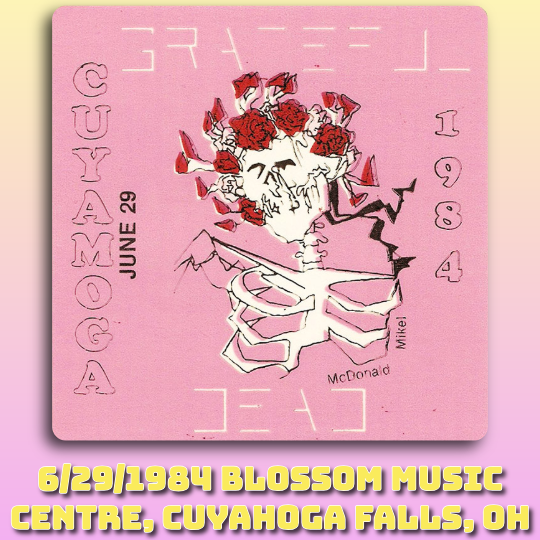
More fabulous music from my favorite venue. This show is a smoker! It had that kind of unrelenting energy and imagination that just won’t quit—it grabbed me from the very beginning and never let go. Only SHNID 14682 and 11502 are complete. You can get set 2 soundboard from SHNID 32781.
The first set checked every box for me. C. C. Rider set the tone—gritty, confident, and full of punch—and Bird Song took off from there. That version flew. It reached the kind of wide-open, exploratory highs I usually expect to find mid-second set, and it stayed lyrically tethered even as the music swirled skyward. The Music Never Stopped was solid in its usual jam slot, and contributed nicely to the set. West L.A. Fadeaway slinked along with a smoky mood that I love, and Don’t Ease Me In turned surprisingly wild—Brent absolutely lit it up with stabbing staccato and swirling washes that gave it unexpected depth. If you’re into Brent’s sound (I definitely am), this is one of those shows where he takes the wheel more than once. His Hammond tones pushed and lifted everything. And then there’s Bertha > Greatest Story—not flashy, but full of drive.
The second set doesn’t drift far into spacier territory. Scarlet Begonias kicks it off with Jerry letting his guitar do the storytelling, gently unfolding an expressive solo before weaving into a jam that felt alive with cross-rhythms. That flowed into Touch of Grey, which was maybe a bit too fast for its own good, but still managed to feel uplifting. Then came Dear Mr. Fantasy, and this one grew into something raw and real. Brent’s organ filled every inch of the room, and Jerry delivered a solo that made me stop in my tracks. The emotion between them was palpable—each note from Brent felt intentional, and Jerry matched it with aching phrasing. They wrung that song dry.
Men Smart (Women Are Smarter) came next, full-throttle and raucous—Bobby whipping it forward and the crowd lifting off as the Rhythm Devils took over with thunder. From there, Space stayed surprisingly linear, pent up and ready to leap into The Other One. Before we got there, they veered into The Wheel, which was warm and textured, and by the time the transition hit, the volume surged and they just erupted. No classic Phil bomb this time—The Other One just grew naturally, a storm gathering in slow motion. When it finally hit full force, it was a white-hot blaze of rhythm and tension that left me scorched. Black Peter offered a much-needed breath, quietly powerful and unhurried, before they brought it all home. Johnny B. Goode was completely unhinged—in the best way—Bobby yelping, the band tearing through it like they’d just remembered how much fun rock and roll can be. This one’s a heater. It’s got heart, teeth, and electricity from end to end.
Music link: https://relisten.net/grateful-dead/1984/06/29?source=2181285 or https://relisten.net/grateful-dead/1984/06/29?source=2181389 or 2nd set SBD: https://relisten.net/grateful-dead/1984/06/29?source=2181216
6/29/1986 Alpine Valley, East Troy, WI

This one lit up from the start and never let go—it’s easily one of the high points from the 1986 tour. The first set was straight-up fire. They came out with so much heat, and the Mississippi Half-Step > Franklin’s Tower > Dancin’ in the Streets trifecta made it immediately clear they meant business. That Half-Step opener carried every bit of the explosive energy I usually expect from a barn-burning show opener, and Jerry was fully dialed in—his phrasing crisp, expressive, and brimming with urgency. Bobby had his comic moment during Minglewood Blues, breaking character long enough to say, “Yes, and it’s ‘T’ right here in, um… Alpine Valley!”—totally goofy but perfectly in step with the mood. Tom Thumb’s Blues might’ve been the emotional anchor of the set—tender and fully committed. Still, Stagger Lee held up strong too, filled with detail and swagger. And the real curveball? Samson and Delilah to close the set—only the third time they ever did that. It totally worked.
The second set didn’t shift gears much from the vibe of the first—it kept riding that same wave of tight grooves and fiery lead work. While the song choices leaned toward familiar territory, the playing was anything but phoned-in. Shakedown Street had a thick, funky edge that pushed it close to epic jamming territory, and the Estimated > Eyes pairing was the kind of seamless ride I always hope for—smart transitions, focused solos, and just the right tempo. Throwing Stones came next, the only tune of the night from the '80s batch, and even that landed with a bit more weight than usual.
June 30th
6/30/1973 Universal Amphitheatre, Universal City, CA

2nd of 3-show run. This second night at the Universal Amphitheatre on June 30, 1973, was a real treat—especially since unlike the previous night, this full show actually circulates. The second set is where things go truly cosmic, but there’s still plenty to appreciate in the first set.
Right from the jump, the first set offered a nice mix of textures and pacing. Bird Song stretched out beautifully—lyrical and open, with just enough tension to keep me leaning in. Cumberland Blues came bursting with that punchy Americana energy, and Row Jimmy felt especially full-bodied—rich and slow in the best way. But it was Playing in the Band that really anchored the set, clocking in at over 14 minutes and delivering a deep, swirling jam that foreshadowed the exploratory gear they’d shift into later.
Then the second set hit, and that’s where the magic lived for me. The Dark Star > Eyes of the World > Stella Blue suite was absolutely immersive. Dark Star was searching and spacey, with enough motion to pull me through its shifting moods without ever feeling lost. Eyes exploded with color—it was an epic version without a doubt. They worked through several distinct themes within the jam, like a band speaking in different dialects of the same beautiful language. And Stella Blue came as the perfect landing, gentle and elegiac. Later, Sugar Magnolia blasted in with joy, wrapping up the journey with sun-drenched flair.
6/30/1974 Springfield Civic Center, Springfield, MA

This June 30, 1974 performance at the Springfield Civic Center really struck me as a quintessential Wall of Sound gem—massive, clear, and filled with unshakable momentum.
The first set had me hooked early on. Jack Straw felt tight and well-slung, and Loser followed with that mid-’70s swagger—slow, gritty, and heartbreakingly confident. I got a real kick out of Greatest Story Ever Told, which came through with punch and sharp edges. Cumberland Blues tore out of the gate fast and loose, with Phil bounding around the beat in that wild, springy way. But the crown jewel was the closing Playing in the Band > Uncle John’s Band > Playing in the Band. That “sandwich” never fails for me when the band’s locked in like this. The transition into Uncle John’s had this wide-open grace, and when they circled back into Playing, it was with renewed energy and a touch of chaos—just the way I like it.
The second set brought the real heat. Truckin' started with some good grit and carried the crowd with it into an inspired Nobody’s Fault But Mine Jam, moody and smoky, before everything bloomed into a gorgeous, long-form Eyes of the World. The way they layered themes through the jam in Eyes made it stand tall even among the all-time renditions—shifting moods and grooves like chapters in a story. And by the time they launched into Not Fade Away > Goin’ Down the Road Feeling Bad, it just felt like full-on celebration mode. That closing stretch absolutely ripped. This whole show had that effortless late-’74 looseness, but with plenty of intention behind it. One for the headphones and a long walk.
6/30/1984 Indianapolis Sports and Music Center, Indianapolis, IN

This June 30, 1984 show at the Indianapolis Sports and Music Center was an absolute blast—start to finish, it was one of those nights where everything seemed to click. The first set had serious lift. Minglewood came out swinging, punchy and raw with Bobby leaning hard into the vocals. Dupree’s Diamond Blues felt like a real treat—tight and well-paced with Jerry in storyteller mode. But the big one was the closing stretch: Lost Sailor > Saint of Circumstance > Deal. Deal is a Jam Anthem version but that entire sequence just lit up. Sailor flowed smooth and deliberate, Saint punched hard, and then Deal blew the roof off. That version was a full-blown Jam Anthem—stretching and exploding with everything Jerry had in the tank. It felt like the band was feeding off the crowd in real time.
And the second set wasted no time. Shakedown Street opened with an undeniable groove, and this one absolutely qualifies as a Jam Anthem. The whole band locked into it—Jerry swirling out leads, Brent adding color and grit, and the rhythm section keeping everything fluid but grounded. After that, it was just wave after wave of momentum. Every transition felt earned, every jam had shape. Honestly, it’s the kind of show that reminds me why I chase these tapes in the first place.
6/30/1985 Merriweather Post Pavilion, Columbia, MD

This June 30, 1985 show at Merriweather Post Pavilion was a total scorcher—full of energy, surprises, and standout moments throughout. The first set got things rolling right away with a spirited Mississippi Half-Step > C.C. Rider > Brown-Eyed Women opener. That whole sequence had a swagger to it that instantly pulled me in. The real surprise of the set, though, was the band’s take on Keep On Growing—the Clapton cover came out of nowhere and was played with real heart and grit. They didn’t just toss it in; they owned it. Everything about this set felt sharp and confident, a band that knew it was on.
And then the second set lifted things even higher. Shakedown Street launched it in style, and this version absolutely qualifies as a Jam Anthem. The groove was deep and elastic, and everyone found their pocket—Jerry’s phrasing, Brent’s textures, and the rhythm section keeping it all under control. The segue into Samson and Delilah was fiery, and the crowd ate it up. Later, Gimme Some Lovin' > He's Gone > Cryptical Envelopment was a total left turn that somehow made perfect sense, a surprising but cohesive run that added depth and texture. And by the time they locked into The Other One > Stella Blue, it felt like the last word—frantic energy giving way to a moment of stillness and soul. The whole show just moves. It’s one of those nights where the setlist choices and execution meet in the best way.
BTW, If you're not yet familiar with Jam Anthem versions of songs you can read all about it in Deadology II by Howard Weiner. Check it out here along with all his other great books.
And that's all for now! Of course, if you want to follow along in your very own copy of my book On This Day In Grateful Dead History: A Daily Listening Journal I still have some copies available here. Once they're sold out, I won't be getting any more made. The costs of printing and shipping has almost doubled in the last few years since I had them printed, and I've decided it's just not worth it. So get one now while you can! https://www.gratefuldeadbook.com/tigdh


Comments